

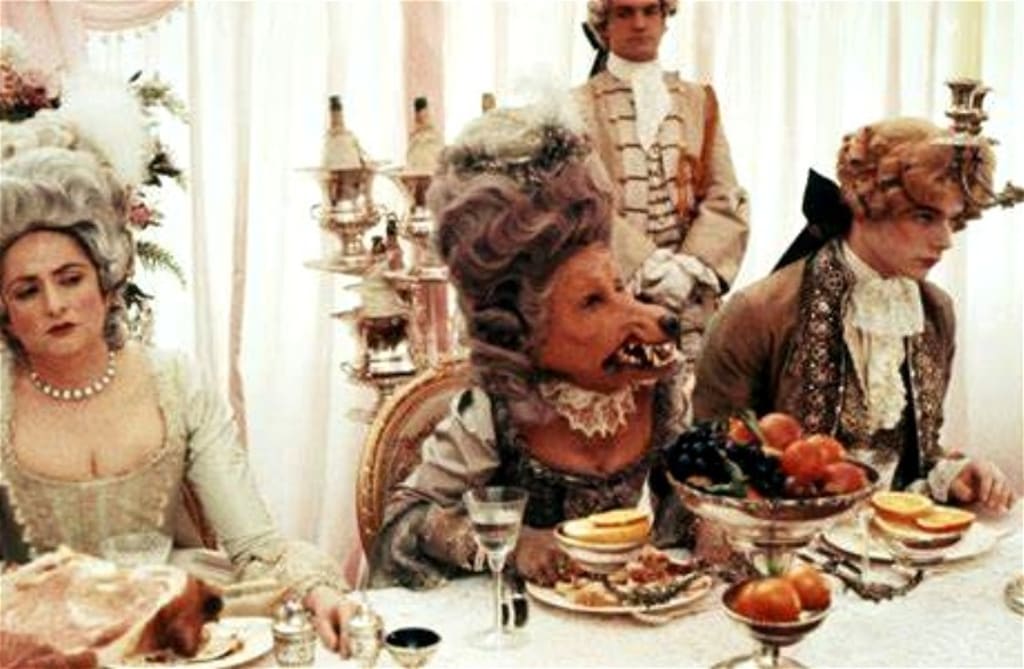
A pack of snarling, ferocious beasts charges down a hall in an English country house. A young girl writhes in her bed, waking with a jolt as her nightmare clings to her like damp cobwebs. Through her window, she catches sight of a glowing-eyed beast—fur matted, jaws razor-tipped and slavering, a snake-like red tongue lolling hungrily. With one tremendous leap, it crashes through her window, sending her toys tumbling from their shelves. Dolls lie abandoned on the floor, staring blankly at the ceiling. Those toys were her innocence, and now they’ve been cast down. Her time has come.
Adapted for the screen by Angela Carter, from her story, The Company of Wolves is a richly evocative film about the beast lurking within men—those who are, as it’s put in the movie, “hairy on the inside.” It’s also a meditation on the simmering, suppressed sexuality of the young. The story centers on Rosaleen (Sarah Patterson), who lies ensconced in her bed in modern times, with her parents (played by David Warner and Tusse Silberg) hovering nearby. The wraparound sequence that frames the story is as perplexing as it is atmospheric. Her sister wanders into the narrative at some point, and we’re left wondering who’s dreaming whom into existence. The film’s dream logic isn’t here to clarify; it’s here to envelop.
Rosaleen’s dream world transforms her parents into the same roles, now inhabiting a medieval or perhaps Eighteenth-century village—a claustrophobic, shadow-drenched backlot at Shepperton Studios. This self-contained world, described by director Neil Jordan as having only “twelve trees,” becomes the stage for a series of embedded stories. Granny, played by Angela Lansbury with a mix of sternness and knowing charm, weaves tales of wolves and men for Rosaleen’s education. These vignettes dive deep into the twisted undercurrents of fairy tales, where the familiar becomes uncanny, and childhood innocence takes on a sinister edge.
The vignettes themselves are a fever dream. Eighteenth-century aristocrats turn into wolves at a candlelit dinner. The Devil himself rolls up in a white Rolls Royce, doling out a werewolf-inducing salve. One segment even veers straight into Hellraiser territory, its grotesque imagery rivaling the best special makeup effects of the era. It gives An American Werewolf in London a run for its money.
And then there’s the subtext—a Freudian tapestry of fear and forbidden desires. Men are warned of their beastly nature, their “hairy insides,” and Rosaleen, on the cusp of womanhood, grapples with the frightening and enticing unknown. She asks Granny probing questions about what men become “when they’ve done with you.” Granny, the consummate storyteller, offers cryptic warnings with the weight of hard-earned wisdom.
The climax is as lushly symbolic as the film itself. Rosaleen dons the iconic red cape—a perfect cinematic rendering of "Little Red Riding Hood." She faces the Hunter (Micha Bergese), whose glowing eyes and sharp teeth lure her into an embrace with the darkness. His wolfish transformation, complete with the now-iconic shot of a human mouth vomiting a wolf’s snout, is grotesque yet hypnotic. Rosaleen doesn’t just confront the beast; she joins him, casting aside fear to run with the wolves, her humanity slipping into the shadows. (And yes, spoiler alert: Granny meets a grisly end, beheaded and revealed to be made entirely of cheap porcelain. You read that right.)
For years, I longed to see The Company of Wolves based on its unforgettable poster alone—the image of a wolf’s snout bursting from a human mouth. That image was so striking it even found its way into Adam Parfrey’s cult anthology Apocalypse Culture (1987), illustrating his essay on lycanthropy. Parfrey’s piece mused on the primal beast lurking in modern men, connecting it to a resurgence of atavistic violence in our techno-obsessed age. I’m still unsure what Parfrey’s ultimate thesis was, but it lingers like the film itself—a question about the wildness beneath our skin.
As beautiful as The Company of Wolves is, it’s undeniably slow-paced. The performances oscillate between ethereal subtlety and outright hamminess, and the surreal tone doesn’t always translate into narrative coherence. Casual viewers may find themselves sighing through its shadowy exploration of burgeoning fears and sexual awakening. For others, the film’s hypnotic visuals and dark fairy-tale logic will be an irresistible howl in the night.
Either way, one thing’s for sure: the hair on your chest might already be growing. Underneath.
The Company Of Wolves
Connect with me on Facebook
My book: Cult Films and Midnight Movies; From High Art to Low Trash Volume 1
Ebook
Print book
About the Creator
Tom Baker
Author of Haunted Indianapolis, Indiana Ghost Folklore, Midwest Maniacs, Midwest UFOs and Beyond, Scary Urban Legends, 50 Famous Fables and Folk Tales, and Notorious Crimes of the Upper Midwest.: http://tombakerbooks.weebly.com
One to See, One to Speak, One to Listen
Contains gore and horror some readers may find disturbing. Rated 14+ Author's Intro: This story is meant to revive the Gothic literature so famously crafted by one of my favourite writer's, Edgar Allen Poe, and as such, the language and style is deliberately antiquated. Thank you for reading my all time favourite work of horror - Les
By Call Me Les21 days ago in Horror
Stories Told At Twilight
A 300-word flash fiction regarding the above image: She never realized the pale blue of her eyes until now. Pressing the palm of her hands against the cold porcelain sink, she sank deeper into her own gaze. Her eyes were not only pale but striking.
By JB Ingland2 days ago in Horror
Wild Card Weekend Recap: What Happens Now?
I think I figured out why I love Wild Card Weekend so much. It's because it's the first playoff anything of the calendar year. The NFL season starts in the fall, and once upon a time, the champion was crowned either on or slightly before New Year's. The evolution of the NFL schedule has resulted in the playoffs starting just into the New Year, and currently, the final week of the season falls on the first weekend of the New Year, with Wild Card Weekend coming a week after that. So yes, chronologically, the NFL's Wild Card Weekend serves as the first playoff anything of the calendar year.
By Clyde E. Dawkins7 days ago in Unbalanced



Comments (1)
Well written, Tom. Your reviews are always professional and detailed. Great job!