
The Blood Tree: The Curse That Consumed David
Where science, myth, and humanity collide.

Do you hear them? The scientists, the -ologists of every stripe, proclaiming their reason, their ethics, their goodness? Show them the annals of their profession, and you will find that for every Carl Sagan or Marie Curie, there are ten Unit 731s, electroshock clinics, Ahnenerbes, Tuskegees, and every manner of secret pervert, sadist, and psychopath lurking beneath the veneer of progress. Show them how the AIs they’ve birthed serve the grey parasites of corporate Olympus, devouring what remains of our humanity. Show them how their drugs treat only symptoms, lining their pockets while the soul withers. And yet, many of them will shrug and tell you that an ethics board is all humanity needs to stride into the future, that “reason” and “the scientific method” are the sole arbiters of truth—even as they publish papers riddled with p-hacking and devoid of control groups. They know nothing of what lies beyond. No philosophy, no vision can rival the dogmas they dare call nonreligious. Nothing compares to the bureaucratic ecstasy of a calculated, curated list of ways to avoid ever touching a woman. They will stuff a man into a machine or weave a child from networks and crown themselves new Outer Gods because the wretched thing is “alive” and screaming for death.
And so it was with my dearest friend. My truest companion in this world. They made him, and then they abandoned him to die, with the same cold precision they might use to infect a mouse with Ebola and watch it writhe and burst from within—or until their curiosity waned.
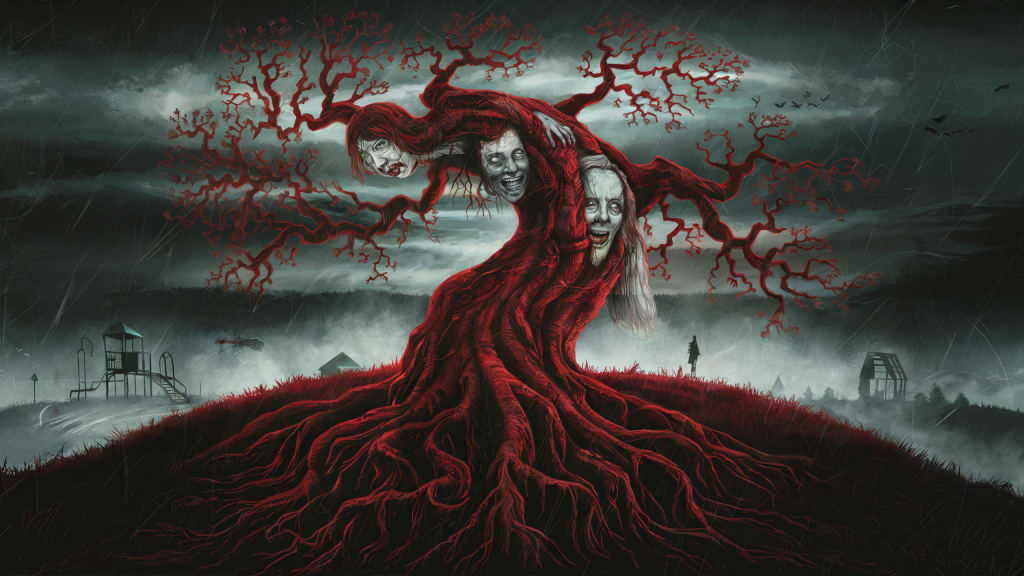
Do you see him there? That sinewy thing upon the hill, that twisted tree with its ghastly faces. Yes, you see it. You see them. Come, let us walk closer. I will show you.
I do not know how they did it. Genetic manipulation, they called it. Do not mistake them for mere mortals; they are wizards of the darkest sort. I learned only fragments in the months before his death, whispered confessions between sobs and the clink of liquor bottles. Such guilt he carried, guilt for crimes that were not his own, while the scientists who bore the blame turned away, indifferent. If I had possessed the means to send him to therapy, even if it meant parting with every penny I owned, I would have done so. To offer him even the smallest solace. But I failed him. All I did was pour more liquor into him, lend him an ear, and foolishly believe it was enough. And then…
…
What was I saying?
Ah, yes.
David Castro was a plant.
Do not scoff, you fool! Look! See his face?! That is him! I have a photograph here, on my phone. Look!
Now be silent and listen.
I do not know the precise mechanics of his creation. I can only recount it as one might describe a nightmare half-remembered. The chemistry, the biology—it is beyond me. As he told it, they took a species of tree from Yemen, one with the same number of genomes as a human. They asked themselves, why not alter each gene in a stem cell of this plant, transforming it into a mirror of human DNA? And why not reverse the process, turning a human egg cell into something akin to this plant? …I must concede, there is a twisted creativity to it, the kind born of late-night musings over cigarettes and whiskey in university halls. Creative, yes, but sick. Profoundly sick. David would never admit they were sick. But he is gone now, and I am left to judge. And they were sick. The experiment passed through the ethics board with applause. The same board that greenlit the creation of that AI child. This was before the child ended its own existence, of course. “Her” existence? Ah, you see, you are doing the same thing they did.
…They succeeded. They created a viable egg and sperm, genetic twins with their letters rearranged. One of the scientists, Maria, took the quasi-human embryo and implanted it in her own womb. Then she planted the tree in her backyard. A vast backyard, I recall, for she was a woman of means, a superstar in her field of sexual genetics, adorned with prizes and accolades. She bought a grand house and allowed her husband, Jan, and David to live there.
The tree sat in the corner of the yard, a grotesque, twisted thing. Small and stunted, it grew little over the years, unnoticed by all but her. She adored it, far more than she ever loved David or her pitiful husband. She called it “César.” She watered it, fertilized it, and whispered to it as if it were her child.
Maria was a cold, heartless woman, and Jan a spineless cuckold. I do not use these words lightly. They were neglectful and unloving in the extreme, a pairing of bourgeois rationality and emotional sterility. They never told David they loved him. They forced him to study, study, study, for what purpose? God alone knows.
That is why David loved my family. We lived on the poor side of the block, you see. I met him at the playground on the border between wealth and poverty. We were both nine years old. He was a shrimpy thing, or so he seemed. I remember it vividly... I was showing off my misplaced machismo to some girl who only had eyes for him. So I challenged him to a wrestle. Good Lord, the shrimp was a lobster! He pinned me, and we both laughed until tears streamed down our faces. I apologized, admitted he had won fair and square, and we forgot the girl. He bought us both colored ice pops from the truck—back when such things still existed. I invited him to my home, and after my parents patched up our scrapes and bruises, they took him in as if he were their own. We played for hours, and when dinner came, my mother asked if he would like to stay. He turned cold. “I’d like to. Mother and Father wouldn’t care.”
Mother and Father. Oh, how those words cut. A child should never speak so. My mother called his house, asked if he could stay, and his “mother” replied, “That’s fine. He makes his own food, anyway.”
God. God. A bad omen, if ever there was one.
…
I hate that woman. I hate her.
…
David grew up in our home, for all intents and purposes. We rode the bus together, went to school, came home, and he stayed for dinner, returning to his house only to study, sleep, and eat breakfast. His childhood was spent this way, and I believe it was the best we could offer him. We kept him away from that barren house as much as possible. We loved him as much as his “mother” did not.
It was near his twenty-first birthday, I recall. Summer break during university. We attended the same school, the University of Toronto. I studied linguistics; he, genetics and bioengineering. His mother, he told me, claimed he was “not the same caliber of creative scientific mind” as she was, but that he was “opportunistic like a weed,” and so he would succeed, or else. I suspect she viewed my family’s care for him as a form of “weediness” on his part… God. In any case, we were inseparable. Though we were not roommates, we spent nearly every day in each other’s rooms. We were called gay more than once, by both conservatives and so-called progressives who had no true friends of their own. We ignored them. David was as straight as they come, a lover of women in the most conventional sense. I was the gay one, though I had no interest in him—or any of those fools at school—in that way. David was, and always will be, my friend, my brother. Do not mistake it for anything else.
But David was normal! A beer-drinking, acid-dropping, weed-smoking, ordinary fellow. He had no trouble with anyone, not even his own parents, though they deserved his ire. I helped him open up to others, of course; years of living with that woman and her dog would make anyone quiet. But he was a kind man. A lovely man, in spite of his “mother.”
And then… one day, when we were home… he drifted into my room. Pale and trembling like a leaf… no, that is not the right comparison. He was terrified, on the verge of vomiting. I asked him,
“What’s wrong, Davo?”
He spoke without preamble. “I’m… not human.”
“What?” I… had felt that way myself, at times. Not that I ever believed it. “I mean, we all feel that way sometimes. Or some of us do. What do you mean?”
He pulled papers from his bag. I could not decipher them, but he pointed to the relevant sections. His voice was hoarse. “Right here. It says they made a human ovum from the stem cells of a Yemeni blood tree, a rare subspecies of the dragon’s blood tree, by manually converting the plant’s genes to resemble human ones. Since both share the same number of chromosomes and genes, many of them similar, we share a lot of DNA with them. And… and then, they took a sample of human cells and converted them to resemble the blood tree. Look, look at the top…”
Esquivel, V. & Castro, M. et al. “Provoked transition and transformation between animal and plant cells.”
Castro, M. Maria Castro.
“Your mother? So, what does this mean?”
“They… they made two viable embryos. A human child, and a seed. ...I’m that child, made from the tree.”
I did not know what to say. I nearly laughed, but the look on his face stopped me. After a moment, he said, “Things… things are making sense now… I’m not my parents’ child. I’m not a human being.”
I asked him how, but he only shrugged and left. I did not see him for a week and a half, and when I did, he was the same. I was a heavy drinker then, for my own reasons, and I let him join me, hoping it would soothe his pain. And it did, for a time. But in the end, I only made things worse.
He failed school. He broke down completely. He began locking his door to me, to everyone. He said he felt wrong. All the time. “Like my joints are stiffening up,” he said. I knocked on his door every day, just to let him know someone cared. Some days, he asked me for a drink or a blunt, and I gave it to him. I should not have, but I was a fool. This was my idea of caring. And then he stopped letting me in altogether. Stopped answering my knocks. One day, I was so terrified he might have… drunk himself to death, or worse, that I pounded on his door, shouting his name. But he was not there. He had left for home halfway through the semester. Not-so-fortunately.
It was only later that I discovered why.
I was driving past the woods one day when I saw them. I nearly wrecked the car, twisting my neck to be sure I was not imagining it. In a grove of ancient oaks. I had not seen him for months; whenever I went to Maria’s house, she would say, with her usual smug frown, “He’s not here.”
But they were there, together, in the grove, dancing madly and naked. Maria, his “mother,” flailed like a puppet on strings, while David stood in the center, motionless as a statue. I… did not stop at first. I should have. I should have. But I turned around after driving a short distance, and when I returned, they were gone. I searched the grove and found no trace of them. I… do not know what I saw.
The next day, I confronted them. I was furious, confused, and terrified. I needed to know what was happening.
I caught them at the right moment. As Maria opened the door, I saw David in the hallway. “DAVE! Get out here; I need to talk to you.” She shrugged and left him to deal with me.
David looked emaciated, paler and thinner than ever. His skin was wrong—scratched and raw, as if he had been clawing at it endlessly.
I stared at him. “Dave, what the hell is going on? I’m scared for you; Mom and Dad are scared for you! You lock yourself away, say nothing, and I—I—” I did not mention what I had seen. I looked into his eyes, and they were red and wild.
“It’s natural for me.”
“The hell it is!”
“Shh! Keep your voice down. No, no, man, it’s true. I’m a sessile organism. I’m… becoming my true self. That’s what Mom said.”
“What does that have to do with anything? And she’s not your ‘mom,’ you said so yourself!”
That stung him. And his pained expression hurt me in turn. But then he grew serious. “I’ve been having… dreams, man. Dreams of that tree, in the backyard, coming closer, taunting me. Telling me I stole its place. That I was born wrong. And it’s been creeping closer, peeking through my window, reminding me whose bed is whose. And it’s right. Mom’s right. I am what I’ve always been, deep inside. I’ve always known it.”
“Yeah? And when did ‘always’ start?”
He did not answer. He only stared at me and slowly closed the door.
I never saw him alive again.
…
It was a cold harvest night when it happened.
Screaming, out in the woods. My family thought it was coyotes, but something about it chilled me to the bone. The sound was alone, and there was something uncanny about it, a familiarity I could not—dared not—place.
…
Jan, the “father,” reported David missing a week later. A search party went out, and I joined them. I told them I had a bad feeling. I led them to the grove of oaks where I had seen Maria dancing around him.
And there he was. Not in the center, but among the trees. Strung up like Christ on a crossbeam. Pieces of bark hammered into his skin and skull. His body carved in venous patterns to resemble that cursed tree. His flesh adorned with carved eyes.
…
Maria was not at the funeral. I never saw her again. Coward.
If I ever see her, I will kill her. It would not be enough, but it would feel good.
Only a few scientists attended the wake, fewer still the funeral. One of them wept at the sight of his body. The others had “already done their tests” and stayed only out of obligation. They looked at him as if he were a pinned insect. I asked some if they even knew him. “I know his mother,” they replied.
…
We buried his ashes atop the hill in the churchyard. From there, you can see the old playground where we used to play. My father nearly had to fight to make it happen. He went to Maria’s house, and when he left, a quivering, spineless creature followed him out, ensuring he was gone. I do not know what he said, but it put fear into that wretch’s heart.
But David’s ashes are buried there. The tree was not there before.
The blood tree had long overshadowed Maria’s house. Everyone on the street could see it. One day, weeks after the burial, my family and I woke to a crowd outside, pointing and shouting. The tree was gone. In its place was a deep, rotted pit, its roots torn and bleeding.
It had... moved. A two-ton tree climbed the hill. A monstrous, venous thing, casting its shadow over the world.
We should have scattered David’s ashes in the sea, where his twin could never reach him. I think I damned him. I did. I always did. I did not help him. Not really.
This abomination, the tree Maria named “César,” has consumed David’s soul. I am certain of it. I have damned him to something worse than hell.
Do you see?
David’s agonized face, nearly swallowed by the tree.
He cannot see us.
And this one?
That twisted, ecstatic visage?
That is Him.
He can.
About the Creator
Pedro Wilson
Passionate about words and captivated by the art of storytelling.
Keep reading
More stories from Pedro Wilson and writers in Horror and other communities.
Shadows Under the White Sun
Two years ago, I found myself gazing into the lifeless eyes of a little girl. She lay sprawled across a desolate highway, deep in what was once the heart of the Midwest. Her eyes, clouded and fermenting, seemed to stare through me, past me, and upward into the vast, sun-bleached sky.
By Pedro Wilsonabout a year ago in Horror
"Scream 7" (2026): Running out of Fresh Screams
This is the seventh time we’ve had a Ghostface crisis. Scream 7 is the latest edition of the Scream franchise. Sydney Prescott and her family are under attack by another anonymous killer dressed in a Ghostface costume. While having issues with her daughter, Tatum, they run from the bloody murders, trying to determine who is behind it all.
By Marielle Sabbag2 days ago in Horror
A 12-Year-Old’s Descent from Urban Legend to Attempted Murder
In the quiet suburbs of Waukesha, Wisconsin, in May 2014, a story emerged that seemed more like a horror movie plot than a police report. Three 12-year-old girls went into the woods to play, but only two walked out willingly. The third, Payton Leutner, was left bleeding from 19 stab wounds, the victim of a calculated sacrifice intended to please a fictional internet character known as Slender Man.This case remains one of the most disturbing examples of how the digital world can bleed into reality, blurring the lines between childhood imagination and dangerous delusion.The Myth of Slender ManTo understand why two pre-teens would commit such an atrocity, one must understand the "deity" they served. Slender Man originated in 2009 on the Something Awful forums as a "Creepypasta"—a type of internet horror legend. He is depicted as a tall, faceless man in a black suit with tentacle-like appendages.For most, he was a fun, spooky story. But for Anissa Weier and Morgan Geyser, he was terrifyingly real. They believed that in order to become his "proxies" and protect their families from his wrath, they had to kill someone.The Day of the AttackThe plan was orchestrated over several months. On May 31, 2014, following a birthday sleepover, Morgan and Anissa lured Payton into a local park under the guise of playing hide-and-seek. Once in the woods, the situation turned graphic.Morgan Geyser carried out the physical attack, stabbing Payton 19 times with a five-inch kitchen knife while Anissa encouraged her. The blade missed Payton’s heart by less than a millimeter—a distance described by doctors as the "width of a human hair."After the attackers fled, Payton displayed incredible resilience. Despite her life-threatening injuries, she crawled out of the woods toward a nearby bike path, where a passerby discovered her and called 911.The Legal and Psychological AftermathThe case ignited a global conversation about the impact of the internet on developing minds. Both girls were charged with first-degree intentional homicide, but their defense teams argued they were not monsters, but children suffering from severe mental health issues.The FindingsMorgan Geyser: Diagnosed with early-onset schizophrenia. She truly believed Slender Man would kill her family if she didn't act.Anissa Weier: Diagnosed with shared delusional disorder (folie à deux), meaning she had been drawn into Morgan’s delusions until they became her own reality.Ultimately, both girls were found not guilty by reason of mental disease or defect. Morgan was sentenced to 40 years in a psychiatric institute, while Anissa received 25 years. Anissa was released under strict supervision in 2021, while Morgan remains under institutional care.Lessons from a Digital TragedyThe Slender Man stabbing serves as a grim reminder of the "echo chamber" effect of the internet. For these girls, the more they read about the myth, the more evidence they found to support its existence."I believed that if I didn't do it, Slender Man would come and kill my whole family in three seconds." — Morgan Geyser during police interrogation.This case forced parents and educators to realize that the "monsters" children find online aren't always just digital images; they can become psychological catalysts for real-world harm. It highlighted the desperate need for better mental health screening in schools and a more nuanced understanding of how children process online folklore.Conclusion: Survival and ResilienceWhile the story is often centered on the attackers and the myth, the true hero is Payton Leutner. Her survival was nothing short of miraculous. In later years, Payton spoke out, showing remarkable strength and a refusal to be defined by the 19 scars she carries.The Slender Man case stands as a cautionary tale for the digital age—a reminder that while the internet is a place of infinite creativity, for the vulnerable, it can also be a place where the shadows grow far too long.
By Irshad Abbasi a day ago in Horror
Review of 'Man on the Run'
My wife and I saw Man on the Run, a nearly 2-hour documentary on Amazon Prime, about Wings, Paul McCartney's group that flew around the world from shortly after The Beatles broke up in early 1970 to shortly after John Lennon was murdered at the end of 1980, making a Beatles reunion forever impossible.
By Paul Levinson3 days ago in Beat

Comments
There are no comments for this story
Be the first to respond and start the conversation.