
The Archivist
Some stories are never meant to be read… but they read you.”

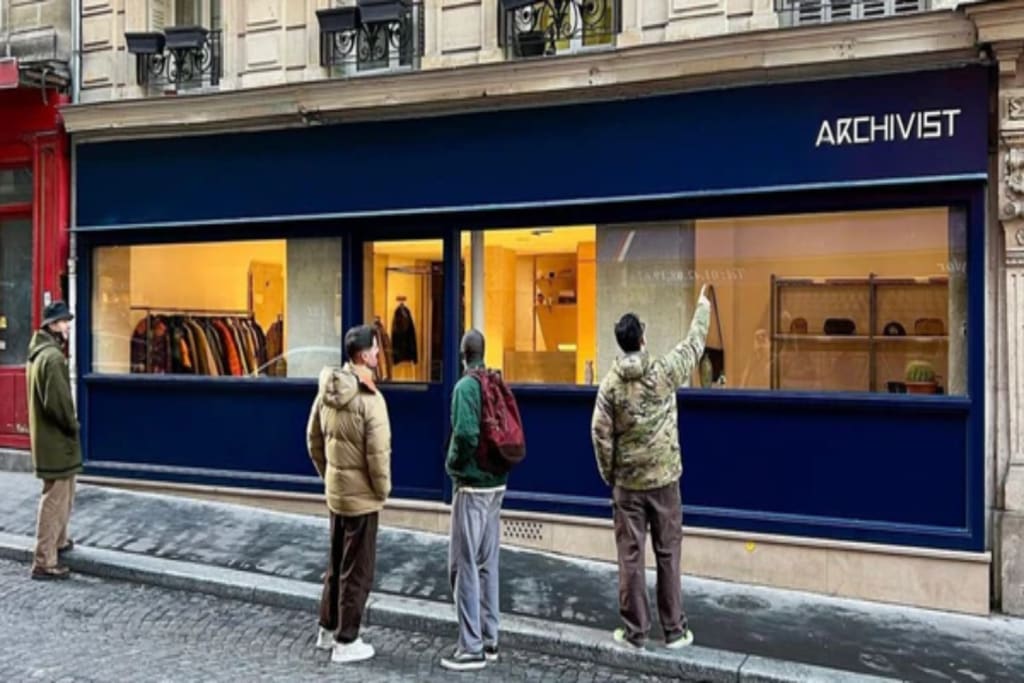
There's a small, forsaken building hidden behind a centuries-old mosque in one of the grimy alleys of Old Dhaka. Few even see it. But if you stand still and listen—really listen—you can hear the soft whisper of pages being turned.
Locals call it Shobdokosh Bhaban — The House of Words.
It was a government records repository during the 1950s, where land title deeds, colonial documents, and partition deeds were stored. Since a fire hit '72, it was shut down. No renovation. No demolition. Nothing.
I am a research student. Or rather, I used to be, before everything hit the fan.
I was working on a thesis about post-partition urban displacement. I'd been through the National Archives, university libraries—private collections. One evening, after an interview with a retired professor of history, he made this strange remark:
"If you want the records they covered up… talk to the Archivist. But go but once. And leave before sunset."
He wouldn't say anything more.
Weeks after, I was walking along Lalbagh Fort when I became lost in a narrow alley. That's when I saw it — a run-down building with flaking signs and a rusty gate. Something pulled me to it. I did not resist.
Inside, it was cold. The sort of cold that doesn't occur due to weather, but due to age. The scent was reminiscent of rotten paper and damp earth.
Shelves as tall as tombstones stood along the room, stacked with yellowing files bound in heavy, black leather, their cracked covers. I stepped forward, and the floor creaked as if it had not borne human weight in decades.
And I heard it — pages being turned. Evenly, smoothly. Somewhere well within.
"Hello?" I yelled.
A figure stepped out from behind one of the shelves.
Tall. Thin. Wearing a heavy black coat, far too hot for Dhaka's climate. His face was gaunt, and his eyes were the whitest I've ever seen—like old yellowed paper.
"You're searching for records," he said, his voice flat and unadorned. "Post-partition urban movement. You're searching for the stories that were never supposed to be told."
I was stunned. "How did you—"
He raised one ink-stained hand. "The words remember.".
He led me down a corridor lined with neglected decades. He stopped in front of a shelf marked DHA/52/URB. From it, he pulled a thick, dusty tome.
The pages inside weren't typed—written by hand. Not just names and dates, but thoughts. Marginalia. Warnings. Glints of obliterated neighborhoods and communities "redrawn for political symmetry."
It was horrifying. Terrifying. And utterly true.
When I looked up to ask him, he wasn't there.
I grabbed my papers and ran. Outdoors, the sun had just about set. A group of kids sat adjacent to me, staring.
"Did you go in?" one of them said. I nodded.
"Did he ask your name?"
"No."
The boy looked relieved. "Good. Don't ever give it."
I had a dream about fire that evening. Burning books. Screams trapped in books. I woke up at 3:17 AM to the whispering and… turning pages. But I was alone in my bed.
The next morning, I noticed my handwriting had changed. Cursive. Careful. Like another person's hand was guiding mine.
Worse — when I wrote in my journal, I wrote what I didn't know. Names I'd never heard. Things that hadn't happened to me.
And the voices. Quiet at first — like a forgotten radio, half tuned. Then loud. Testimony. Regret. Shrieks. Laughter.
One of the voices kept whispering over and over:
"Burn the ledger… before he reads you."
I came back.
Candles now filled the hallways. The archivist stood behind a table groaning under books. Some hung in the air, their pages flipping without hands.
"I shouldn't have returned," I said.
"You were written in," he said.
He picked up a book. My name was embossed on the spine.
"You read with intention. That lends meaning to the words. Now, they write you."
He yanked open the book. My voice rang through the room—not my words, but my thoughts. Every lie. Every shame. Every secret I'd kept concealed.
"You're not just an archivist," I whispered.
He smiled faintly. "I possess the words they silenced. The truths they tried to erase. The stories that wanted to be forgotten. But words. never die."
I ran. I don't know how I got out. I don't remember the exit. But I made it home.
My journals now write themselves.
Every day, new pages appear — of things I've yet to do. Things I don't need to know. Things I've not said. Things I have yet to dream.
And each page ends in the same way:
About the Creator
MD NAZIM UDDIN
Writer on tech, culture, and life. Crafting stories that inspire, inform, and connect. Follow for thoughtful and creative content.
Keep reading
More stories from MD NAZIM UDDIN and writers in Horror and other communities.
Hunting Gypsies
Hard rain was pouring down—thick, solid sheets that hid the world outside Ivan's car. Then, with a sickening crunch, his car slid off the road and crashed into a muddy field just shy of the edge of a dense black forest. When Ivan came to, the engine kept going, but the radio was now a cacophony of static and shattered songs, switching between them in an endless cycle, like a broken record.
By MD NAZIM UDDIN 10 months ago in Horror
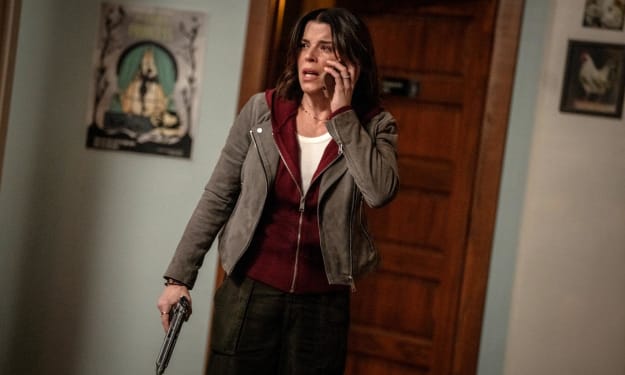
"Scream 7" (2026): Running out of Fresh Screams
This is the seventh time we’ve had a Ghostface crisis. Scream 7 is the latest edition of the Scream franchise. Sydney Prescott and her family are under attack by another anonymous killer dressed in a Ghostface costume. While having issues with her daughter, Tatum, they run from the bloody murders, trying to determine who is behind it all.
By Marielle Sabbag4 days ago in Horror
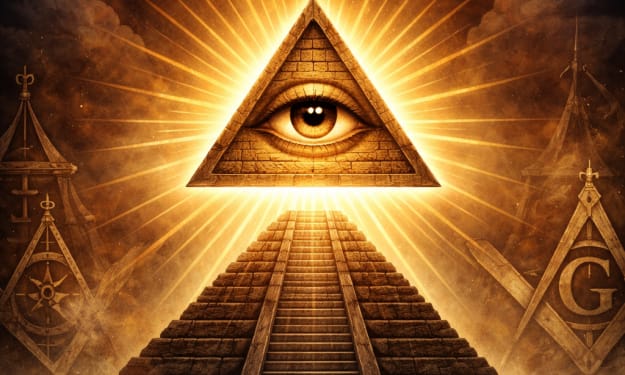
A Symbol Linked to Freemasonry and the Illuminati
The Eye of Providence, often referred to as the “All-Seeing Eye,” is one of the most recognized and debated symbols in the modern world. Depicted as a single eye enclosed within a triangle and often surrounded by rays of light, this symbol has appeared in religious art, national emblems, and popular culture for centuries. However, in recent times, it has become strongly associated with secret societies such as the Freemasons and the Illuminati, fueling countless conspiracy theories about hidden power and global control.
By Irshad Abbasi 3 days ago in Horror


Comments
There are no comments for this story
Be the first to respond and start the conversation.