

Edward Carrington had always been a man of science. An astronomer by profession, his life was dedicated to the study of the stars, the planets, and the infinite cosmos that stretched beyond human comprehension. His fascination with the universe had been a source of wonder and joy for years, but that joy began to curdle into something darker when he stumbled upon an old, weathered book at a second-hand bookstore on the outskirts of town.
The book, bound in cracked leather and written in a language that was not entirely decipherable, was titled De Profundis. Inside, the pages were filled with strange symbols, arcane diagrams, and writings that seemed to blur the line between science and the occult. At first, Edward dismissed it as nonsense, a relic of a bygone era when superstition ruled over reason. But there was something about the book that captivated him, a pull that he couldn’t quite explain.
He began to study it obsessively, spending hours in his dimly lit study, the only sound was the ticking of the clock and the scratching of his pen as he tried to decode the cryptic text. The more he read, the more he felt a strange kinship with its author, a nameless figure who spoke of the vastness of the universe in terms that were both poetic and terrifying. The author described the stars not as distant suns, but as the eyes of ancient gods, watching from the void, indifferent to the struggles of man.
Edward’s obsession grew. He started to see connections between the book’s writings and his own research. The constellations he had once viewed as beautiful patterns in the night sky now seemed to take on a new and more sinister meaning. He began to perceive strange alignments, patterns that should not exist, and whispers of an ancient order that defied the laws of physics. The stars were not just random points of light; they were part of something much larger, something far beyond human understanding.
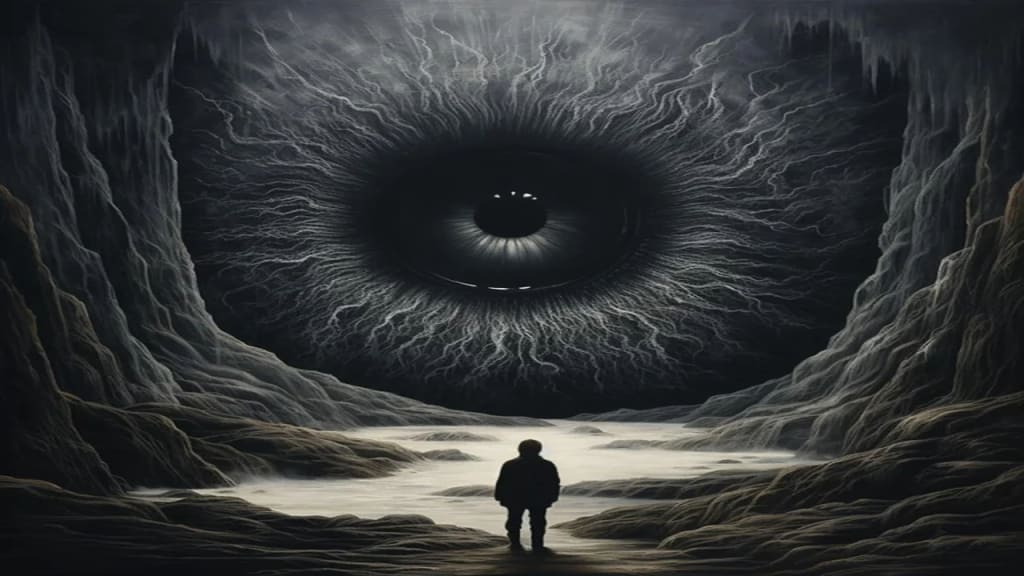
As weeks turned into months, Edward’s obsession deepened. He withdrew from friends and colleagues, his once sharp mind now clouded by a growing sense of dread. The nights were the worst. He would stand at his telescope for hours, staring into the blackness, feeling as if the universe were staring back at him. The familiar constellations seemed to shift and writhe, their shapes no longer comforting but threatening, like the coiling bodies of ancient serpents.
Sleep became a distant memory, as did his former life. The book had become his sole companion, its pages more real to him than the world outside. He began to have dreams—visions of a vast, black ocean, where nameless entities stirred beneath the waves, their forms too alien to describe. In these dreams, he was not alone. He could feel the presence of others, minds that were not human, but far older and infinitely more powerful. They whispered to him in a language that was not spoken, but understood, a language of the void.
During his waking hours, Edward started to experience strange phenomena. The stars he had once admired now seemed to flicker in and out of existence as if they were blinking at him, acknowledging his gaze. He would hear a low, droning hum, a sound that seemed to come from the very depths of space, resonating in his skull like the tolling of a cosmic bell. His reflections in mirrors and windows no longer matched his own appearance, subtly distorted as if his image were being pulled into another dimension.
The world around him began to lose its solidity. Objects in his study would appear to shift when he wasn’t looking, their edges blurring as if they were being seen through a warped lens. His sense of time became disjointed—days would pass in a blur, while minutes would stretch into eternity. The more he tried to grasp the nature of his reality, the more it seemed to slip through his fingers, like sand in an hourglass.
One night, while poring over a particularly obscure passage in De Profundis, Edward felt something inside him snap. The words on the page seemed to twist and writhe, forming new shapes, and new meanings. The book spoke of the Great Abyss, the space between the stars where the Old Ones dwelled, ancient beings whose existence predated the universe itself. The insignificance of human life was laid bare before him, the entirety of human history nothing more than a blink of an eye in the face of these timeless entities.
Edward realized with a growing horror that the book had not merely been describing the universe; it had been preparing him, showing him the truth that lay beyond the veil of reality. The universe was not a place of wonder but a cold, indifferent expanse, ruled by entities that cared nothing for the fleeting lives of men.
As he read the final lines, Edward felt the weight of the cosmos press down on him, crushing his mind under its vastness. The stars, those distant, beautiful lights, were not beacons of hope, but the eyes of beings so alien, so ancient, that to even acknowledge their existence was to invite madness.
With a final, shuddering breath, Edward let the book slip from his hands. His mind, once a tool for understanding the universe, had been shattered by the very knowledge he sought. The vastness of the cosmos had consumed him, leaving him a hollow shell, a man who had glimpsed the true nature of reality and had been driven mad by what he had seen.
As he stared blankly at the night sky through his telescope, Edward Carrington understood one terrible, unalterable truth: the universe was vast, cold, and utterly indifferent, and in its infinite expanse, humanity was less than a speck of dust, doomed to be forgotten by the stars.
About the Creator
V-Ink Stories
Welcome to my page where the shadows follow you and nightmares become real, but don't worry they're just stories... right?
follow me on Facebook @Veronica Stanley(Ink Mouse) or Twitter @VeronicaYStanl1 to stay in the loop of new stories!
Keep reading
More stories from V-Ink Stories and writers in Horror and other communities.
The Devourer of Memories
The small town of Ashford was a place of whispers. Nestled deep in the forest, its streets were lined with old, creaking houses and fog that seemed to cling to the ground like a shroud. The town had seen better days, but it was the sudden rise in cases of amnesia that truly frightened the residents. People were forgetting things—small details at first, but soon entire chunks of their lives would vanish, leaving behind only blank spaces in their minds.
By V-Ink Storiesabout a year ago in Horror
One to See, One to Speak, One to Listen
Contains gore and horror some readers may find disturbing. Rated 14+ Author's Intro: This story is meant to revive the Gothic literature so famously crafted by one of my favourite writer's, Edgar Allen Poe, and as such, the language and style is deliberately antiquated. Thank you for reading my all time favourite work of horror - Les
By Call Me Les20 days ago in Horror
Hell Without Fire: Why A Short Stay in Hell Quietly Ruined My Peace
Short introduction A Short Stay in Hell by Steven L. Peck is a very short novel, almost novella-length, but don’t let that fool you. It’s one of those books you finish quickly and then keep thinking about for way longer than you want to. It falls under horror, but not the usual kind. There are no monsters, no gore, no shocking twists. Instead, it deals with eternity, punishment, and what happens when hope is stretched way past its breaking point. It’s quiet, simple, and somehow deeply unsettling.
By Rosalina Jane2 days ago in Horror


Comments
There are no comments for this story
Be the first to respond and start the conversation.