
Tainted Halloween Candy: Few Reported Cases Prove it's an Urban Legend
Most, but not all, of the 200 reported cases of tainted Halloween candy have been hoaxes


Children love trick-or-treating and getting tons of candy as they go door-to-door in costume, although for parents, it is the spookiest part of Halloween. Urban legends dating back to the 1950s tell tales of candy injected with poison, drugs, razor blades, and sewing needles, maximizing the fear in the hearts of parents who worry their child’s candy might actually have one of these unwanted surprises inside.
Candy Tampering is an “Urban Legend”
Joel Best, a University of Delaware sociology and criminal justice professor who has studied cases of Halloween candy tampering since the 1990s says most claims of candy tampering are hoaxes or urban legends. No child has been seriously injured or died from eating tampered Halloween candy.
Since 1958, there have been approximately 200 reported cases of Halloween candy tampering in the U.S. and Canada, although most were hoaxes or manufacturing mishaps. In some cases, children inserted objects into candy to prank friends or family.
When the media reports cases of candy tampering, they often fail to provide follow-up information, leaving viewers with nothing more than the minimal details from the initial story
"Is it possible that someone maliciously passes out treats with the intent of harming children at random? Of course. But this raises the question why there usually aren't multiple reports from the same area."
Parents have a reason to worry about their children’s Halloween candy since some strange characters exist in this world. This means that even in the best neighborhoods, trick-or-treating can expose children to questionable personalities. We never know what goes on in another person’s mind and there will always be one or two people out there willing to take extreme measures like this for their own personal amusement or sadistic pleasure.

Reported Cases of Halloween Candy Tampering
The first case of candy tampering in the U.S. happened in 1959 when a California dentist distributed 450 laxative-laced candies to kids in California. William Shyne was charged with “unlawful dispensing of drugs” and “outrage of public decency” after 30 children “fell violently ill” after consuming the candies.
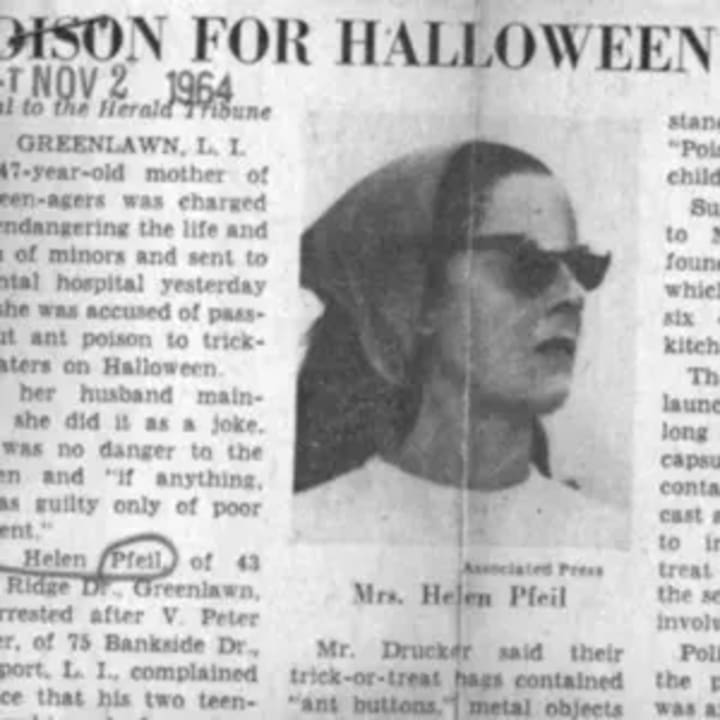
Helen Pfeil, a mother from Greenlawn on Long Island, New York, became frustrated and handed out Halloween bags filled with dog biscuits, arsenic ant traps, and mesh scrubbing pads to kids she believed were too old to trick or treat. She was sent to a state mental institution.
One of the first known deaths resulting from candy tampering actually turned out to be a cover-up by the child’s parents. In 1970, a 5-year-old Michigan boy died after ingesting heroin. Lab tests confirmed the boy’s Halloween candy contained heroin dust. After an investigation, police learned the boy had accidentally found his uncle’s heroin stash and ingested a large amount of the drug. To make it look like an accident, his parents sprinkled heroin on the candy.
The Murder of Timothy O’Bryan
A father killed his child and attempted to hurt two other children in 1974 after lacing Pixie Stix candy with cyanide poisoning. Ronald O’Bryan and his neighbor took their children trick or treating this year. During the escapade, O’Bryan disappeared into a dark area of the front porch, then reappeared with three Pixie Stix.

O’Bryan told the neighbor that the person at the home gave him the candy to give to the kids.
Hours later, O’Bryan called 9-1-1 telling them his son had ingested tainted candy. Little 8-year-old Timothy O’Bryan died, an autopsy revealed he had ingested cyanide. O’Bryan gave tainted candy to his 5-year-old daughter and three other children, none of whom ingested it or became ill.
An investigation revealed that O’Bryan poisoned his son to get his hands on his $40,000 life insurance payout. He apparently handed out laced candy to other children because he thought it was commonplace and he could easily pass the incident off as a case of candy tampering.
Don’t Worry So Much About Halloween Candy
Parents always worry about their kids. It’s part of their job. So while it's a good idea to check candy before allowing kids to get their candy fix this Halloween, parents should not overly concern themselves with the decades-long legend of Halloween candy tampering.
About the Creator
Criminal Matters
The best of the worst true crime, history, strange and Unusual stories.
Graphic material. Intended for a mature audience ONLY.
Follow me @ facebook.com/criminalmatterspage
Keep reading
More stories from Criminal Matters and writers in Horror and other communities.
Haunted Adult Games Kids Should Never Play
Tricks are for kids, but ritualistic games are for adults, especially when the following are at play. The games mentioned here bring unknown curiosities to life, so they say, playing on fears and the irresistible lure of a good mystery. If you aren’t afraid of potentially psychologically distressing fun, play one or two games from this list. Just in time for Halloween!
By Criminal Matters2 years ago in Horror
Becca
"Everything is so... flat." Denille said stupidly as she looked around her new neighborhood. She looked around at the muted desert where even the smallest sign of life seemed to have given up. The plant life was shrubs that were half cooked by the heat and where there should have been a lawn, a mess of white rocks laid glistening in the sun. Even the sky looked stretched thin, like the sun had ironed it smooth. She’d moved from Riverside, where at least there were hills, but here in Barstow, everything felt baked and brittle.
By Sara Wilson7 days ago in Fiction




Comments
There are no comments for this story
Be the first to respond and start the conversation.