
salem witch trials: A wound that is still infected
will it happen again, or did it already?

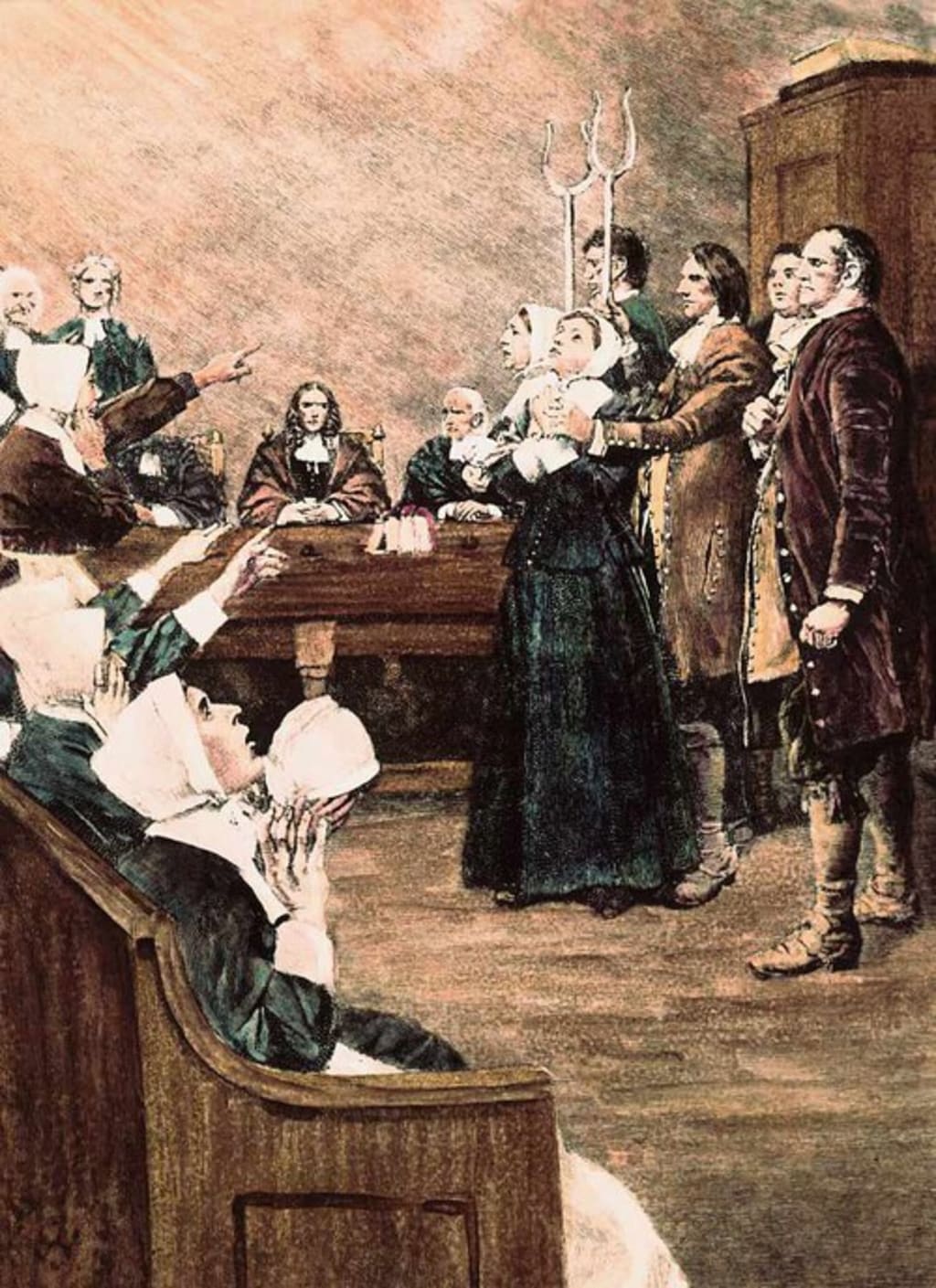
In the frostbitten shadows of 1692, a small Puritan town in Massachusetts descended into madness. Salem, once a quiet settlement built on devout Christian faith and order, became the scene of one of the most chilling episodes in American history—the Salem Witch Trials. Over the course of just a year, paranoia gripped the community like a vice, and the line between reality and nightmare dissolved.
What unfolded in Salem was not merely a case of superstition run amok—it was a calculated, communal hysteria, ignited by fear, religious fervor, and an unforgiving thirst for purity.
The Spark of Evil
The horror began in the cold winter months when Reverend Samuel Parris’s nine-year-old daughter, Betty, and her cousin Abigail Williams, 11, began to exhibit bizarre behaviors. They contorted into unnatural shapes, screamed uncontrollably, and claimed to be tormented by invisible forces. Their symptoms baffled physicians, and in the absence of physical ailments, the conclusion was grim: the Devil had touched Salem.
The girls accused three women of witchcraft: Tituba, the Parris family’s enslaved Caribbean woman; Sarah Good, a destitute beggar; and Sarah Osborne, a bedridden elderly woman. These women—social outcasts, conveniently easy to vilify—became the first sacrifices in a grotesque theater of fear.
Under pressure, Tituba confessed. But her words didn't end the nightmare—they fed it. She described spectral meetings with the Devil, grotesque rituals in the woods, and more witches lurking in Salem. Her confession lit a wildfire that no one could control.
A Town Possessed
Within weeks, accusations spread like infection. Children, respected townsfolk, even churchgoers were named. Spectral evidence—claims that a person's spirit had harmed others while their body was elsewhere—was accepted in court. Dreams, hallucinations, or even grudges could doom a life.
Trials were conducted in makeshift courtrooms where judges seemed more like executioners than arbiters of truth. Hysteria reigned supreme. Justice had fled Salem.
The terror reached its climax between June and September of 1692. Nineteen innocent people were hanged. One man, Giles Corey, refused to enter a plea and was crushed to death with stones over two agonizing days—his last breath squeezed from him as he muttered, "More weight."
Children accused their own parents. Friends betrayed friends. Neighbors turned on each other, not out of belief, but to protect their own skins—or settle old scores.
The Specter of Death
Imagine being dragged from your home at midnight, your cries lost in the howling wind. You’re chained in a filthy, lightless dungeon, your only company rats and the moans of other accused “witches.” No one listens to your pleas. You're presumed guilty. You stand before stern-faced magistrates, their minds poisoned by fear. And if you protest your innocence too strongly? That too is proof of your guilt.
The hangings were public. A perverse mix of execution and theater. The crowd gathered as the accused were led to Gallows Hill. They prayed, wept, screamed for mercy. None came. The nooses tightened around necks, and with each body dropped, a terrible silence followed—until the crowd dispersed, taking the horror home with them.
A Town Awakens from a Nightmare
By the fall of 1692, the frenzy began to crack. Prominent figures like Increase Mather—father of judge Cotton Mather—condemned the trials, declaring, "It were better that ten suspected witches should escape, than one innocent person be condemned."
Governor William Phips dissolved the court and forbade further arrests. It was too late.
Nineteen dead. Over 200 accused. Families ruined. Reputations shattered. It took over twenty years for the Massachusetts government to formally apologize and compensate the victims’ families. But no gold could repay what Salem had lost.
The Horror That Never Left
The Salem Witch Trials are often taught as a cautionary tale, a relic of primitive superstition. But their terror is timeless. They reveal the darkest corners of the human psyche—how fear can be weaponized, how truth can be buried under hysteria, and how easily good people can become monsters when they believe evil walks among them.
Salem did not burn witches at the stake, as in Europe. But it burned its own soul.
Centuries later, the name Salem still conjures whispers of dread. The ghosts of the wrongfully condemned linger in our collective memory, a grim reminder of what happens when fear eclipses reason.
The Salem Witch Trials were not just a series of events. They were a descent into Hell—one that humanity walked willingly into, blinded by terror, and driven by the terrible belief that evil could be cleansed by murder.
And the most chilling part?
It could happen again.
what if it has already repeated itself and we never got any smell?
About the Creator
E. hasan
An aspiring engineer who once wanted to be a writer .
Becca
"Everything is so... flat." Denille said stupidly as she looked around her new neighborhood. She looked around at the muted desert where even the smallest sign of life seemed to have given up. The plant life was shrubs that were half cooked by the heat and where there should have been a lawn, a mess of white rocks laid glistening in the sun. Even the sky looked stretched thin, like the sun had ironed it smooth. She’d moved from Riverside, where at least there were hills, but here in Barstow, everything felt baked and brittle.
By Sara Wilson7 days ago in Fiction



Comments
There are no comments for this story
Be the first to respond and start the conversation.