
Safe by Candlelight
It might be the right place to hide, but the wrong person hiding.

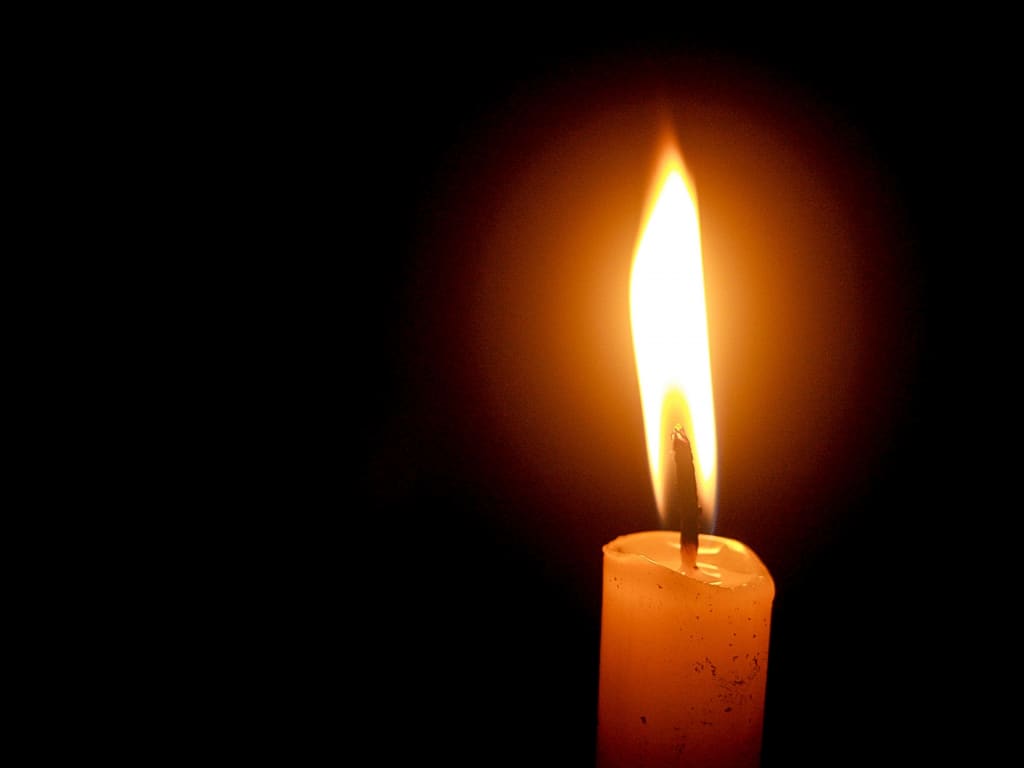
The cabin in the woods had been abandoned for years, but one night, a candle burned in the window. Henry saw it like a beacon in the dark and ran to it.
The door wasn’t locked but desperate panic didn’t spare him a second to think twice about it, shoving his way inside and slamming it shut behind him. For a long while he hunkered behind the door, trying to calm his breathing, waiting for any sound from outside. The flickering candle waited with him.
But there came no footsteps, no voices, not even the sound of a passing car from beyond the door, and most importantly: no sirens. Henry smiled, and with a thrill of triumphant he laughed. It echoed through the house.
When Henry finally stood and looked around he didn’t find much; in the weak glow of the candle light there was a faded old armchair, a side table with nothing on it, and that was all. There was nothing on the walls, no knick-knacks, no sign that anyone had lived here in a long time.
He hesitated before he called out: “Hello?” The response was only more silence, which just made him grin wider. He was as alone, perfect. He just needed one night to hole up, keep quiet and hidden til the coast was clear.
The candle sat on a simple saucer, it was awkward for Henry to pick it up without getting wax on his hand. He held it out in front of him as he walked, the flame dancing with the movement. Behind him the darkness closed in in his wake.
The kitchen proved as bare as the living room. He slammed the cupboards with a curse when he didn’t find any food, not even a: “goddamn can of beans!” Fine, he told himself, it was fine for tonight. He had money in his pockets, though less than he’d hoped. The wad of hundreds amounted to the last folks’ whole life savings they’d said, ‘surely it’s not worth it,’ they’d said. He laughed again, if that’s all they had, what kind of life were they living anyway?
He gave up on his search in the kitchen and stepped out in the hall, candle and saucer in hand, in the glare it took a moment for it to register but when he saw it a jolt of electricity hit his nerves: another light, there at the end of the hallway on a table.
Henry’s hand went to his belt, fingers closing around the handle of the knife tucked there.
“Hello?” he called, “Who’s here?”
There was no answer.
Cautiously he made his way down the hall. Another candle burning away, the wax barely started melting. It had just been lit.
He paused, listened, and then lashed out at the nearest door, kicking it down with a splintering of wood. Knife drawn he stormed into the room. More nothing.
“If there’s someone here,” he called, “It won’t do you no good to hide.” The knife caught the candlelight, blood staining the blade. “I’ll find you.”
He kicked down the door on the opposite side too, frustration growing when he found it in the same state. He was sweating now, that relief he’d felt only minutes ago ebbing away. He picked up the first candle again, thought for a moment and blew out the second and knocked it to the ground, crushing it under his boot.
Henry walked the hallway warily, ears open for even the slightest shift or creak, but the only sounds there were came from his own two feet, his breath coming out harshly.
He returned to the living room, nerves prickling. He had no intentions on sleeping tonight, not that he figured he could, but still he went to the armchair, sitting down and putting the candle and the knife on the side table within reach.
He took a steadying breath as he leaned back and looked across the room at a portrait on the wall. An old woman looked back at him, gray hair in a bun, hands folded on her lap.
Henry could have sworn the walls were bare before; probably he just missed it, he told himself. Probably it was the adrenaline, he told himself.
“This your place then, you old broad?” he asked the portrait with a chuckle. “Kind of a dump.”
From the corner of his eye came a glint of something and he was on his feet in a heartbeat. Looking down the hallway he saw the other candle, burning there on the table as if hadn’t been touched. Henry was always the kind of man to skip most emotions and go right for anger and now his blood boiled. He made to go back for the knife but then, one and then the other, lights suddenly shone through the broken-down doors of the other rooms.
For the first time in his life fear shoved anger aside.
“I’m- I’m not playing any games!” Henry called, voice quavering. As always there was no response.
Next to him came a flicker, and a candle started burning away in the kitchen.
Frantically he dove for the knife, clutching it so tightly his fingers went white. The room was brighter, he realized, looking at the first candle sitting there, his eyes hurt to look at it. Spinning around he found the whole cabin was brighter, the glow from the candles in all the rooms near vivid as sunlight.
Even through the fear thrumming through his veins his first true worry was this: someone might find him.
He ran – like he’d run his whole life, never facing whatever it was that chased him – but when he got to the door this time he found it locked. He threw himself at it, his whole body slamming into the wood but it held fast. He scrambled away, tripping over himself, blinking against the increasingly harsh light that had engulfed the whole house. He didn’t even realize he was screaming.
“Stop! Stop your games! I’ll find you!” He swung out with the knife desperately. He stabbed blindly into the wall where the blade sunk deep from the force, and stuck.
And then the light began to pulse, like a heartbeat. As he cowered in the middle of the living room he watched the shadows grow and shrink, feeling pure dread down to his bones.
Finally, for the first time that night, he heard a noise: the sound of the door creaking open. For a brief moment he felt wild, violent relief, until he saw the shapes slinking in. In the swelling of the candlelight their eyes flashed and their teeth gleamed, sharp as knives’ blades.
The cabin in the woods had been abandoned for years, but the woods around it were still very full of all kinds of things. The old woman had been kind to them and in turn they watched over her – and her house. Just because she was gone didn’t mean that they weren’t still watching, in case the house ever called for them. Just because she was gone didn’t mean her house wasn’t still hers, and the house knew she would never abide a man like Henry.
The police never found Henry, but then again neither did anyone else.
About the Creator
Keep reading
More stories from writers in Horror and other communities.
I Knew it
It was an ordinary day for Joaquín. He was walking calmly down the street when, suddenly, with the screech of brakes, a car stopped beside him. Two men jumped out, grabbed him, and after a brief struggle forced him inside, not before Joaquín—his voice breaking—let out a couple of desperate screams for help.
By David de la Riva Agüero Vega2 days ago in Horror




Comments
There are no comments for this story
Be the first to respond and start the conversation.