
Rapt in Plastic
An Essay on Twin Peaks: Fire Walk With Me (1993)

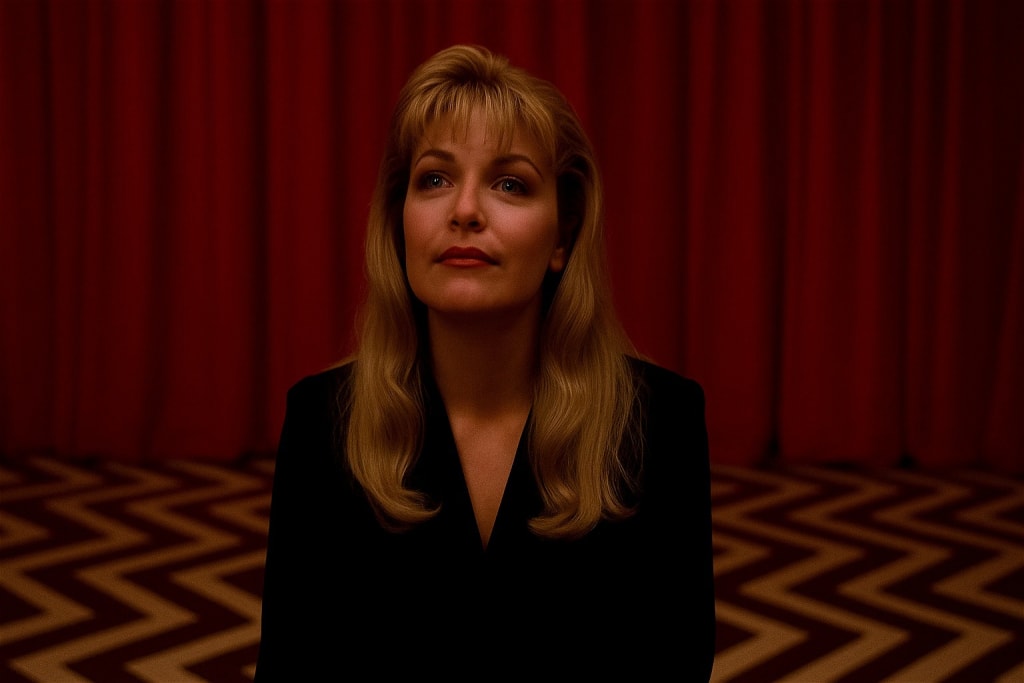
1993 was the year we discovered not who killed Laura Palmer (Sheryl Lee)—we had already learned that a year or two previously, if memory serves. After her killer was revealed, her homicidally incestuous entanglement with demon-possessed father Leland (Ray Wise) came to an end, leaving the series, which had hinged on this particular salient plot point, feeling adrift, and soon to be given the unceremonious axe. What was left over, the remains, though not as their mysterious, tragic, all-American, blue-tinged beauty Laura might suggest, were not washed up on a riverbank, wrapped in plastic, but would go on to become one of the cult hit television oddities of all time.
It was, indeed, a show unlike anything anyone had ever seen, with the quirky offbeat charm of a sitcom mixed with the dire and dark, brooding atmospheric ambience pioneered by horror soaps like Dark Shadows. Indeed, Twin Peaks seemed to emerge from a broadcasting alternate dimension—or, perhaps even more appropriately, from a dream—infused with aspects of television programs past, shows you couldn’t quite remember, in an era when the world was waking up from the mores of the past, from cold structures, and learning to swing. To dance.
The film of Twin Peaks, then, is a frustrating amalgamation of that television quirkiness and a dark symbolic, existential horror nightmare. A place where the deep blacks of the cold, annihilating forests of the Pacific Northwest seem to conjure the weird, surrealistic denizens of another world—a place where the dimensional portal opens up into the Red Room, and The Arm (also called “The Man From Another Place,” portrayed by actor Michael J. Anderson) holds court. Also, of course, the demonic, long-haired drifter “Bob” (Frank Silva); all of whom are the enginery of some obscure, macabre force, some ancient ritualistic power that feeds off of hatred, fear, pain, sadism—“Garmonbozia,” it is called, comically and obscurely.
The Dreaming Town
Intersecting this grand opera of Hell is the otherwise quiet, seemingly time-capsule-idyllic town of Twin Peaks, a place with upscale neighborhoods, posh houses, picture-perfect young people living in a retro dream of America that is neither the 1950s nor the 1990s. In the midst of this—or rather at its fringes—is a world of vice: drugs, prostitution, and ugliness as exemplified by criminals such as Jacques (Walter Olkewicz) and the abusive Leo (Eric Da Re), who beats wife Shelley (Mädchen Amick). Poverty and crime tarnish the facade of American opulence here, the dark brooding core of the American nightmare; the ants or insects crawling, burrowing beneath the surface of the perfectly landscaped yard in which Jeffrey Beaumont’s (Kyle MacLachlan there also) father has a stroke in Blue Velvet.
That film was a precursor to Twin Peaks, setting the theme and stylistic content of the latter hit series. Our film here begins with the FBI and the murder of prostitute Teresa Banks, whose body, not unlike Laura’s later, would be found floating in a river, after being bludgeoned to death. In the opening scene, after the slow, static-infused credits have rolled, the lead pipe or whatever it is comes crashing down on the television box, symbolically representing not only the breaking of the “fourth wall” of televised conventions imposed on the series, but also the crushing of Pandora’s box, the opening to a world of woes, and the shattering of the virginal hymen. The film that follows is a serious, dark underbelly to a story already infused with horror, gloom, and dread.
Lil and More
Special Agent Chester Desmond (Chris Isaak) and Agent Sam Stanley (Kiefer Sutherland) are dispatched by FBI director Gordon Cole (David Lynch) to investigate the murder of Banks. As a parting message to see them on their way, he introduces them to “Lil,” (Kimberly Ann Cole) who, he explains, is his “mother’s sister’s girl.” She is wearing a bright red dress, has dyed orange hair, one hand raised and one in her pocket. She’s shuffling in place and wearing a “sour face.” This, we are made aware later, is a secret, physical code, a sentence that must be parsed—a form of communication hinted at as the shots of telephone and power lines suggest the free flow of energy and communication that “chants out between two worlds,” as the strange little poem from which the movie title is taken informs us.

After a trip to a trailer park to meet Harry Dean Stanton, the two agents confront a feisty and menacing local sheriff and his deputy, who will figure prominently later in the film, his mask ripped away. A “bridge” featuring both David Bowie and Kyle MacLachlan as Special Agent Dale Cooper, reprising his famous role, opens an inscrutable, cryptic world of strange visions—an alternate dimension, seemingly, or a place of egress to a dream state wherein, such as with Lil, the symbolism (masked boys in suits, smoke, monkey faces, weird “Woodsmen” with long beards) unfolds in a place where electrical energy explodes from the darkness. We get a long, extreme close-up of a human throat, the camera pulling back to reveal hungry teeth. “Electricity,” it informs us, is the lifeblood of the Lynchian dreamscape, the cold breath of another world.
Twin Peaks: Fire Walk With Me (1992) - A Visit From Phillip Jeffries
“We all live inside a dream,” declares David Bowie, as the “long-lost Agent Philip Jeffries,” in the bridge that brings together both the prologue and the rest of the film. The surrealistic montage, depicting the catatonic and metaphorical entities in their own avant-garde version of Hell, leaves us confused. The image of a monkey face, recurring, is both symbolic of the “monkey on the back” of addiction, even demonic possession. In as much as it is hidden behind a child’s enigmatic plaster mask, it is also coyly the director hinting at the way he is monkeying about with the viewer. What secrets is he trying to hide? What is he revealing?
Laura’s Last Days
In the manner in which dreams switch suddenly, what we assumed was going to be a detective story featuring Isaak and Sutherland’s FBI agents turns its focus away from them (they mostly disappear) to Laura Palmer. She is the picture-perfect American homecoming queen, in an idyllic, affluent and picture-perfect neighborhood, going to a high school that might have made Archie and Veronica proud. It is infused with an early Nineties sensibility though. Laura is shown abusing cocaine in the high school restroom stall.
Laura’s dating life hinges between the stereotypical bad-boy heartthrob Bobby (Dana Ashbrook), with whom she does cocaine, and James Hurley (James Marshall), with whom she shares a secret love. It is James who is with Laura on the night of her death.
Laura’s home life, outwardly idyllic, is punctuated by the menace of the steadily ever-growing madness of father Leland (Ray Wise) and the desperation of mother Sarah (Grace Zabriskie). Her friendship with good girl Donna Hayward (Moira Kelly, Laura’s Betty to Laura’s Veronica) is strained by Laura’s seedy double life as a coked-up call girl for local scumbags such as the morbidly obese Jacques and wife-beater Leo. Donna begins to slip into Laura’s habits, a fact that horrifies Laura as much as her own life that is spinning, below the picture-perfect surface, out of control.
Laura’s life features nightmare flashes of the demonic entity BOB, and hints from the other world, such as Frances Bay as an old woman with a strange young grandson and a painting of a door. This is a film of doors, of gates and strange egresses; of communications from beyond. Beyond is the enginery of death and destruction, the fire that consumes (spirit) and the blood transmuted, as sprayed from the hand of the demonic Bob, another denizen of that inscrutable Other Place, after he has hung up his Leland suit, his costume, in the air.
There is no sense that the denizens of that other world, even the One-Armed Man who drives up and shouts weird dialogue at Leland and Laura, are in any way enemies or opposed to each other. Quite the opposite—they seem to be actors in a drama that is beyond our understanding. The Man From Another Place may seem at times sad, or even outraged in one instance, but ultimately, he dances, and he laughs. “I am the Arm,” he says cryptically. “And I sound like this.” He then pats his lips while whooping, making a sound that calls to mind the beeping of an old-fashioned telegram machine. The dream is a communication, cryptic, from another world. It’s a place that, much like the image of the physical Lil, can be read in the minutiae of often mesmerizing and inscrutable detail. And once that understanding has been gained, can we not pass through the egress of our own delusions, and come to a new understanding of the mechanism of tragedy and how it molds our experience in conventional reality?
Twin Peaks as Illusion
Twin Peaks is an illusion. Laura’s life is an illusion, beneath the surface of which lies corruption just as dark and disgusting as that of her hometown, of the floor that is panned across in the Roadhouse in a single shot, revealing a moon-like, cratered surface of half stubbed-out, smoldering cigarette butts, mud, grease, spilled beer, and so on. Leland is a costume. All is false, including her love for Bobby. (She really loves James.)
The Indelible Final Image
The gate to the final, blood-soaked conclusion is scored by the same bassline and weird, rockabilly-infused theme played by the band in the previous Roadhouse scene—wherein Laura and Donna strip down and sin graciously while drinking in a whorehouse bar in the woods, bathed in red light, surrounded by writhing strippers. Much of the dialogue is non-sequitur, as backwards as the movements in the infamous Red Room with its jagged, zig-zagging black-and-yellow decorated floors and art deco furnishings. The dialogue, when we’ve breached the gates of Hell, lacks cohesion and becomes dreamlike, cryptic, absurd—as communication, or the free flow of energy, is stifled by that mechanism that works to disorder the universe: the secret language of dreams.
Twin Peaks (Fire Walk With Me)-Final Sequence
Laura and Ronette Pulaski (Phoebe Augustine) are in a cabin with Jacques and Leo when Leland, being controlled by Bob, kills Jacques and Leo flees, leaving Laura and Ronette tied up inside. Leland enters, and grabbing the tied-up girls, escapes with them in a shot that is at once absurd and weirdly nightmarish: twin flashlight beams shining in their terrified faces as he runs with them, suspended, I take it, from his grasp, behind. The visual look of the film is gorgeous and perfect, incidentally.
Ronette is left alive, but Laura, as we already know, meets her fate at the hands of father Leland, who is also revealed as the hideous Bob in a finale that is operatic in its Greek tragedian undertones. The killing coitus, the forbidden death in incest, Laura’s secret desire and sin made manifest in her own ultimate destruction—or Leland’s sin, invoking and allowing a gateway for Bob to enter and possess him. It’s the secret mechanism, the hidden communication of the enginery of dreams and destruction, that place of all possibilities, wherein the common life of Laura becomes the sacrificial stuff by which The Arm gets all his “pain and suffering.”
The final image is the most iconic of all, a total immersion in the symbolic nature of a televised goddess, laughing in a painterly shot of Dale Cooper standing at her shoulder. A blue light—that of television falsity, communication, and electrical impulse of energy, the galvanic battery and plasmatic stuff from which our illusory reality is formed—coalesces on her now smiling visage. She is a legend for television viewers, brought back from the dream, and made iconic in their minds. And the Angel did, indeed, save her after all.
There are parts of this film that seem inept. (The scene with the “Log Lady” Catherine Coulson, in particular, seems like an absurd, gratuitous tack-on from the television series, poorly executed.) But then, dreams feature absurd details, images we focus on, events that happen for reasons unfathomable and illogical as Kafka awakening with eight legs in Gregor Samsa’s bedroom. Did Lynch intend for this banality to mask something greater? Is he simply “monkeying” with us? We’ll never really know.
It’s an illusion, as every dream is an illusion. And language is an illusion, a communication masking actual meaning. Scrambled as a Burroughs cut-up, it can be deciphered. The surface is a rotting, carcinogenic moonscape of hunger at the center of the void. And it is an illusion that runs deep and inscrutable roots beneath a surface that is, forgive us, “wrapped in plastic.”
Twin Peaks: Fire Walk with Me (1992) ORIGINAL TRAILER [HD]
My book: Cult Films and Midnight Movies: From High Art to Low Trash Volume 1
Ebook
About the Creator
Tom Baker
Author of Haunted Indianapolis, Indiana Ghost Folklore, Midwest Maniacs, Midwest UFOs and Beyond, Scary Urban Legends, 50 Famous Fables and Folk Tales, and Notorious Crimes of the Upper Midwest.: http://tombakerbooks.weebly.com
"Scream 7" (2026): Running out of Fresh Screams
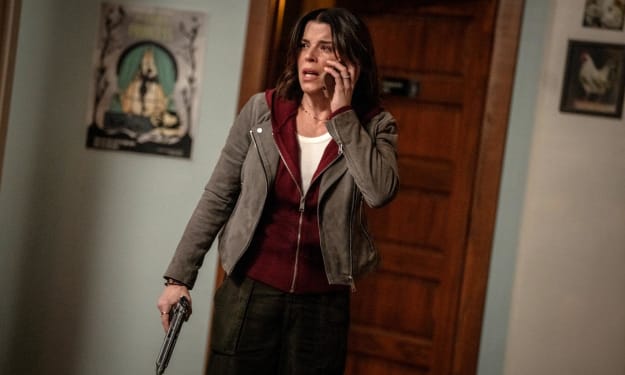
This is the seventh time we’ve had a Ghostface crisis. Scream 7 is the latest edition of the Scream franchise. Sydney Prescott and her family are under attack by another anonymous killer dressed in a Ghostface costume. While having issues with her daughter, Tatum, they run from the bloody murders, trying to determine who is behind it all.
By Marielle Sabbag9 days ago in Horror
Comments
There are no comments for this story
Be the first to respond and start the conversation.