

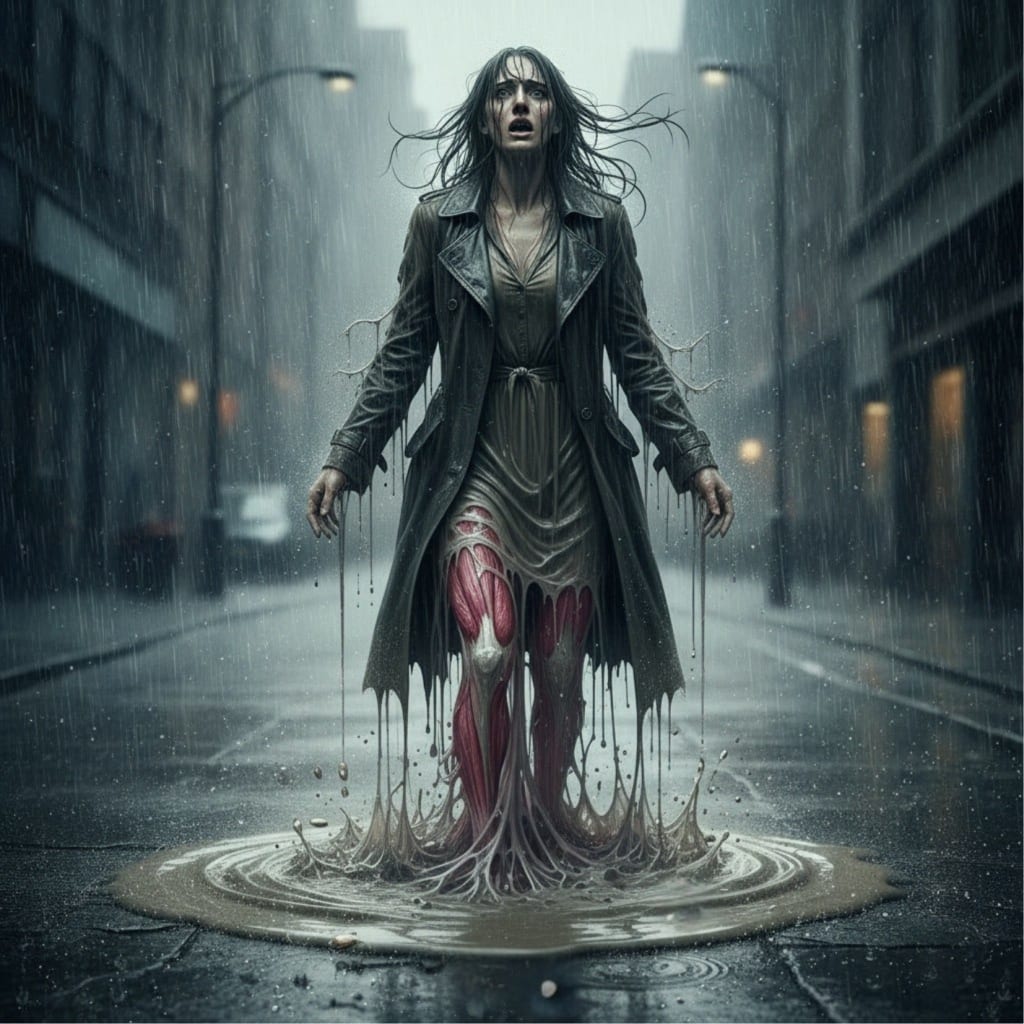
It started at midnight and behaved like rain. Same scent, same hush on asphalt, same nervous laughter from doorways. Only difference: where it meets human skin, the body lets go.
Not a boil or a burn. Release. The epidermis smears into a clear film, muscle loosens into a pink slurry, bones separate like chalk rinsed under a tap. Hair floats; teeth ping against tile; clothing keeps its shape until gravity has its say.
Everything else is fine. The awning doesn’t droop. Pigeons shake themselves and blink. A labrador noses a T‑shirt full of no one and whines. Cars idle under the downpour, wipers dutiful, paint unmarked. Streetlights bloom puddles of gold on sidewalks crowded with shoes.
News anchors keep their faces behind glass and talk about humidity. Experts line up to name what won’t accept a name. It isn’t acid. It isn’t pathogen. It’s a rule that woke up.
By morning, the city is a museum of absence. Benches hold coats. Hooks next to doorways hold hats. The subway runs on time; only the passengers have turned to quiet. Stations smell faintly of saline and metal. A baby stroller rolls three feet and stops. No alarms. No sirens. The machines still believe in us.
I seal my windows and check for leaks with the back of my hand. Stupid habit; I stop. Plastic sheeting, duct tape, towels at the thresholds. I eat cereal dry and listen to the water drum on the roof like nothing is happening.
On Day Two, I test a theory: I set out a bowl and catch a cup of rain. A fly lands on it and skates the meniscus, unbothered. I dip a wooden spoon: fine. A finger hovered over it thunders in my pulse. I pull back, angry at my curiosity.
On the street below, a couple runs, hand in hand, coats over heads. He hesitates and—no scream, only collapse, a soft, fast retreat from person into trace. She keeps running for three more steps before she understands she is holding fabric. The coat folds around air. She stops under a scaffold and squeezes the empty sleeve. Her mouth shapes a name that has no echo.
We adapt in dumb, practical ways. Umbrellas become helmets. Trash bags become uniforms. We tape together shower curtains and move between buildings like amateur beekeepers. The grocery posts a sign: MASKS DO NOTHING. HOODS HELP UNTIL THEY DON’T. Shopping carts clog the door with canned beans and brittle lettuce. An employee mops a clean floor. The floor stays clean.
By Day Five the city is neat. No rubble, no scorch, just arranged reminders. Offices hum; server rooms chill; printers wake and spit orphan jobs into trays. A screensaver drifts across an empty boardroom: floating pipes build themselves forever and never meet a hand.
Kids learn fast. They crawl under tables and draw skies on the undersides. They give the sun sharp teeth. They won’t walk near windows when it’s gray. One boy counts drops against glass and cries without sound, bored of sadness already.
The rain is never loud. It doesn’t pound or rage. It falls with the ordinary patience of tap water. You can drown in a teaspoon if you breathe wrong, a lifeguard once told me. November nods.
Outdoors, the city wears us like a rumor. Sidewalk cafés host cups that won’t be claimed. A crosswalk flashes a white walking man at no one. A delivery drone settles a parcel on a stoop and lifts off, task completed. Somewhere, an automated vacuum maps a two‑bedroom without stepping on a soul.
I collect photographs from frames and stack them in a plastic bin. Not to save them from water—paper is fine—but because the faces make a noise I can’t think over. My mother’s smile becomes a tone that sits behind my eyes. I tape the lid shut.
On Day Ten, a rumor hardens into protocol: Wait. Don’t touch the residue. Not because it harms—touching it does nothing—but because you’ll imagine the warmth. You’ll start naming it. Naming is the trap.
We build habits: door‑to‑door ropes, plastic corridors between buildings, “dry clocks” that chime the hours you can risk moving. People in top‑floor apartments sleep in bathtubs under plywood. Basements become towns. We learn the timbre of drains. We develop a sense for pressure changes the way old sailors sniff wind.
If this has a moral, it isn’t about cruelty. The rain is not a message; it’s an update. The world reviews its terms and conditions and fixes a clause: human bodies dissolve on contact with precipitation for a while. That’s the whole note.
On Day Thirty, at midnight, a pause lands. Not sunshine. Just the absence of water. The silence is boxy, like a room with carpet. You hear refrigerators. You hear yourself. Doors open cautiously, plastic crinkling, tape lifting with a slow peel. People step into a city that kept going and kept nothing. We count who’s there by the weight of the floorboards.
A cat sits on a hood, tail ticking, dry and smug. A bus sighs at a stop and closes its doors. A satellite dish keeps its aim. All our artifacts waited well.
We don’t cheer. We look up—quick, guilty—then down again. Nobody thanks anything. We just start moving, inventory in hand: tools, food, names. The first thing we fix is the calendar, because if it isn’t November anymore, we need a new word for what just ended.
Incident Slips (Intercut)
Slip A — Reykjavik, 00:03
Two hosts continue a morning show in an empty studio. The cameraman left his sweater on the chair. They rehearse jokes they didn’t plan to use. The red light never blinks. Their laughter sounds like it belongs to other people.
Slip B — Lagos, 00:11
A bus arrives with no riders. The driver steps off under a canopy and counts the seats like an usher after a late movie. He writes “37” on his palm. He doesn’t wash it off.
Slip C — Guadalajara, Day 4
A boxing gym leaves the bell on a timer. Every two minutes the round ends for no one. The ring is perfect, bright blue, unmarked. A poster on the wall says CHIN DOWN. HANDS UP.
Slip D — Kyoto, Day 7
Shoes lined at a genkan like a small army. House silent except for the dishwasher finishing a cycle. Chopsticks in a rack, one still damp. Someone will turn it, or no one will.
Slip E — Detroit, Day 12
Robotic arms in a plant weld chassis to chassis. A green light holds. A siren never sounds. The cars are flawless and destined for nobody.
Notes on Survival (Found)
Don’t test the rain. Curiosity is a dare you can’t win.
Residue is only memory. It won’t hurt you. It will slow you.
Windows lie. Gray looks harmless until it isn’t.
Move on the dry clocks. Trust the schedule, not the sky.
Count who returns. Twice. The first number is hope; the second is true.
Coda
If there’s a lesson, it fits on a sticker: The world isn’t for us; we share it until it updates. In November it updated. Everything else stayed the same. Birds, bricks, the baffled cat on the hood—untouched. Only we edited out.
Morning after, we start over with smaller gestures: towels off windows, bins of photographs, a kettle for every address that still has a stove. We learn to say rained the way we say widowed—a weathering with a human shape. When the forecast returns to ordinary, we still bring umbrellas inside and hang them over the tub. Not because they work. Because habits do.
-End
About the Creator
Dblkrose
They call me D. I write under Dblkrose. My stories live in shadow and truth. I founded Black Spyder Publishing to lift my voice—and others like mine. A brood weaving stories on the Web. www.blkspyder.com | [email protected]
Baron Midnight: Unearthed
Mama Noire’s parlor pulsed with the scent of copal and cinnamon — a thick, sweet veil curling through the room like the breath of ancient spirits. Candlelight flickered across walls adorned with relics: withered black roses sealed in glass bottles, faded photographs pinned within hand-carved frames, bone beads looped around wooden crucifixes. At her feet, chalked veves glowed faintly, humming with old power.
By DblkroseExclusive • 8 months ago
"Scream 7" (2026): Running out of Fresh Screams
This is the seventh time we’ve had a Ghostface crisis. Scream 7 is the latest edition of the Scream franchise. Sydney Prescott and her family are under attack by another anonymous killer dressed in a Ghostface costume. While having issues with her daughter, Tatum, they run from the bloody murders, trying to determine who is behind it all.
By Marielle Sabbag8 days ago in Horror

Comments
There are no comments for this story
Be the first to respond and start the conversation.