
My Brother's Imaginary Friend Never Went Away
Horror-tinged or surreal coming-of-age with a mysterious twist
My Brother’s Imaginary Friend Never Went Away
By ZIA ULLAH KHAN
We used to laugh about it.
Back when we were little and life was still tinted in soft yellows and safe routines, my brother Charlie had an imaginary friend named Benji. Not Benny, not Ben. Benji. A name too cartoonish to take seriously.
Charlie would talk to Benji during meals, leave a spot for him at the table, and blame him for the usual kid stuff—missing toys, crayon on the walls, cereal spilled on the dog. Our parents chalked it up to a vivid imagination and a phase that would pass.
But Benji never passed.
And over time, we stopped laughing.
Charlie was four when Benji first arrived. I was seven, and I remember the exact day. It was raining outside, the kind of cold spring rain that made the windows sweat. We’d just moved into the old farmhouse our grandparents left us. It creaked in every direction and smelled faintly of rot, no matter how many candles Mom lit.
Charlie sat in the corner of our shared bedroom that night, whispering to someone while holding one of his toy soldiers upside-down.
“Who are you talking to?” I asked.
He turned to me with wide eyes, the kind that seem too big for a kid’s face.
“Benji. He lives in the attic.”
That was the first red flag. We weren’t allowed in the attic. It was nailed shut, old wood warped like something was pushing against it from the inside. Dad said it was unsafe, full of broken furniture and black mold.
“Benji doesn’t like you,” Charlie added casually, almost sing-song.
I scoffed. “Well, I don’t like him either.”
From that moment on, things changed.
At first, it was little things—cold spots in Charlie’s room, toys rearranged into strange patterns, whispers late at night that I thought were just my brother talking in his sleep. Mom noticed bruises on Charlie’s arms and chalked them up to rough play. But Charlie never played rough. He was a quiet kid. Soft-spoken. Sensitive.
I caught him one night, standing on the landing between the second floor and the attic, holding a dead bird. Its wings were twisted. Its eyes missing.
“Benji said it was already broken,” he whispered.
I told Mom.
She made us both sleep in her room that night, but she didn’t do anything else. I think she was afraid.
Not of Charlie.
Of the idea that something might actually be wrong.
Time passed. Charlie turned eight. Still no signs of letting Benji go.
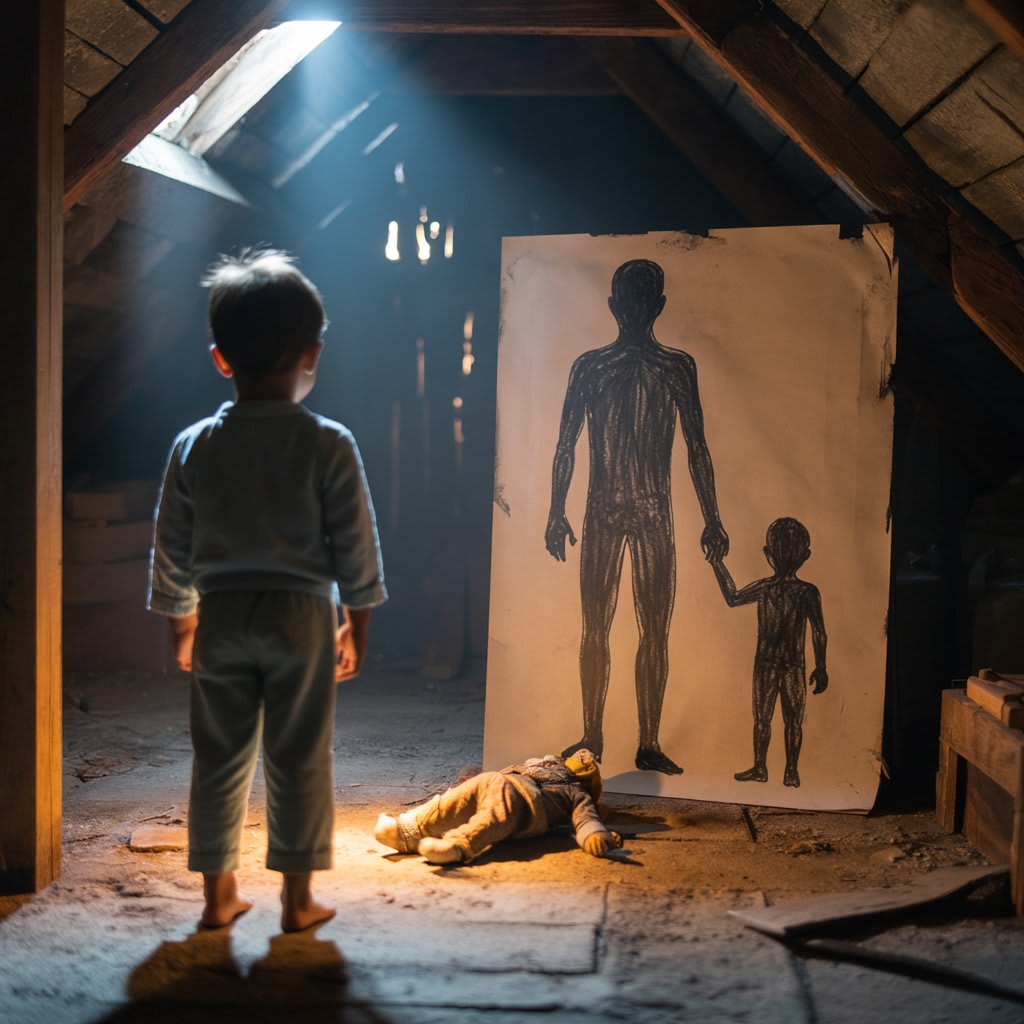
Worse, Charlie started drawing him. First as a kid, same size as him, with no eyes. Then older, taller. Always the same: featureless face, long fingers, wearing what looked like a priest’s robe made of ash. The drawings got darker. Scribbles over the eyes. Rooms burning. A black sun.
Benji didn’t want to play anymore, Charlie said.
Benji wanted us to listen.
The turning point came the summer I turned thirteen.
We were outside, and I dared Charlie to climb the big oak in the back of the property. He was halfway up when he froze. Not scared—just still.
“He says you’re going to fall,” he called down.
Before I could respond, he let go.
The fall cracked his arm in two places and gave him a concussion. In the hospital, he kept mumbling Benji’s name, even while unconscious. When he woke up, he looked at me like he didn’t recognize me.
“He’s growing,” Charlie whispered.
“Who?”
“Benji. He said he likes it here.”
I did what any scared, confused teen would do. I went online. I looked into imaginary friends that didn’t go away. I expected to find comforting psychology articles.
Instead, I found patterns.
Dozens of stories. Mostly from rural towns, old houses. Always a child between four and six. Always an imaginary friend with a strange name—Banji, Binjee, Bengi. Always drawings of a tall figure with no face. Always whispers, attics, dead animals, and sudden injuries.
And always a moment where the sibling disappears.
I became obsessed.
I blocked the attic door with furniture. Slept in Charlie’s room. Installed a baby monitor, even though he was nine. I stopped going to school. My parents thought I was losing it, but I didn’t care.
I wasn’t going to be one of the stories.
One night, I woke to the baby monitor crackling.
Not static.
Voices.
Two voices. One was Charlie. The other was not.
It was wet. Deep. And slow.
“Soon,” it said.
I ran to the room.
Charlie was gone.
The window was open.
The attic door… was no longer nailed shut.
I didn’t scream.
I climbed the attic stairs.
The air was heavy. The kind of thick that sticks to your lungs. The attic was empty, except for one thing: a circle of ash and salt in the center, and a child-sized drawing on the wall in what looked like charcoal.
Charlie. Holding hands with a tall figure.
Both of them were smiling.
I found Charlie sitting outside the next morning. Muddy, dazed, but unharmed.
He didn’t speak for days.
When he did, he said only this:
“He left for now. But not for long.”
Charlie’s seventeen now. I’m twenty.
We don’t talk about Benji.
But the drawings came back last year. Slipped under my door. Under my pillow. On the back of mirrors.
They’re different now.
He’s not just in them.
He’s watching me from them.
My brother has a new imaginary friend.
He says it’s a little girl this time.
She lives under the floorboards.
And her name?
Ellie.
Which, by complete coincidence—or not—is short for my name.
About the Creator
ZIA ULLAH KHAN
A lifelong storyteller with a love for science fiction and mythology. Sci-fi and fantasy enthusiast crafting otherworldly tales and quirky characters. Powered by caffeine and curiosity.
Keep reading
More stories from ZIA ULLAH KHAN and writers in Horror and other communities.
Of Entropy and Chaos
As the frequency from the tape filled the office, the city outside the 42nd-floor windows underwent a terrifying, high-definition transformation. The "Static" didn't just swirl in chaotic clouds anymore; it organized. It snapped into a rigid, mathematical lattice that mirrored the steel skeletons of the skyscrapers below.
By Nathan McAllisterabout 6 hours ago in Horror




Comments (1)
good