
Movie Review: 'Spiral' Doesn't Quite Live Up to the Legacy of Saw'
The idea to revive the Saw franchise lacks that franchise's scary intelligence.

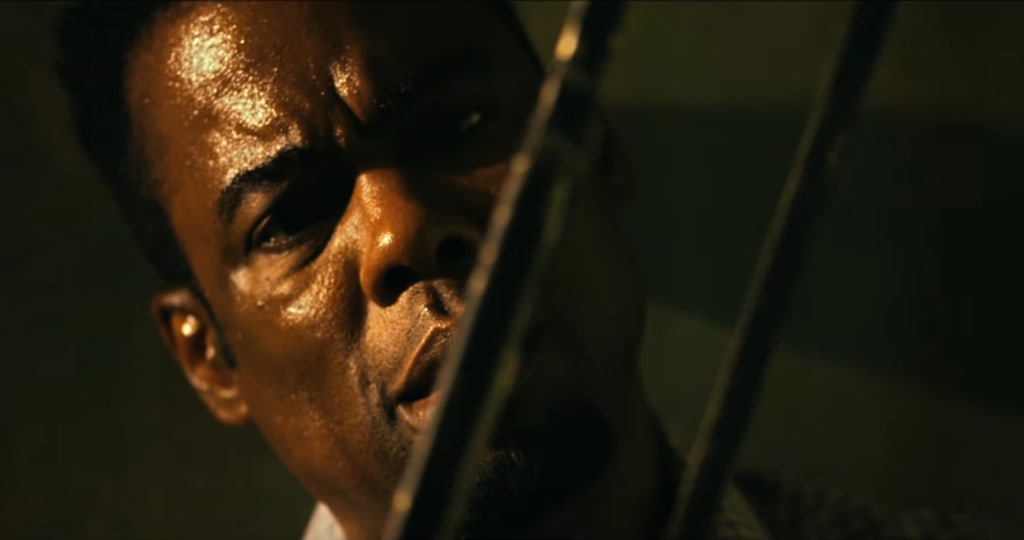
It’s rather appropriate that Chris Rock would use the Saw horror franchise as a means to send a message regarding Police Reform. The Saw franchise is one of the most thoughtful and conscientious franchises in the history of American horror. The film's messages regarding valuing your life and paying dearly for your sins make it one of the strangest and most fascinating franchises Hollywood has ever produced.
It’s fitting that Rock would see in the Saw franchise the chance to make a political statement. In Spiral, Rock and director Darren Lynn Bousman may not have the benefit of the legendary Jigsaw killer to state their point but his philosophy and that of the original franchise does linger into Spiral which uses Jigsaw extreme moralizing to send a message regarding the reform of American law enforcement. It's a shame that the film mostly uses Saw as a marketing tool rather than the guiding philosophy behind their movie.
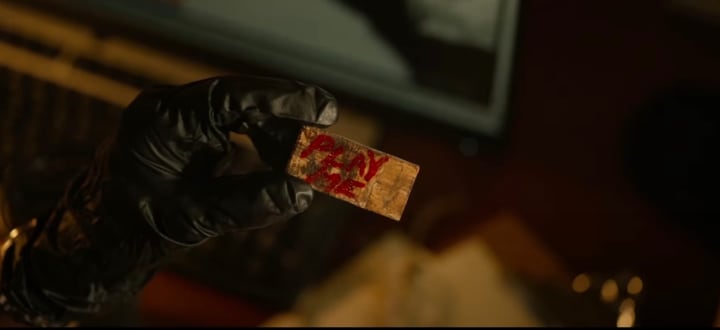
In Spiral: From the Book of Saw, Chris Rock stars as Detective Zeke Banks, a lifer cop whose family have been an integral part of law enforcement for years. Zeke’s father, Marcus (Samuel L Jackson), was the Chief of Police when Zeke became a member of the force. Marcus retired not long after his son was called a rat for turning in a fellow officer who murdered a witness to a crime in cold blood. The murder covered up a crime committed by a fellow cop.
Not long after Zeke turned in his partner, he was shot by a suspect after his fellow officers failed to respond to his call for back-up. He recovered but the bitterness between Zeke and his fellow detectives still lingers even years after the incident. Zeke’s latest case has roots that date back to his start on the force and the tail end of what was the Jigsaw murders which sent the City into a tailspin and led to a severe police crackdown on crime, one that was less than ethical and used Jigsaw as a justification for going beyond the bounds of legality.
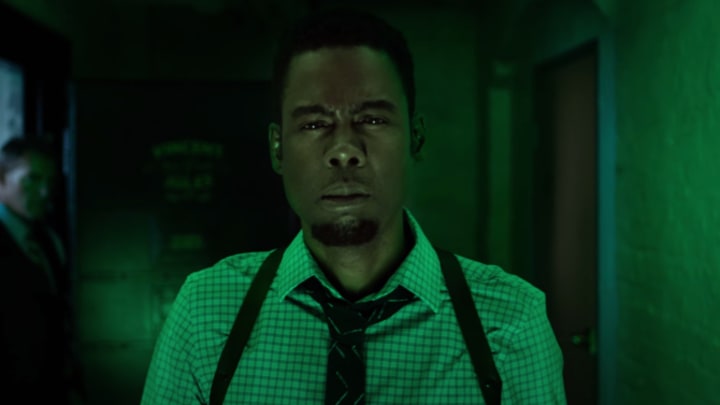
We witness a Police Detective on his night off wandering through a carnival when he spies a purse snatcher. The Detective, despite not being on the clock, does his civic duty and chases after the thief, a chase that leads him down a sewer tunnel and into a subway corridor. There, the detective is attacked from behind and rendered unconscious. When the detective awakens, he finds himself in a trap. His hands are bound above him, he’s teetering precariously on a wooden box, and his tongue is locked inside a device intended to tear it out if the Detective escapes the device. A voice on a tape recorder indicates that the Detective has just minutes to decide if he will let his tongue be ripped out of his body or if he will be stuck and killed by a speeding subway train. He doesn’t choose quickly enough.
Zeke ends up being the detective on this case. Initially, cops believe the dead man to be a homeless man in the wrong place at the wrong time but Zeke is savvy enough to grab details that indicate the victim was far from homeless and his situation had nothing to do with mere bad luck. This becomes very clear when Zeke receives a package including the dead detective’s badge and a clue that leads him to another box, hidden at the courthouse. The box contains the detective’s tongue.

It doesn’t take much for Zeke and his new partner, William Schenk (Max Minghella), to determine that they have a Jigsaw copycat on their hands. This time, the Jigsaw copycat is targeting cops. Other cops soon find themselves the target of this copycat and his motivation slowly comes to the fore. The intention is to teach a lesson to corrupt members of the force, if you abuse your power, you will receive punishment, a punishment intended to teach a lesson but mostly ends up killing those ensnared in the trap.
Spiral doesn’t really have that much interesting to say about Police corruption or reform. The point appears to be enacting violence against corruption but the point is deeply muddled in execution. Like the original Saw, the most effective and provocative point of Spiral is the notion of how violence begets violence and the notion that a killer can be both horrifyingly out of line and still have a point to make. Police corruption is a huge problem and it makes sense that it might drive some misguided person to violent retaliation.
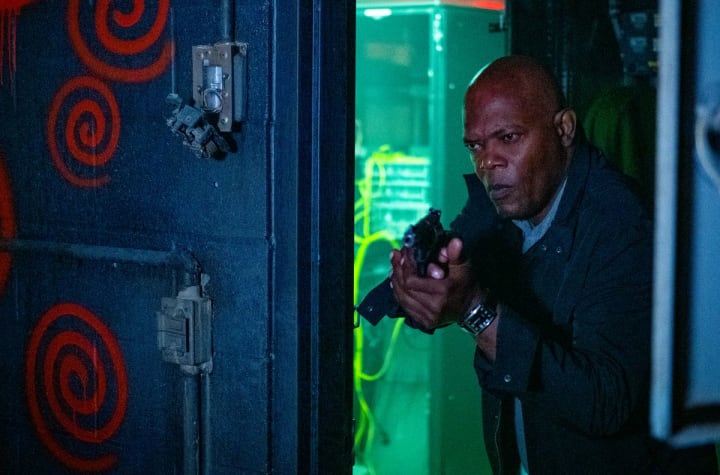
Unfortunately, Spiral doesn’t have the smarts to make that point effectively. The attempt appears to be to try and marry the audience satisfying blood and guts of the Saw franchise with a serious point about Police corruption but most of the film centers on Chris Rock’s detective chasing his own tail in a series of working the case scenes until the killer randomly reveals himself in time for the big finale. That finale isn’t particularly satisfying, there isn’t much of a resolution to the story. The big twist finale has a sort of random quality, like a videogame game cut scene intended to set you up for the next level of the game except it just ends there.
Chris Rock is effective in the lead, bringing together his comic persona with a gritty, bitter quality. The performance is effective enough to make you put aside what you expect of Chris Rock in favor of a more self-serious and tough quality. Rock has an undeniable star quality and while some audiences may struggle to take the comic actor seriously as a tough guy, bitter cop, I bought in because Rock is so innately charismatic and the script allows Rock room to breathe and riff a little to make us feel comfortable.
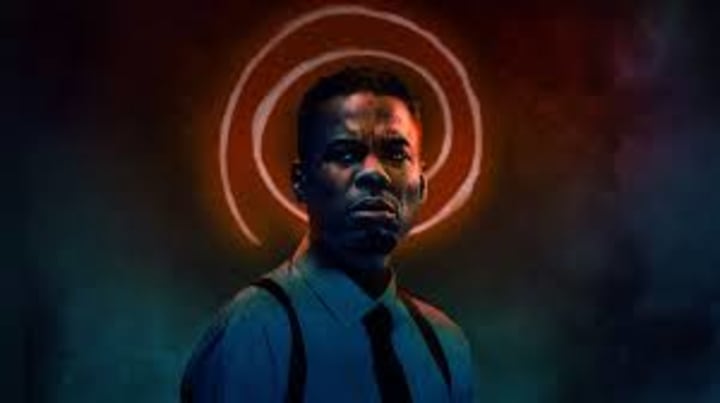
The Saw lore aspects of Spiral are limited to the traps. The traps are escapable, in the tradition of Jigsaw John Kramer, a nod to his philosophy about teaching a lesson with his deathly violence. That said, the traps play like leftovers from previous Saw entries repurposed for this story. Why the killer was inspired by the Jigsaw killer is rather unclear. Tangentially speaking, the Police crackdown mentioned in the movie was in reaction to the Jigsaw killer but how that trickles down to the character chosen to carry on Jigsaw’s legacy is unclear. Why did this person decide to be just like Jigsaw?
That lack of motivation on the part of the killer, at least the motivation to be Jigsaw, leaves the movie lacking a true connection to the series. Spiral plays like a movie intending to cash in on the success of the franchise as a marketing gimmick. The tagline “From the Book of Saw” is a strong indication of the mercenary aspect of Spiral. Chris Rock and Darren Lynn Bousman may have set out to make a Saw movie but instead of a continuation or homage, they're mostly capitalizing off of the cache for a story that only kind of resembles the original, minus much the franchise's wicked intelligence and terrifying moralizing.
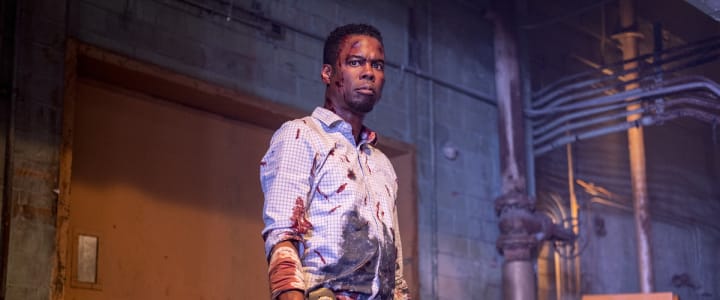
The Police Reform aspect of Saw has no teeth to it. Rather than leaning into the moralizing with a serious point about reforming corruption, Spiral uses that as tacked on motivation for the killer while Rock's character enacts a rather straightforward police procedural. Compare that with Saw 6 which had no big stars but did have a lot to say about the corruption and heartlessness of insurance companies. That film used the Jigsaw killer to effectively make the case against the heartless practices of insurance companies in deciding between life and death for the people at the mercy of their algorhythm and desire to keep costs low.
That film rarely gets any credit for taking on the insurance industry but it should. The trenchant commentary on how we allow bean counters to make life and death decisions regarding people suffering from everything from cancer to needed transplants is something that few movies, let alone gory horror movies, have the guts to take on. Saw 6 did that and didn't receive half the plaudits given to Spiral which, in it's marketing, seems to get plenty of credit for attaching their concept to Police Reform. As if just having the idea was good enough.
About the Creator
Sean Patrick
Hello, my name is Sean Patrick He/Him, and I am a film critic and podcast host for the I Hate Critics Movie Review Podcast I am a voting member of the Critics Choice Association, the group behind the annual Critics Choice Awards.
Keep reading
More stories from Sean Patrick and writers in Horror and other communities.
Movie Review: 'Nobody'
Hutch is a rather diffident fellow, a serious normie, on the surface. Hutch's life rarely changes from day to day. He has a routine like clockwork, a seriously boring marriage, on the brink of collapse from the weight of apathy, and two normie kids. It appears, again, on the surface, to be a painfully normal existence. And yet, something in Hutch’s manner causes you to wonder about him. His workouts are rather intense for a man whose life is spent behind a bean counter desk.
By Sean PatrickExclusive • 5 years ago
The Screams Beneath the Floorboards
Old houses make noise. They creak, groan, and sigh as if remembering things they were never meant to keep. That’s what I told myself when I first heard it—a faint sound beneath my feet, barely louder than the wind slipping through cracked windows.
By David John5 days ago in Horror



Comments
There are no comments for this story
Be the first to respond and start the conversation.