

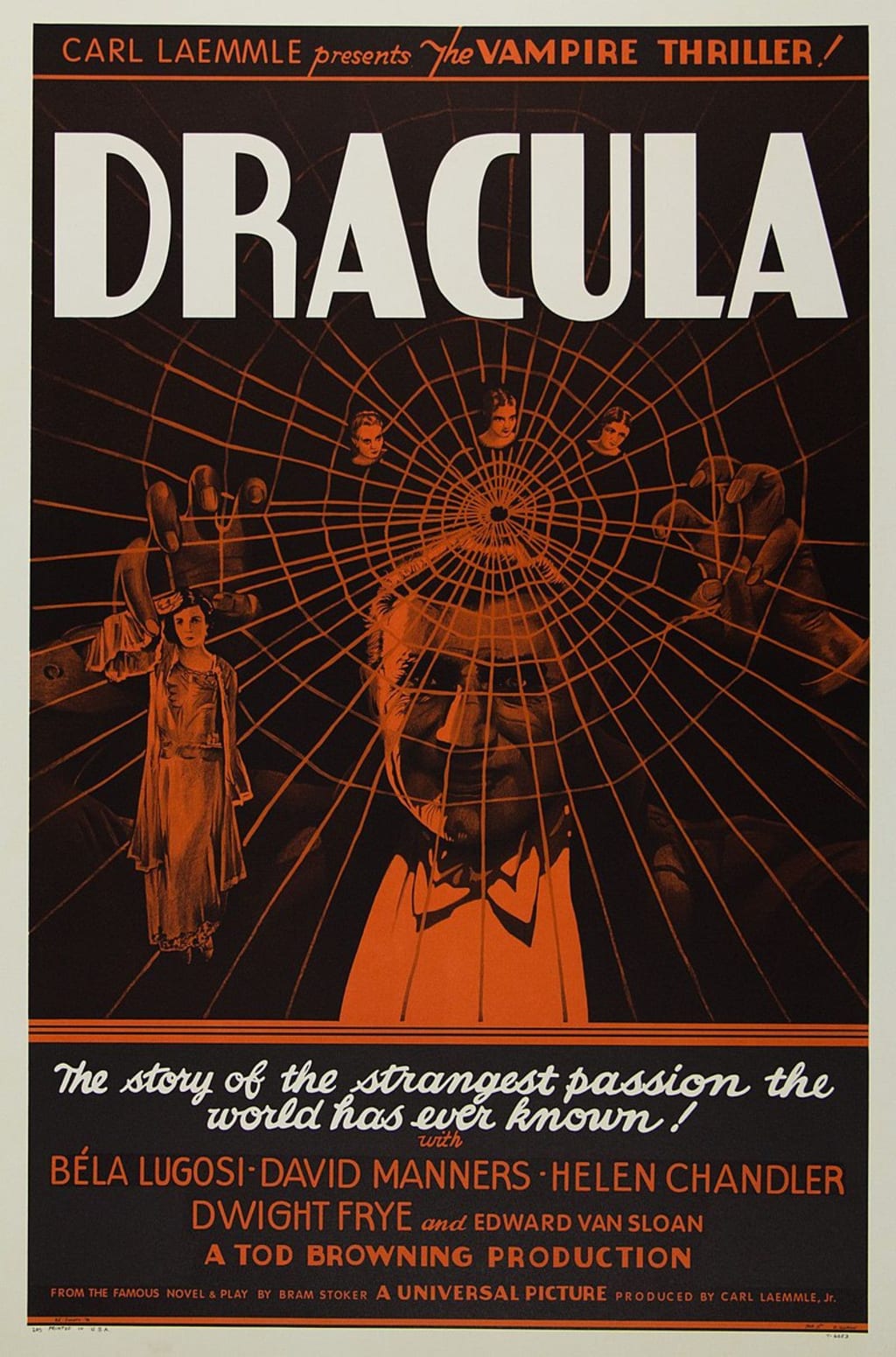
Stilted, strange; a surreal yet gripping and ultimately unforgettable cinematic experience, Todd Browning's original 1931 production of Dracula, starring the sad, tragic yet incomparable Bela Lugosi (a man whose shadow and strange legend still shine darkly across the six decades since his death), is a film few moderns have seen. Or, at least we take it to be so. (Once, when asking a group of young kids playing a vampire-themed roleplaying game if any of their vamps looked like Bela Lugosi, the ringleader answered with a puzzled, "Who?" I suppose since they were all probably all of sixteen, they can be forgiven.)
Be that as it may, Dracula is a piece of motion picture art, a glimpse of cinematic history virtually unsurpassed by any similar entertainment (except perhaps for James Whale's Frankenstein, released the same year); it is quintessential viewing for the students of the gothic, of the horror genre; for all of those who want to see what a human interpretation of a very severe and troubling dream of love and death can portray.
It begins with "Swan Lake," by Tchaikovsky; but there is no musical score afterwards, and none necessary. (Note: experimental composer Philip Glass composed a score that was released in a special DVD edition in the 1990s. Opinions will vary as to whether or not this was appropriate, necessary, or whether it actually somehow ruined or tainted the film.)
We find ourselves on a coach, taking a bumpy, rocky road through the stark, rural landscape of Transylvania. Aboard, Renfield (the small, thin, almost frail-looking Dwight Frye) is sitting with locals, as well as one woman ( Carla Laemmle) who also seems to be an American tourist, a flapper in large round glasses reading legends of vampires from a huge book on her knees. Renfield departs at a local inn, telling the driver, "Don't take my luggage down. I'm going on to Borgo Pass."
Upon hearing this, the innkeeper becomes alarmed. He questions Renfield, who tells him he must go on to meet Count Dracula's carriage. The innkeeper tells him he must not do that, as at the castle there are "witches and vampires...who take the form of wolves and bats!"
Renfield believes it all superstitious nonsense, but an old woman comes forward, bearing the crucifix, which is shown in a sort of freeze-frame. She implores him to wear it, "For your mother's sake!"
Renfield is driven to meet Dracula's carriage.
We next get a glimpse of the crypt beneath the castle. As rodents and beetles emerge from coffins, wherein the bony hands of the long dead are still reaching up from their moldering boxes, Dracula's sepulchral, ghostly wives emerge from their slumber, sensing that soon, soon, it will be time to feed.
And then we see Dracula, Bela Lugosi himself, a weird, still, dead yet undead image, the camera slowly closing in on him as he stands resplendent in his dark, pristine cloak and tuxedo. His eyes stare eerily, uncannily into the distance. He commands our visual attention like few other images can, emerging as if from a troubled sleep, to haunt our collective psyche.
Of course, in the foul, dusty crypt, it is hard to understand how such elegant beings as Dracula and his wives maintain their appearances. it is as if they reconstitute their physical beings upon awaking, each molecule of their body maintaining its perfection as long as they are not denied the deep red sanguinary wine they so desire. Every ghost, even the seemingly-solid physical variety, is clothed perfectly, forever.
The Count dresses as his own coachman, wrapped tightly in a hat and hood around the face. Renfield is retrieved, tiny and terrified and forlorn on the rocky, dangerous road through the mountain pass.
The carriage speeds through the night, alarming Renfield enough so that, at one point, he looks from the carriage window to exhort the driver to slow his speed. He sees, to his amazement, no driver, but a slowly flopping "thing", what he takes to be a bat, flying over the driver's seat.
Finally, Renfield arrives at the castle, a place that seems to be in ruins. He enters, noting the rubble and deterioration of a ruins of great age (one he must take, at first, to be abandoned).
"I bid you welcome! I am...Dracula!"
Lugosi appears at the top of the stairs, holding a candelabrum. He is standing in front of an immense web. (Previously, we have seen obviously phony spiders crawling, seemingly without moving their legs, up the wall. These join the lazily flopping bats, each flapping wings too slowly to ever maintain flight, each of which is also obviously on the end of a fishing line.)
Renfield joins Dracula a the top of the stairs, following him, as in the novel, to a table of food. Dracula is apprised of his purchase of Carfax Abbey in London. He eagerly looks over the deed, the delivery of which is the reason Renfield has even come to this accursed land. (Where, to quote the Dracula film made by Francis Ford Coppola in the 1990s, "The Devil and his children still walk with earthly feet!")
Renfield manages to cut himself on a bread knife, and Dracula comes forward like a predatory animal, his arms extended, his fingers pointing forward...until the crucifix that Renfield is wearing falls from his shirt, causing Dracula to reel back and cover his eyes with his cloak.
The events of the novel (and of Nosferatu, the legendary, German silent film production of Dracula by F.W. Murnau) are here compressed: Renfield is accosted by Dracula, as his weird, ghost-like wives also approach. The scene fades, finally coming upon a ship, tempest-tossed against a raging storm at sea.
The sailors are fighting above deck to save themselves and their ship. Below, the now enthralled and insane Renfield is speaking to the count, like Carl von Cosel to Elena, through the lid of his coffin. Dracula, a sinister, groping hand, emerges, to deal the death-blow to the crew.
The ship comes to rest, a deadly derelict, in Whitby Harbor, in England, its destination. The captain is dead, lashed to the wheel. Renfield is discovered below, his manic, insane visage captured, in a still shot, emerging from the cargo hold. Someone, a voice-over, states what is plain, "Why, the man's gone crazy!"
Indeed, next the camera descends, with a bat's eye view, across the grounds of Seward Sanitarium, where Renfield has degenerated to the point where he is eating his famous flies. He pitifully implores Martin, a hospital orderly with a heavy cockney accent, not to throw away the spider he was just going to doff.
Dracula we again meet walking the streets in top hat and cloak, in the London fog, bringing up an image that would later be popularized in fictional films about Jack the Ripper. Like the Ripper, he accosts a poor cockney flower girl, a low-class victim no one will miss. Then, he emerges from the misty night to go to the theater.
It is here we meet Seward (Herbert Bunston) and Johnathan Harker (David Manners), Lucy Weston (altered from the novel's "Westenra," and played by Francis Dade) and Johnathan's soon-to-be-bride, Mina (Helen Chandler). Dracula comes to their box. His strange, croaking, halting manner of speaking, his weird intonation and the cryptic things he says, fascinate Lucy.
Things such as, "There are worse things waiting man...than death!" (One wonders: Whatever could he mean? To what "worse things" is he referring?)
That night, Lucy becomes Dracula's second English victim. She dies the next day. Later, as the "Woman in White," (also referred to, in the novel, as the "Bloofer Lady") Mina will read of the vampire Lucy luring little children away to feast on their blood.
"Dracula? I never even heard the name!"
So tells Renfield to Dr. Van Helsing (Edward Van Sloan, who was also in Frankenstein), who has tested Renfield's blood and who is convinced that the nosferatu he has been seeking his entire life is now here. Renfield erupts violently when Van Helsing confronts him with wolfsbane, and tells him, "You know too much to live, Van Helsing!" Dr. Seward says (as one of his few lines) "Now, now Renfield!"
At first, Renfield denies even knowing who Dracula is. He is only afraid that his cries might "disturb Madame Mina."

"Rats! Thousands of them!"
Later comes a visit by Dracula himself, in which he banters with Harker and Van Helsing coyly, before Van Helsing springs upon him with a mirrored cigarette case. Revealing that he casts no reflection enrages Dracula, and he rather gives up the game. He knocks the cigarette case out of Van Helsing's hand in a rage. Then, turning to leave, he says, "You are a wise man, Professor, for someone who has not yet lived even a single lifetime."
The next time he and Dracula have an encounter, Van Helsing shows him the crucifix. Dracula turns away violently, hiding his eyes with his cloak. Gloating to Van Helsing that Mina is now under his control, Dracula is warned by Van Helsing that he'll have Carfax Abbey torn down, "stone by stone." Dracula leaves, later, possessing the nurse (Joan Standing) to remove the wolfsbane necklace from around Mina's sleeping throat.
Renfield makes an incredible speech:
Renfield: He came and stood below my window in the moonlight. And he promised me things, not in words, but by doing them.
Abraham Van Helsing: Doing them?
Renfield: By making them happen. A red mist spread over the lawn, coming on like a flame of fire! And then he parted it, and I could see that there were thousands of rats, with their eyes blazing red, like his, only smaller. Then he held up his hand, and they all stopped, and I thought he seemed to be saying: "Rats! Rats! Rats! Thousands! Millions of them! All red-blood! All these will I give you! If you will obey me!"
Abraham Van Helsing: What did he want you to do?
Renfield : That which has already been done! [giggles sinisterly]

The final moments of Dracula, wherein Mina becomes completely possessed by the vampire, attacks Johnathan while in the garden (after telling him, "You must never kiss me!) and then escapes with her unded paramour to Carfax Abbey, bring us to the inexorable end of the vampire drama: the staking through the heart.
Van Helsing and Johnathan proceed to Carfax Abbey to rescue Mina. Or, if that is not possible, drive a stake through her heart. We see a wide shot of a staircase coming down to the dusty, ruined crypt below. Dracula and Mina stand at the top of it, with Renfield facing them. Having outlasted his usefulness to the count, Renfield is thrown down the stairs to his death. Dracula and the possessed Mina continue down.
Van Helsing and Johnathan enter. They discover Dracula's coffin, but Mina is not in hers; she is still alive they surmise. They quickly dispatch Dracula, with his off-screen groans of agony signaling his death.
By his death, then, Mina is released from the spell of the vampire.
Many of the actors from the Twenties stage production of Dracula, including Edward Van Sloan and Lugosi, returned for the film production. Lugosi, however, wanted to initially drop the role of Dracula, leaving it in the past forever: "I don't want it to possess me," he stated. Of course, oddly, he was buried in his Dracula cape, a real, deathlike imitation of the famous sleeping vampire, the image of which he helped mold into a cultural icon. The film Dracula is now ninety years old; stilted, stiff, stagey; more or less a literal, filmed version of the play Lugosi made so popular. Yet the movie still has an undeniable dream-like, quiet power, a virtual surreality that heightens the feeling of disquieting strangeness, that brings a creeping sense of the gloom and haunting despair of the dead (and the undead) to the viewer in the modern age.
About the Creator
Tom Baker
Author of Haunted Indianapolis, Indiana Ghost Folklore, Midwest Maniacs, Midwest UFOs and Beyond, Scary Urban Legends, 50 Famous Fables and Folk Tales, and Notorious Crimes of the Upper Midwest.: http://tombakerbooks.weebly.com
The Vanishing Lighthouse Keepers
The Flannan Isles Lighthouse stands on the largest of a group of remote islands in the Outer Hebrides of Scotland, built in 1899 to warn ships away from dangerous rocks that had claimed countless vessels over the centuries, and it was staffed by teams of three lighthouse keepers who rotated in shifts to maintain the light and keep detailed logs of weather conditions and everything that occurred during their watch, following strict protocols established by the Northern Lighthouse Board that governed every aspect of their duties and responsibilities. On December 26, 1900, the relief vessel Hesperus arrived at the island to bring supplies and rotate the keepers, but when Captain James Harvey approached the landing area, he immediately sensed something was wrong because there was no flag flying on the flagpole as there should have been, no storage boxes waiting on the platform for the supplies being delivered, and no keepers waiting at the landing to help secure the boat and unload the cargo as protocol required, and when he sounded the ship's horn repeatedly and fired a flare to signal their arrival, there was no response from the lighthouse despite the fact that someone should have been on duty and watching for the relief vessel.
By The Curious Writerabout 10 hours ago in Horror


Comments
There are no comments for this story
Be the first to respond and start the conversation.