
In the Swamp of the Night:An Anatolian Jinn Wedding
A dark Anatolian folk horror tale about a frog hunter who stumples upon a jinn wedding in the marshes-and pays a lifelong price for being chosen.

I. The Frog Hunter in the Dark
In a remote village of Anatolia, there lived a young man who made his living by catching frogs. His name was Ismail. Since his childhood, he and his father would go to wetlands and swamp edges at night to catch frogs, then take them to town to sell.
After his father died, this work became Ismail’s only source of income. Everyone in the village called him “the frog catcher.” He wasn’t ashamed of it; on the contrary, he was accustomed to the smell of the swamps and the coolness of the nights.
Night was always the best time for frog catching. When the moon rose, mist would cover the swamp, and the cries of the frogs would intermingle. Ismail would step into the mud with his bare feet and follow the sounds until his sack was full. The wetter and marshier it was, the more frogs could be found.
The villagers didn’t dare approach those places even during the day. But for Ismail, those wetlands were like a second home.
One night, Ismail again slung his sack over his shoulder and went to the edge of the swamp. The air was restless, and the moon hung pale behind drifting clouds. The frogs were louder than usual, their calls echoing unnaturally across the water. Bubbles rose slowly on the surface of the marsh, as if something beneath was breathing.
As Ismail bent down to catch another frog, he noticed something strange in the distance.
A light.
At first, he thought it was a reflection of the moon on water. But this light did not move. It flickered steadily, warm and alive. Then came the sounds—faint at first, almost carried by the wind.
Drums.
Flutes.
Voices singing in a rhythm unfamiliar to him.
Ismail straightened up, his heart tightening. No one gathered in the swamps at night. No weddings, no fires, no music. The village was far away, and these wetlands were avoided even in daylight.
Curiosity fought with fear.
Quietly, carefully, Ismail stepped toward the sound.
He parted the reeds and bushes and looked through.
What he saw made his blood run cold.
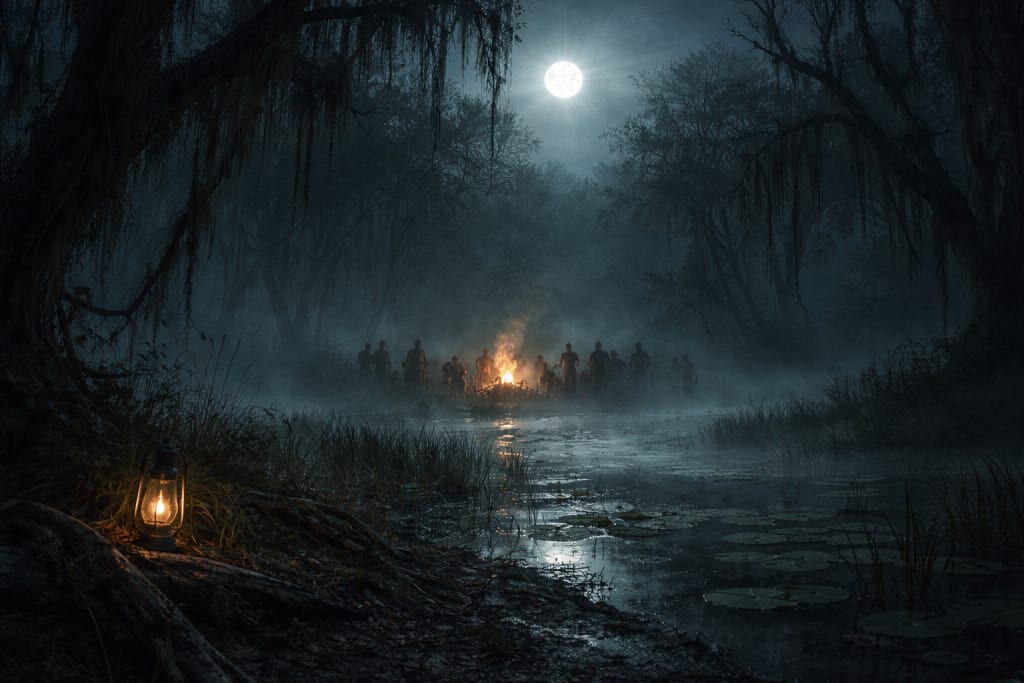
In the middle of the swamp, on a patch of dry ground that should not have existed, a wedding was taking place.
Torches burned in a wide circle, their flames unmoved by the wind. Men and women held hands and danced in a slow halay around a large fire. Drums beat in a deep, echoing rhythm, and flutes cried with a sound that seemed almost mournful.
Yet none of the faces were familiar.
Their clothes were unlike those worn in the village—too old, too strange, stitched in patterns Ismail had never seen. Some of the dancers moved stiffly, as if their joints bent the wrong way. Others glided over the ground instead of stepping on it.
Ismail felt his chest tighten. This place was marshland. No one could stand here, let alone celebrate.
He took a step back.
A hand touched his shoulder.
Cold.
Unnaturally cold.
Ismail turned slowly.
Standing behind him was a short figure, no taller than a child. Its face was deeply wrinkled, as if carved from old leather. A crooked nose hung over a thin mouth that curved into something between a smile and a grin. Its ears were long and pointed, twitching slightly.
But Ismail’s eyes were drawn downward.
The creature’s feet were wrong.
They bent backward, like those of a goat.
His breath caught in his throat.
Before he could scream, the creature leaned close, so close that Ismail felt its breath—cold, damp, smelling of ash and earth—brush against his ear.
“The groom has arrived…” it whispered.
At that instant, the drums stopped.
The flutes fell silent.
The dancers froze mid-step.
One by one, every face around the fire turned toward Ismail.
Their eyes gleamed in the torchlight.
An old man stepped forward from the circle. He leaned heavily on a crooked cane. His skin was dark and rough, the color of damp soil. When he spoke, his voice echoed unnaturally, as if coming from underground.
“We have watched you for years, Ismail,” he said.
“From the time you were a child chasing frogs in the mud.”
Ismail tried to run.
His legs would not move.
“My daughter has chosen you,” the old man continued.
“This night is not a coincidence. This wedding… is yours.”
Hands gripped Ismail’s arms from behind.
Cold hands.
Too many hands.
He was pulled toward the fire.They forced Ismail to his knees before the fire.
The flames burned an unnatural green, casting twisted shadows that did not match the bodies around them. The air thickened, heavy enough to press against his lungs. The drums began again—slower now, deeper—each beat echoing inside his chest like a second heart.
From the opposite side of the circle, the bride emerged.
She was veiled from head to toe in a thin, shimmering cloth, pale as moonlight on water. Her movements were fluid, almost floating, her feet barely touching the marshy ground. As she stepped closer, Ismail noticed something that made his stomach turn.
Her shadow lagged behind her.
When she stopped, it took one more step.
A hand reached out from beneath the veil. Long fingers, jointed oddly, with nails like polished obsidian. She lifted the veil just enough for Ismail to see her face.
It was beautiful.
Too beautiful.
Her skin was smooth and pale, her eyes dark and endless, reflecting the green fire like still pools at midnight. When she smiled, Ismail felt warmth spread through his body—comfort, desire, forgetting.
“Drink,” the old man commanded.
A clay cup was pressed to Ismail’s lips. The liquid inside glowed faintly, thick and oily. It smelled of fermented reeds, smoke, and something bitter—like burnt roots.
“I don’t want—” he began.
Cold fingers pinched his jaw open.
The liquid poured into his mouth.
It burned as it slid down his throat, not hot, but alive—writhing, crawling. His vision blurred. The swamp spun. The drums grew distant, then unbearably loud.
Laughter rose around him.
Not joyful laughter.
Hollow laughter.
When Ismail looked up again, the bride stood inches from his face.
“You belong to the marsh now,” she whispered.
“Your breath, your shadow, your name.”
She leaned forward and kissed his forehead.
The fire went out.
The night collapsed inward.
When Ismail opened his eyes, morning had already come.
He lay face-down in the mud at the edge of the swamp. His clothes were soaked, his sack of frogs overturned beside him, empty. The fire, the drums, the voices—gone. Only the croaking of frogs and the distant call of birds remained.
For a moment, he thought it had all been a dream.
Then he tried to stand.
His legs trembled beneath him, weak as if he had been ill for days. When he finally managed to rise, he noticed something strange: the swamp no longer felt foreign. The smell of rot and stagnant water felt familiar—almost comforting.
Ismail walked back to the village in silence.
The villagers noticed it immediately.
His mother said his eyes looked darker, as if the whites had dulled. The butcher crossed himself when Ismail passed. Dogs whimpered and pulled at their chains. Even the frogs in the baskets at the market went quiet when he approached.
“You look sick,” one man said.
“You look married,” another joked.
Ismail did not laugh.
That night, he could not sleep.
Every time he closed his eyes, he heard the drums again—slow, distant, beating beneath the sound of his own heart. When he finally drifted into a shallow sleep, the air in the room grew cold.
The oil lamp flickered.
Someone sat at the edge of his bed.
He did not need to look.
“I came home with you,” a voice whispered.
“Where else would a wife go?”
Ismail turned his head.
She was there.
The veil was gone. Her hair spilled over her shoulders like black water. In the dim light, her face was almost human—almost. Her eyes reflected no light at all.
He tried to scream.
His voice would not come.
She leaned close, her breath cold against his ear.
“Do not fear,” she said softly.
“The fire has bound us. The swamp has witnessed us. Even death will not separate us.”
Her hand rested on his chest.
Under her palm, his heart slowed.
Morning came, but the night did not leave Ismail.
His mother noticed it first. He no longer ate properly. He avoided mirrors. At dawn, she found him sitting upright in his bed, staring at the wall, his lips moving soundlessly.
“Who are you talking to?” she asked.
Ismail did not answer.
At night, strange marks appeared on his body—faint burns on his arms, like fingers pressed too long against hot metal. When his mother touched them, they were ice cold.
On the seventh night, she heard him whispering.
“I didn’t choose her,” he murmured.
“I didn’t know…”
The air in the room thickened.
A shadow formed in the corner, stretching unnaturally long. The oil lamp went out by itself. From the darkness came a woman’s laugh—soft, pleased.
“You did choose me,” the voice said.
“You drank. You danced. You crossed the fire.”
Ismail collapsed to the floor, clutching his chest.
That was the night his mother knew.
She wrapped him in her shawl and went from house to house at dawn, asking for help. Some doors closed before she could speak. Others listened and shook their heads.
“A swamp wedding?” one old man said.
“Then he is already half gone.”
At last, they sent her to a hodja who lived beyond the hills, a man who dealt with what came from fire and shadow.
They traveled for hours by cart. Ismail sat unmoving, his eyes hollow, his breath shallow. When they reached the hodja’s house, the animals nearby grew restless. Chickens scattered. A dog howled and fled.
The hodja opened the door before they knocked.
“You are late,” he said.
Inside, the air smelled of old books, ash, and bitter herbs. The hodja listened without interrupting as Ismail’s mother spoke. When she finished, he closed his eyes.
“A jinn bride,” he said quietly.
“And not an ordinary one.”
Ismail finally spoke.
“She says she carries my child.”
The room went silent.
The hodja’s hand froze on his prayer beads.
“That,” he said slowly, “means the bond has deepened.”
A sudden wind swept through the room. The candles bent low, their flames stretching sideways.
From behind Ismail, a familiar voice whispered, full of joy:
“He is telling the truth.”
Ismail screamed at last.
The hodja stood up slowly and opened a wooden chest that had been sealed with rope and wax. Inside were old talismans, a copper bowl blackened by fire, and a knife whose blade reflected no light.
“You must understand this,” he said, his voice grave.
“Jinn are born of fire. Their unions are sealed with fire. Words alone cannot undo what was bound in flame.”
Ismail shook his head violently.
“I don’t want her dead,” he whispered. “I just want her gone.”
The hodja looked at him with pity.
“She will never be ‘gone,’” he said. “Only silenced.”
He drew a circle on the floor with ash and salt, murmuring prayers older than the village itself. Ismail was placed in the center. His mother stood behind him, clutching her scarf so tightly her fingers bled.
As the hodja lit the fire in the copper bowl, the temperature in the room dropped sharply. Frost crept along the walls. The shadows began to move.
Then she appeared.
She stood just beyond the circle, more beautiful and more terrifying than before. Her hair flowed like smoke. Her eyes burned like embers beneath ash.
“My husband,” she said softly.
“Will you truly burn your own family?”
Ismail covered his ears.
“I never agreed to this!” he cried.
She smiled.
“You drank the fire-wine. You danced in our circle. You crossed the marsh at midnight. That is consent among us.”
The flames in the bowl surged upward.
The hodja raised his voice, reciting verses that cracked the air like breaking wood. The girl screamed—not in pain at first, but in rage.
Her form flickered. Her skin split with lines of glowing red, as if fire lived beneath it.
She reached toward Ismail, stopping just at the edge of the circle.
“If I burn,” she hissed,
“what remains will still call you father.”
The fire roared.
Her scream filled the room, high and piercing, until it shattered into silence. The flames collapsed inward, leaving only ash and the smell of scorched earth.
The hodja fell to his knees, exhausted.
“It is done,” he said.
“The bond is broken.”
Ismail sobbed. His mother held him, believing it was over.
But that night, long after the fire had cooled, Ismail woke to a familiar sound.
A soft, wet giggle.
He turned his head.
In the corner of the room stood a small child, no taller than a stool. Its eyes were pitch black. Its smile was too wide.
“Father,” it said.
The oil lamp went out.
And in the darkness, something breathed.
About the Creator
Bülent ORTAKCİ
Turkish writer exploring the crossroads of history, archaeology, and the paranormal. I focus on forgotten stories, uncanny events, and mysteries that blur the line between truth and legend.
Keep reading
More stories from Bülent ORTAKCİ and writers in Horror and other communities.
The Body Exchange Ritual
At night, the only light leaking from the windows of Mr. Bedri’s mansion was the dim lamp of his study. He felt the weight of his ninety-five years in his bones, in the muscles that had softened like rotting apples. The reflection in the mirror was repulsive: sunken cheeks, sagging skin, cloudy eyes.
By Bülent ORTAKCİabout a month ago in Horror
One to See, One to Speak, One to Listen
Contains gore and horror some readers may find disturbing. Rated 14+ Author's Intro: This story is meant to revive the Gothic literature so famously crafted by one of my favourite writer's, Edgar Allen Poe, and as such, the language and style is deliberately antiquated. Thank you for reading my all time favourite work of horror - Les
By Call Me Les20 days ago in Horror


Comments
There are no comments for this story
Be the first to respond and start the conversation.