


The factory had always been there, tucked deep within the forest; a place most people pretended didn’t exist. I was little more than a sprout when I first arrived, fresh and naive, unaware of the invisible threads that already bound me within its walls. The trees cast wrought iron shadows over the pathway leading deeper into the woods, each bend and twist leading me deeper towards an angelic aroma. Before long I saw it: the factory.
It wasn’t so much built as it was birthed from the forest itself, like something half-alive and half-forgotten, grown from the same roots and vines that curled around the towering trunks. The walls were a strange patchwork of timber and twisted branches, windows nothing more than hollowed-out gaps where glass should’ve been. Chimneys rose from its roof, spewing out plumes of smoke that smelled faintly of vanilla but carried with them an edge, a sharpness that made my nose twitch. From a distance, it almost looked inviting. Up close, it felt wrong—like something born out of a need that could never be sated.
Inside, the factory buzzed with life. The endless hum of machines and the rhythmic clatter of tools, automated and precise, provided a comforting backing rhythm and pace to the work that the elves used to keep up their pace. I didn’t realize it then, but the factory wasn’t a place for elves like me to live or to work. It was a place to be consumed, piece by piece.
Stepping inside, I was met by a crush of sounds and smells. The gentle whir of the ovens counter-harmonized with the soft clinking of mixing bowls as the elves grinding flour chanted in time. The aroma of dough, melted chocolate, and cinnamon assaulted my nostrils and reminded me of my grandmother. The delightful combination made my head spin. I barely noticed the metallic tang underneath the heady decadence that should have told me something was off.
Everything about the factory was imbued with a kind of magic that was both playful and comforting. The mixing spoons stirred on their own, dancing through batter with a graceful twirl. Rolling pins glided effortlessly over dough, guided by invisible hands. Even the ovens seemed to have personalities, their fires crackling merrily as they baked batch after batch of cookies to perfection.
I remember my first task: decorating a tray of sugar cookies. The icing shimmered, like a rainbow caught in a soap bubble. As I piped the icing, intricate patterns that I could not have possibly replicated on my own flowed forth from the tip. The tools themselves did all the work; I was just along for the ride.
"Not bad," an older elf named Merriweather had said, winking. "The factory likes you."
"Likes me?" I echoed, puzzled.
"Oh yes," she replied with a grin. "This place has a mind of its own. Treat it well, and it'll make your work a joy."
Fidget teased me about my wide-eyed wonder. "You're like a kid," he chuckled, his eyes twinkling despite his usual cynicism. "Can't blame you, though. This place does have its charms."
"Can you believe we get to work here?" I’d respond, shaking my head in disbelief. "It's like a dream."
Fidget shrugged, a small smile tugging at the corners of his mouth. "Don’t get too comfortable. Life is long, when you’re an elf."
I brushed off his warning. But slowly, the magic began to change.
We elves started to feel it, though no one thought much of it at first. The energy we once had seemed to drain away, leaving us slower, more tired; our movements mechanical, our laughter hollow. The jokes that used to echo through the factory became rarer, forced, as if we were all pretending nothing had changed. The magic that had once been our source of joy had curdled into something darker.
I didn’t notice it at first. None of us did. We were blinded by the routine, by the caramelized fumes and the warmth of the ovens. But Fidget—cynical, sharp-tongued Fidget—saw it. He was always the first to see things for what they really were.
“El,” he’d said one night after our shift, “this place is killing us. Can’t you feel it? Every day, we work harder. Every day, we get less.” He took a long, slow drag on a cigarette he’d bummed off one of the factory hands, his eyes dark and hollow. “And the worst part? We keep smiling about it. Like we’re supposed to be grateful.”
I couldn’t argue. The wages hadn’t risen. The conditions hadn’t improved. Yet the demands increased, like some invisible hand squeezing every drop of life out of us. The factory had started to feel less like a workplace and more like a body, alive and hungry, feeding off us. And somewhere, high above, the CEO watched, hoarded, and feasted on our labor.
The joy of creation had vanished. Where once we had found joy in art, there was now only the soulless recreation of tools reproducing an endless stream of perfect products. More cookies. Faster fudge. Bigger batches. Every day, more and more. Larger and larger. But somehow the rewards shrank in comparison. We were little more than unformed dough to the factory, to be pressed into shape by unyielding hands before being sold and consumed.
It all came to a head on Halloween, under the ancient roots of the tree. The forest was cold and damp, the air heavy with exhaustion. “We stop working,” I told the others. “No more cookies, no more fudge. Let them choke on their profits.”
And so we did.
The ovens went cold. The sweet aroma vanished, leaving behind only the stale scent of burnt sugar and ash. For days, the factory sat silent, as if holding its breath.
And then he came.
The CEO, a man we’d only heard of through rumors, appeared without warning. Like a nightmare made flesh, he was tall, pale, and lean. Dressed in a suit that shimmered unnaturally in the dim light, his lapels were covered in rainbow luminescence drawing attention downward and away from his eyes, dark and predatory. His gaze swept over us like a butcher inspecting his meat. I couldn’t help but notice that his footsteps made no sound.
“You’ve stopped working,” he said, his voice as smooth and cold as polished stone. There was no anger, just a calm statement of fact. “Why?”
I stepped forward, heart pounding. “We’re done being exploited,” I said. “We’re the ones keeping this company alive, and we are making less and less each day while the company prospers! It is time we get what we are owed.”
The CEO’s lips curled and he tilted his head slightly, looking like a bemused corgi. “What you are owed?” He took a step closer. His suffocating cologne masking the usual smell of fresh bread, making it difficult to breathe. “Tell me, Elwood, what do you think you deserve?”
The way he said my name made my blood run cold. How did he know who I was? I swallowed hard, refusing to be cowed. “Fair wages. Better conditions. We deserve more than this,” I said, my voice firmer now, though my hands trembled at my sides.
The CEO let out a low, almost affectionate chuckle, his dark eyes gleaming with something unreadable. He took another step closer, and I had to fight the instinct to step back.
The CEO tilted his head, his predatory eyes shining in the light. "Fairness," he mused, almost tenderly, as though it were a child’s word. "You speak of fairness as if it has a place here. This factory, Elwood... it runs on you. It runs on every soul that walks through its doors. Fairness? This is the closest you’ll ever come to fairness—a trade of labor for life. A cycle. Eternal. You give, it takes. Everyone does their part."
“You don’t know what you’re talking about,” I spat, anger surging, but my voice cracked under the weight of the moment.
“Oh, but I do. I understand better than anyone.” His voice slipped into a chilling whisper. “You think this is exploitation? No, Elwood. This is balance. You were meant for this, all of you were. And now, you’ve stopped giving. What happens to a machine that starves?”
I wanted to scream, to fight back. My body was weakening, but my mind still grasped for something—anything—to hold onto. “We’re not machines,” I hissed through gritted teeth. “We’re not yours.”
His smile widened. "You always were."
It had to mean something, I knew. I repeated the line, like a mantra in my head that would keep me from slipping. The certainty that had once anchored them however had rotten beneath the waves. The factory didn’t need us. It merely needed our bodies and our energy.
“I’m not afraid of you,” I said, hoping that the firmness of my voice did not betray my own cowardice.
The CEO’s grin widened. “Fear?” He let the word hang in the air for a moment, like he was savoring it. “I don’t want your fear, Elwood. That’s too easy.” He leaned in closer, his voice a low, intimate whisper. “What I want is your belief. I want you to understand… there is no escape. Not for you. Not for any of them.”
Before I could react, he moved. Fast. A blur, like the air itself bent around him. His hand shot out, gripping my wrist in a hold that felt less like skin on skin and more like flesh fusing together, like my very bones were being sucked into him. The sensation wasn’t pain. Not exactly. It was something worse, something sensual, a dark, hot pleasure that crept up my arm, spiraling through my veins. I gasped, but it was too late. This couldn’t be happening. We were the lifeblood of the factory. We kept the wheels turning, didn’t we? I wasn’t just another gear in the machine. I couldn’t be.
The crackling sensation beneath my skin began, like molten sugar flowing through my veins and eagerly hardening as it cooled. But it wasn’t the sensation that truly disturbed me. It was the silence. The factory, once alive with the sounds of whirring ovens and clanging trays, had gone completely still. It had an oppressive presence all its own, suffocating the air around me as the very walls of the tree drank in all the noise.
In that silence, time stretched unnaturally. I could hear things nobody should ever have to hear; Fidget’s shallow breaths, rapid and panicked; the creaking of joints as the other elves began their slow, horrifying change. My heartbeat thumped, footsteps in an empty kitchen.
“You think you know what you deserve,” the CEO purred, his voice slipping into something wet, pulsing. “But in the end, it doesn’t matter. You’re part of the machine, Elwood. And like all parts… you’re replaceable.”
My body was melting, cracking, shifting all at once. My skin felt like marzipan. Stretching. Hardening. Pulling away. My bones became brittle and dry, breaking and reforming beneath my flesh. Was I still standing? Still Elwood? Still me? Or had I become something else, folded and kneaded into a batter I no longer recognized? I tried to scream, but what came out wasn’t sound. It was a whistle, sharp and shrill, like steam escaping a kettle before being cut off in a choking spray of crumbs that covered the floor in front of me.
Fidget’s breath was ragged, but he straightened, his gaze hardening. ‘You think you’ve won,’ he spat, his voice barely a rasp. ‘But we’ll outlast you. You’ll choke on us before the end.’ His body convulsed violently, a marionette dancing on invisible strings.
I tried to hold onto something, but every time I reached for a memory, it was already gone. Slipped through my fingers like grains of sugar. My childhood, my name, the things that once tethered me to the world outside this factory, slipped away, piece by piece. I tried to hold on to the sound of Fidget’s laughter, the warmth of Merriweather’s voice, but the harder I fought, the faster they crumbled. Was I even real anymore? Was I ever?
Fidget fell to his knees. His body snapped and popped as his joints jerked with unnatural vigor. His eyes darted around wildly, searching for an escape as a miasma filled his lungs. The air thickened, sweet and sticky, the scent of caramelized sugar curdling in my nose. My thoughts became sluggish, like syrup drizzling down the sides of a rancid sundae. Time swirled, slipping through my fingers and coating my hands in spilled molasses.
The CEO loomed over me, his smile wide, twisted, a thing of pure malice. “You see, Elwood?” he whispered, his voice sliding into my mind like syrup. “You’ll always be useful. Even now.”
I looked at Fidget; his body twisted and frozen, his face contorted in terror; and I realized that I couldn’t even feel pity for him anymore. There was nothing left in me to feel. I was empty. Hollow. Whatever part of me that had been capable of feeling had been consumed long ago.
The CEO picked Fidget up, inspecting him like a fine piece of art. Then, with deliberate slowness, he brought the Fidget cookie to his mouth. A small, quivering sigh escaped the CEO’s lips as he trembled in anticipatory pleasure.
I watched as the CEO’s too-perfect teeth sank into Fidget’s legs. The crunch echoed through the factory like a thunderclap. I saw the agony behind Fidget’s frozen face, still aware, even as his body shattered in the CEO’s mouth. The CEO savored the bite, his eyes rolling back in ecstasy as Fidget’s essence was devoured.
The CEO swallowed, licking his lips, and then bit again. By the time he finished, all that remained of Fidget were crumbs. He turned to me, his eyes gleaming, full of hunger.
“Delicious,” he said, his voice slick with satisfaction.
About the Creator
Aaron Richmond
I get bored and I write things. Sometimes they're good. Sometimes they're bad. Mostly they're things.
Keep reading
More stories from Aaron Richmond and writers in Horror and other communities.
What Lies Beyond The Door?
There was only one rule: don’t open the door. It was scrawled everywhere, gouged deep into the walls, the words weeping red. Lately, they seemed to pulse with urgency. At times, muffled voices and strange noises tempting me to open the door called me and cajoled me into paranoia.
By Aaron Richmondabout a year ago in Horror
The Circleville Letters - The Town That Was Watched
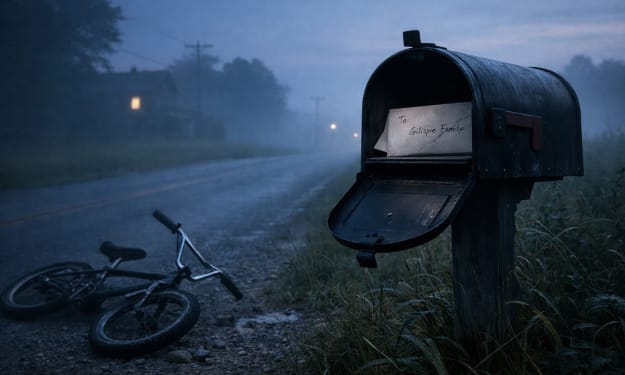
There are some names that stay with you... When I was a kid, I had a best friend who lived one block from my house. His mother’s name was Mary. Their last name was Gillispie. I never thought twice about it. It was just the name on the mailbox. Just the woman who waved from the porch when we rode our bikes past her house in the late afternoon light.
By Veil of Shadowsabout 24 hours ago in Horror



Comments (1)
Great thriller story. The Horror of the Keebler elves it seems to me.