
The Circleville Letters - The Town That Was Watched
Freaky Friday Edition

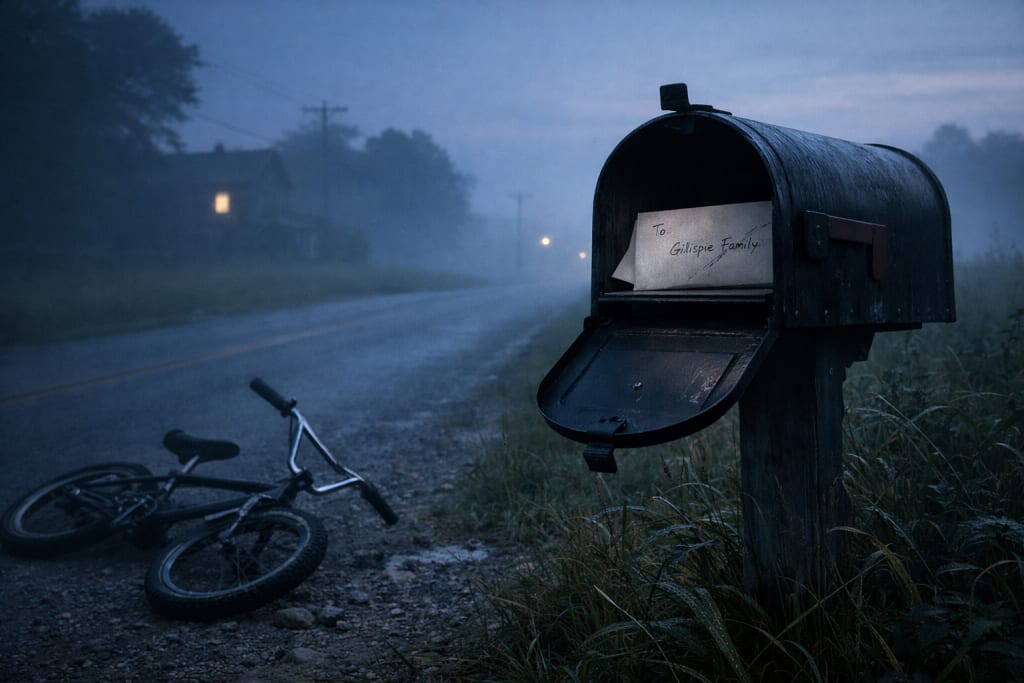
There are some names that stay with you... When I was a kid, I had a best friend who lived one block from my house. His mother’s name was Mary. Their last name was Gillispie. I never thought twice about it. It was just the name on the mailbox. Just the woman who waved from the porch when we rode our bikes past her house in the late afternoon light.
Years later, I would see that same name in a very different context. Not on a suburban street. Not attached to childhood memories. But in connection with one of the strangest, most unsettling harassment cases in American history.
In the mid-1970s, in the small rural town of Circleville, Ohio, anonymous letters began arriving in mailboxes. They were blunt, accusatory, and unnervingly specific. They accused local residents of affairs, secret relationships, and hidden behaviors. They referenced intimate details that were not common knowledge. They were unsigned, but the message was clear: someone in that town was watching.
One of the primary targets was a school bus driver named Mary Gillispie. The letters accused her of having an affair with the local superintendent. They were mailed not only to Mary but to her husband, Ron Gillispie. They threatened exposure. They promised that the alleged secret would be revealed publicly if the behavior did not stop. The tone was cold, self-assured, almost moralistic. The writer positioned themselves as someone correcting wrongdoing. Mary denied the allegations. Ron was furious.
At first, it seemed like an ugly, private matter being amplified by someone with too much time and too much spite. But the letters did not stop. They spread. Other residents began receiving them as well. The accusations varied, but the pattern was consistent: deeply personal knowledge, weaponized through ink and paper.
In 1977, the situation escalated beyond paper. Ron Gillispie received another letter. Accounts differ on exactly what it said, but it was serious enough that he left his house with a gun, reportedly intending to confront whoever he believed was responsible. That confrontation never happened. Instead, Ron died that night in what authorities ruled an alcohol-related car crash. Officially, it was an accident. Unofficially, many in Circleville were not convinced.
The letters continued after Ron’s death. If the suspected source of the harassment had been confronted and neutralized, why were the letters still arriving? Why did the tone remain the same? Why did the writer continue to reference details that seemed to require proximity? The tension simmered for years, but it boiled over again in 1983.
Mary Gillispie was driving her school bus route when she noticed a sign posted along the road. It accused her, again, of the same affair. Publicly. Bluntly. She stopped the bus, removed the sign, and took it with her. What she discovered next turned a campaign of harassment into something far darker.
The sign had been rigged with a gun. If she had pulled it differently, or with more force, the weapon could have discharged directly at her. The harassment had escalated from psychological torment to attempted murder.
The firearm was traced to Paul Freshour, Ron Gillispie’s brother-in-law. Freshour denied involvement. He maintained that he had nothing to do with the sign, nothing to do with the letters, nothing to do with the campaign that had consumed the town for years.
He was arrested, tried, and ultimately convicted for the booby trap. The prosecution argued that he was also the anonymous letter writer. They pointed to similarities in handwriting. They pointed to an opportunity. They pointed to a motive rooted in family conflict.
Paul Freshour went to prison. The case, on paper, was closed. But the letters did not stop. While Freshour was incarcerated, new letters surfaced. Some were sent to investigators. Some were sent to Freshour himself. One reportedly mocked law enforcement for believing they had caught the right person. The implication was chilling: either a copycat had emerged, or the original writer had never been caught.
Handwriting analysis suggested similarities between the letters and Freshour’s writing. But handwriting analysis is not infallible. Critics of the conviction argued that the evidence was circumstantial. That the case was built more on suspicion and family tension than on airtight proof.
Circleville, meanwhile, had changed. It is one thing to read about anonymous letters in a large city. It is another to imagine them arriving in a town small enough that you recognize most of the names on the mailboxes. The letters did not simply accuse. They implied surveillance. They implied someone who knew schedules, routines, and secrets whispered behind closed doors.
They created a climate of suspicion. When something breaks in a large city, it is an isolated event. When something breaks in a small town, it ripples. It changes how people look at one another in the grocery store. It alters how long they linger at the mailbox before bringing in the day’s delivery.
The Circleville Letters stretched on for decades. Some estimates suggest hundreds were sent. Many were destroyed by recipients who wanted no part of the spectacle. Others were preserved as evidence, fragments of a psychological war waged through envelopes and stamps.
Paul Freshour was eventually released from prison after serving time for the booby trap conviction. He continued to deny being the mastermind behind the letters. Supporters argue that the true author was never identified. Skeptics maintain that the simplest explanation remains the most likely: that the harassment was the work of one obsessive individual whose resentment spiraled out of control. But there are still inconsistencies that linger.
How did the writer obtain such intimate information about multiple families? Were some accusations based on rumor, or were they based on observation? Did more than one person contribute to the letters over time? Was it possible that someone inside the community, someone trusted, was feeding information to the author?
There is no confirmed grand conspiracy. There is no official second suspect. There is only ambiguity. And ambiguity, in a case like this, is fertile ground for dread. Because the real terror of the Circleville Letters was not the gun hidden behind a roadside sign. It was not even the fatal crash on a dark Ohio road.
It was the knowledge that someone, somewhere, was paying attention. Paying attention to who visited whom. Paying attention to who worked late. Paying attention to whispers.
It is easy to dismiss anonymous letters as the product of a troubled mind. It is harder to dismiss the impact they had. A marriage fractured under accusation. A man died in the middle of a confrontation that never reached its target. A family was torn apart by suspicion. A community was forced to wonder which of their neighbors might be watching from behind drawn curtains.
There is something uniquely invasive about a written accusation. Unlike a rumor spoken in passing, a letter can be held. Re-read. Studied. The words do not fade with the sound of a voice. They sit on the kitchen table. They wait on the counter. They can be tucked into a drawer and rediscovered years later.
In Circleville, the letters became a kind of shadow presence. They were not visible in the daylight streets or in the fields surrounding the town, but they shaped behavior all the same. They turned ordinary mailboxes into potential points of threat.
Even today, the identity of the Circleville letter writer remains debated. Some believe the case was effectively solved. Others insist that the wrong person took the fall. There are no dramatic confessions. No hidden journals were discovered decades later. No final revelation tying every thread neatly together. Just paper. Just ink. Just the uneasy feeling that someone knew too much.
When I think back to that childhood street, to the mailbox with the name Gillispie printed on it, I remember how ordinary it felt. How harmless. A name is just a name. A street is just a street. A town is just a collection of houses, roads, and people trying to get through their days. Until something changes. Until a letter arrives that suggests you are not as unseen as you thought.
Circleville still receives mail. The town still exists. The roads are still there. But the story lingers because it taps into something fundamental and uncomfortable: the fear that someone close enough to know you might also be close enough to harm you.
Not with claws. Not with shadows. But with information. And sometimes... that is more than enough.
About the Creator
Veil of Shadows
Ghost towns, lost agents, unsolved vanishings, and whispers from the dark. New anomalies every Monday and Friday. The veil is thinner than you think....
Keep reading
More stories from Veil of Shadows and writers in Horror and other communities.


Comments
There are no comments for this story
Be the first to respond and start the conversation.