

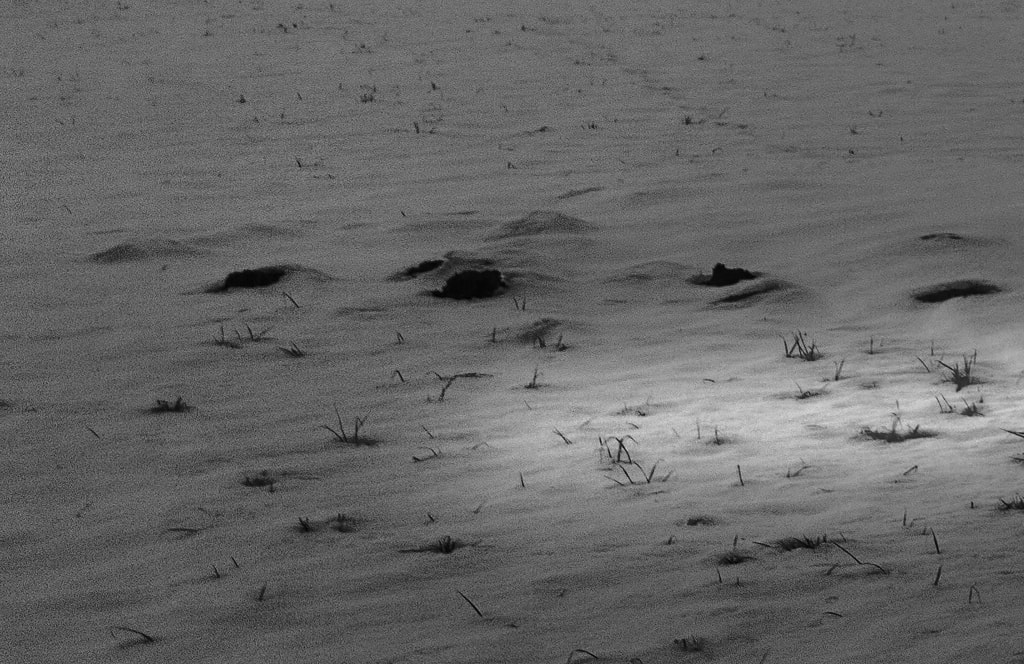
Highway 90 Red
Rosalyn shut her notebook and looked up at the red spots on her t-shirt reflected in the glass of the window. It’s done, she thought before immediately reopening the notebook, crossing out some lines and scribbling others, then finally shutting it again and exhaling as she pushed it away. “Now it’s done.”
She spent the next few hours typing up the mystery novella she had scratched into the pages of her trusty black book as the rain battered her window and the sky lightened to the deep gray of early morning. Rosalyn was a fast typer, but she had always preferred writing her stories by hand because she liked to be able to see her thoughts play out in real time, and because she knew that she was too impulsive to be trusted with the “delete” button.
Eventually, the story was typed up and she spent a few days editing before uploading it to her writing blog. Prior to this, Rosalyn had had a modest number of fans, somewhere in the mid hundreds, but within hours of posting this story online the number of people reading her work skyrocketed into the thousands. Not long after, she was contacted by a publisher who wanted to put her words to paper, or rather back to paper, and send them into the world of physical bookstores. Publicity events followed, then awards, then literary fame. In public, Rosalyn revelled in her success, but during the late hours she spent alone in hotel rooms on the publicity tours, she would often brood about how it had been this story that had brought her here. She hadn’t been immediately sure she had even wanted to share it because it was darker, grittier, and bloodier than her previous work. It didn’t even really sound like her voice.
Stranger still, though, was the response that the public had had to it. They loved it. They relished it. They admired her penchant for detail in describing the gruesome murder, every stab in a circular pattern in the victim’s belly and the smaller cuts that had preceded it. Indeed, she could see the event so clearly, could smell the night air and the blood as if it was actually smeared across her face and hands and dotting the snow all around her.
Her success had afforded her a new house with bigger windows to stare out of as she pondered over the empty pages of a new little black notebook. She had furnished her living room in shades of red, the dark red couch being the place where she most liked to write, but curiously, she hadn’t been able to scribble even a word since finishing her last book. Curled into her red sofa, she glared at the blank pages of the notebook, then heard a faint knocking at her door.
“Police!” She heard from the other side as she dropped the notebook onto the coffee table.
“Is everything okay?” She asked as she opened the door.
“Are you Rosalyn Rogers?” The officers looked very severe, one young man with dark hair and one older woman both in uniform and thick coats.
“That’s my pseudonym for writing.” Rosalyn managed. “Not my real name, but well yes, that’s me.”
“We would like to speak to you about your book, may we come in?” The man asked and Rosalyn stepped back.
“Of course,” she said as she hurried into the living room. “Can I get you tea or coffee or anything?”
“No, thanks.” The male officer replied as they sat down on burgundy chairs in the living room.
Rosalyn followed suit, sinking into the cushions of her red sofa as her shoulders seemed to turn to stone. “What do you want to know about the book?” She asked.
“Where were you on the night of January twelfth, 2016?” The older woman officer, who had been silent until now, asked.
Rosalyn thought for a moment before responding, “Well, I can’t really say where I was on that exact day,” she paused. “But I was living in Issaquah, Washington, with my parents.”
“Try to remember what happened on that exact day,” the same officer asked and Rosalyn detected an accusatory tone.
“Did something happen?” She responded.
“I don’t know, did it?” The woman officer asked before the younger one cut in.
“Your book, Ms. Rogers, resembles the details of a crime that took place on that day in North Bend, Washington. In fact, your book perfectly describes to the most minute detail every single bit of evidence we have on that case, every single injury recorded in the autopsy from the cause of death to the smallest incision on the torso. Can you explain to us why you know so much about this case?”
Rosalyn froze for a moment before letting out a small laugh that caused the woman officer to scrunch her nose and lower her brows.
“Is this funny to you?” She growled.
“No!” Rosalyn straightened up and brought her face back to neutral. “No, of course not, it’s just that I don’t know what you’re talking about. I don’t know anything about a real murder, it must be a coincedence.”
“A coincidence?” Started the woman officer. “A coincidence that you wrote that the victim was found with twenty thousand dollars stuffed in increments of one thousand sewn into the lining of his coat? A coincidence that you wrote that the victim had been found with a hunting rifle near the highway? A coincidence, Ms. Rogers, that you wrote the exact right color of clothing the victim was wearing, the exact amount of money found on his person, the exact area of his discovery, and the exact injuries he had received that had caused his death?”
Rosalyn stumbled over what to say, landing on, “I really don’t know.”
“Tell us what you were doing that night,” the officer demanded.
Rosalyn thought back to that year, to Issaquah in mid-January. It had likely been raining or snowing. “What day of the week was it?” She asked.
“Saturday between the hours of 9pm and 2am,” the male officer stated.
“Well, it was Saturday night, so I was probably out. I was probably…” She paused and her heart seemed to jump as she remembered. “I, actually, I was really into Twin Peaks back then, David Lynch and all.”
The officers stared at her.
“I think that might’ve been the day I drove up to that diner that was in the show, you know? Double R? Cherry pie?” She said, realizing the location of the diner as she spoke.
“That diner is in North Bend, Washington, Ms. Rogers,” the younger officer replied.
Rosalyn froze and her guests watched her, then Rosalyn’s gaze dropped to their name tags. Rodriguez and Jones. Jones was the older woman who stared at her with eyes like headlights.
Rosalyn shuddered then broke the silence. “Look, I was just going up there to see the diner and take some pictures, that’s all. Nothing out of the ordinary happened.”
Rodriguez leaned towards her. “You wrote in your book that the victim had a wife and son, and that they had been in on the illegal activities that the victim had perpetrated during his life.”
“Well, yeah, did the real victim have a family?” Rosalyn questioned.
“He did. A wife and son,” Rodriguez replied.
Rosalyn let out a cynical chuckle. “And did he actually run a torture game on his property in which he kidnapped people who sometimes escaped, before he’d hunt them down?”
The officers eyed her silently.
“And did he get his victims by pretending to need a ride because his car broke down on the side of Highway 90, like in the story?” She continued.
“Yes,” Jones replied.
“Was he found with stab wounds in his abdomen in the shape of a crosshair?”
“Yes,” Jones repeated.
Rosalyn’s blood seemed to pulse faster and she continued in rapid succession, “Did he have a gray beard and dark hair? Was his coat red but not red like spilled blood more like a brilliant red, like the red of a curtain at a theater? And didn’t that seem weird that a hunter wore a bright red coat to go hunting, or did it make sense because he wanted to be seen by his prey? And were deer antlers found next to his head where he lay…”
The officers looked at her with narrowed eyes that drifted upwards as she trailed off. Rosalyn followed their gaze to where a deer’s head hung on the wall above the sofa she was sitting on. Its antlers were missing and had instead been replaced by a bouquet of dried flowers on either side.
“I think you should come with us, Ms. Rogers,” Rodriguez stated as he stood up.
“No, I… I mean, I didn’t do it. I just wrote the story–it’s fiction!” Rosalyn urged, rising with the officers.
“Yeah, it’s fiction. Come with us and we’ll sort it all out,” Rodriguez continued.
Rosalyn followed him as Jones trailed behind with a darkened expression. As they reached the doorway, Rosalyn pulled her coat from its hook and put it on. It was bright red, and it was lumpy. She smoothed her hands down the sides of it and felt that the lumps were solid and cylindrical. Rodriguez looked at her and she stared back as she pulled at the thread near one of the lumps inside of the coat and a wad of fifty dollar bills dropped to the floor with a dull thud. Rosalyn’s heart seemed to follow the money to the floor as the three figures stared at each other in hollowed silence in the entryway.
Rosalyn murmured, “The coat, it would’ve been with the victim right? You would’ve kept it as evidence…”
“Yeah,” Jones growled. “We would have, if we had found the coat.”
Rosalyn’s eyes darted up to the officers and Rodriguez spoke.
“The coat was described to us by the victim’s wife, who said that he used to sew his money into the linings of his jackets so that he’d always have cash in case he needed to make a quick getaway. She said he left wearing the red one on the day that he was murdered.”
Rosalyn’s hands shook as she reached for another lump in the jacket and pulled the corresponding thread. “He was hunting,” she murmured and another wad of cash hit the floor.
“He was,” Jones returned.
“He tried to get me,” Rosalyn said, moreso recounting the story she had written than the actual memory. “I had stopped to help him and he tried to kidnap me, but I escaped.”
“Why didn’t you go to the police?” Rodriguez asked, as Jones straightened her stature behind Rosalyn.
Rosalyn considered this as her gaze landed on Rodriquez’s badge. “He was rich,” she said.
“You blackmailed him,” Rodriquez reached around his belt as Jones placed her hand on a gun holstered to her hip. “You blackmailed him and you didn’t report him.”
“I wanted the money,” Rosalyn felt like it wasn’t she who was talking now but the protagonist of her book instead. “But after a while I wanted something more, I wanted the story.” She paused before looking up at Rodriguez’s face. “But you’re not the police, because the police never found the body.”
She turned and elbowed Rodriquez into the wall, pushing past him and out of the open door and into the snow. She ran, pulling at threads in her jacket as she stomped through the frigid front yard, dropping wads of fifty dollar bills in a path as she went. A shot rang out through the night and the red jacket she wore turned to a darker shade, matching the snow around her. As she lay still and her eyes focused on blood dripping through the ice, she wondered if she had already written this into the little black notebook on her coffee table.
About the Creator
Laura Aitken
Writer, fine artist, and photographer from California.
Keep reading
More stories from writers in Horror and other communities.
Killing him slowly
There’s an intruder in my house again. He stumbles through the door, wet carrier bags in hand. He’s bought me offerings. I show my appreciation, letting him caress my beautiful body. He wants to touch me. I rub myself against his legs. He sighs, dropping the bags. He can’t resist touching me. Running his hand slowly down my spine, I arch my back towards his caress, let out a low purr. It’s what we both need.
By N J Delmas2 days ago in Horror



Comments
There are no comments for this story
Be the first to respond and start the conversation.