

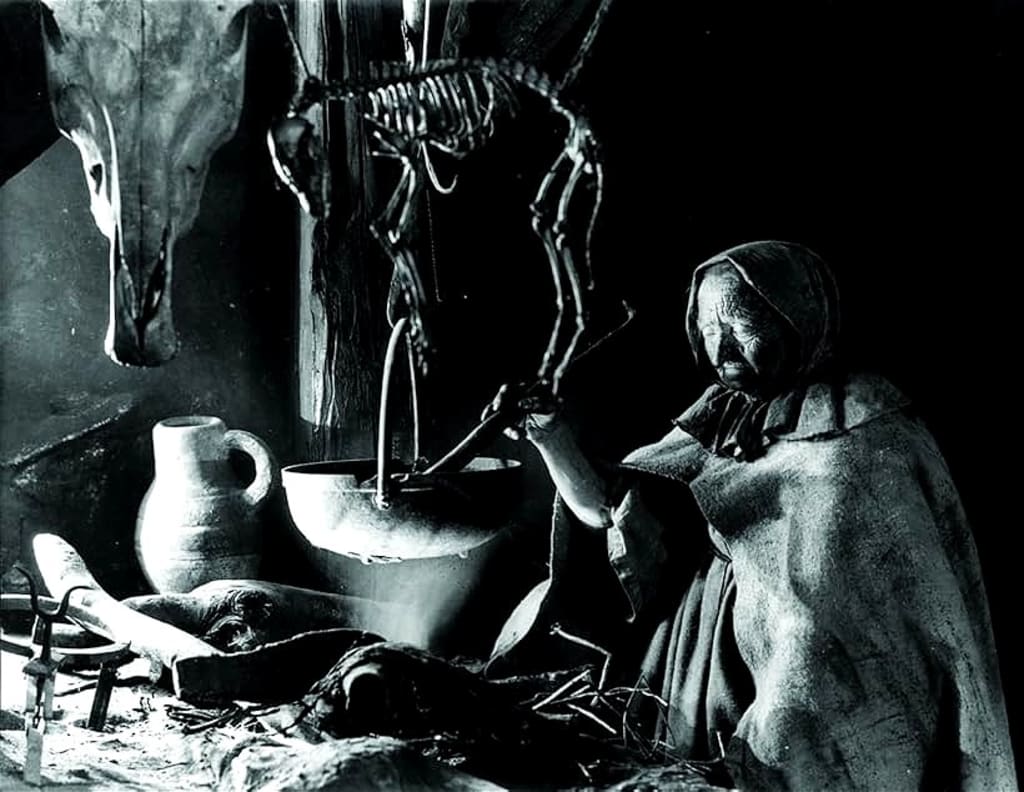
“Lock them out and bar the door!” – William S. Burroughs
The world was once a place where witches rode brooms through the midnight air—on the eve of May—to meet the Devil at the Brocken, the highest peak, the pointed aerie from which the demonic revels would commence. One night only. The veil between worlds at its thinnest. The ancient spirits of evil would rise, leading a bacchanal of crones and harlots, spinning wild and unhinged around the ceremonial fire, around the bubbling cauldron of molten potentialities—the accursed cosmic soup from which all forms of malevolence and earthly desire might spring forth.
Summer would come, but first: the rite. Black, vile, obscene. A blasphemous affront to the Hebrew God. The Devil’s minions poured into the night to welcome their Lord. And as William S. Burroughs so rightly muttered in his nasal narration to Häxan: “Kiss his ass.” The osculum infame. The Kiss of Shame.
In the Tarot, the fifteenth trump shows the Devil squatting above two chained souls. Are they bound by force… or by longing?
Witchcraft Through the Ages—originally released in 1922—is a fevered pseudo-documentary, a cinematic grimoire conjured by Benjamin Christensen. It begins with stiff tableaux, the kind you'd find on a dusty museum diorama, but quickly dissolves into a hallucinogenic descent into occult delirium. This is not history—it is myth bled raw.
Our tale begins with a trio of peasants carefully unwrapping a mummified hand—a Hand of Glory—believed to grant dark powers to thieves and witches alike. From there, we slip into the first of many vignettes: a woman’s fantasy of seducing a rotund monk, his jowls jiggling with gluttony and lust, the scene played for a touch of comic relief. But the laughter curdles quickly.
We descend into the dreams—the fevered visions—of a sleeping woman. In the flickering darkness, a particularly nasty devil comes rapping at her shutters. He slips in, steals her soul as she sleeps, and drags her through the air, across the rooftops, straight to Hell. There, she watches in frozen horror as he churns butter in a fashion most... suggestive.
Gold coins—the filthy lucre of her fevered avarice—rain down from clawed, demonic hands. We soar through the skies with witches, streaking across the blackened night on broomsticks slick with flying ointment—those potion-slathered rods so blatantly, so obscenely suggestive of the forbidden phallus of the Master of Sin.
The Devils here are real. Forked tongues, curling horns, cloven hooves, and the hairy, heaving bodies of medieval nightmares. Pagan dances erupt around the fire—satanic priests writhing in ecstasy—as if the film itself could not contain their howls. A silent movie, yes, but one that screams with the wild, unspoken noise of the damned.
The hysterical sisters—dragged down to the gutter of demonic possession—laugh and shriek in mania, their bodies wracked by the icy fingers of Asmodeus and Ashtaroth. Their twisted convulsions, their wild-eyed howling, calls to mind The Devils of Ken Russell—though that particular desecration of church and flesh would not erupt onto screens for nearly fifty years.
Then, a detour into sickness disguised as righteousness—a history lesson scrawled in blood and fire. The tortures of the Inquisition. The madness of holy men. We see an innocent woman, broken under interrogation, bound hand and foot, and hurled into a river. If she floats, of course—she’s a witch. She’ll be burned. If she sinks and drowns? God be praised. No devilry here. Just death. Just madness.
Women wake from slumber, embracing their demon lovers, recalling that line from Coleridge’s "Kubla Khan"—women wailing for their demon-lover. They rise in astral form, leaving flesh behind. Here, all the old folktales and midnight fantasies come alive again, dancing ‘round the fire on May Eve, offering babies’ blood, baptized in fire and frost, in the living ichor and burning sulphur of pitiless Hell—Hell unleashed upon the earth.
This film was directed by Benjamin Christensen. But what does it matter? It might as well have been birthed from the infernal womb of the blackest, most batrachian bogie ever loosed upon this night of nights—when the veil is thin, paper-thin, and flutters.
Witchcraft Through the Ages begins as a tedious parade of cardboard exposition. But it ends at the unpearly gates, with snake-tounged imps and fallen angels riding through the darkness, witch-lips pressed lovingly to their scaly backsides.
And make no mistake—it is never anything less than a spell being cast.
Can you hear them? Scratching outside, in the dirt. They want in.
Won’t you let them?
As the infernally nasal William S. Burroughs hisses at the beginning:
“Lock them out and bar the door!”
With my personal score:
Häxan: Witchcraft Through the Ages (1922) I Silent Horror Film
Connect with me on Facebook
My book: Cult Films and Midnight Movies: From High Art to Low Trash Volume 1.
Ebook
About the Creator
Tom Baker
Author of Haunted Indianapolis, Indiana Ghost Folklore, Midwest Maniacs, Midwest UFOs and Beyond, Scary Urban Legends, 50 Famous Fables and Folk Tales, and Notorious Crimes of the Upper Midwest.: http://tombakerbooks.weebly.com


Comments (1)
Maybe, but not tonight. I don't have it left in me.