
Ghost Palace Hotel Bali: Haunted History of Bedugul’s Abandoned Resort
The Dark Legacy of Ghost Palace Hotel – Voices in the Mist, Vanished Guests, and a Billionaire’s Curse
A Monument to Corruption: The Tragic History of the Hotel
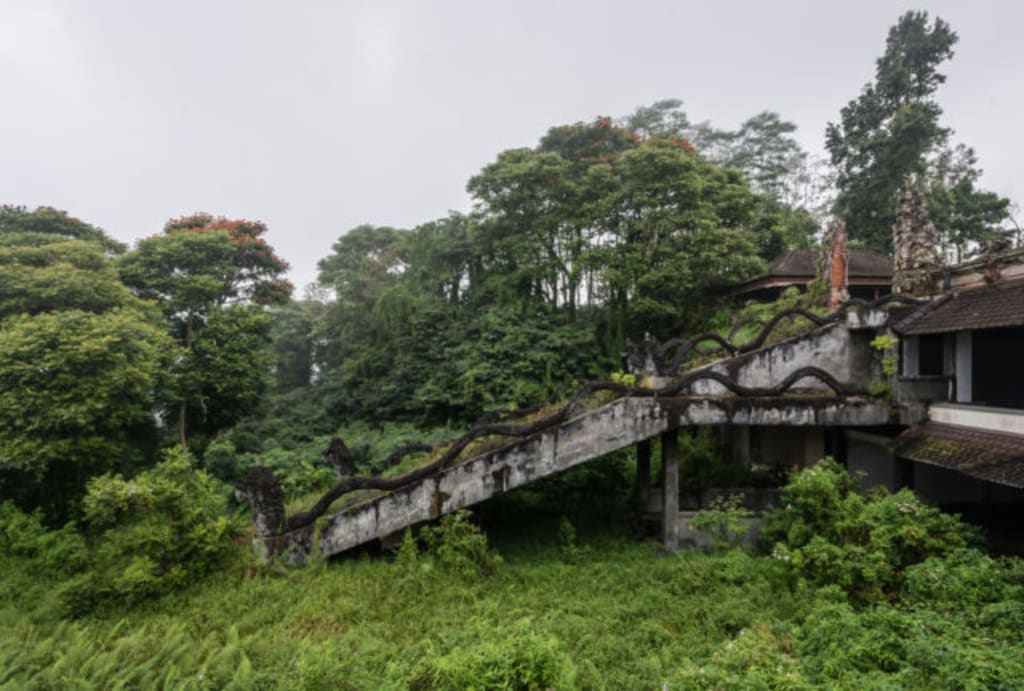
Perched above the foggy highlands of Bedugul, the Ghost Palace Hotel (officially PI Bedugul Taman Rekreasi Hotel & Resort) is a decaying monument to greed, political corruption, and ghostly legend. It began in the early 1990s as a side project of Indonesia's then-authoritarian leader President Suharto's youngest son, Tommy Suharto. Thought out as a high-end retreat overlooking Lake Buyan, the hotel was showy Balinese in design: stairways lined by snakes, marble floors, and balconies with floor-to-ceiling windows overlooking sensational views of volcanic peaks and rice paddy fields.
Construction was halted in 2002 when Tommy was imprisoned for masterminding the murder of Supreme Court Justice Syafiuddin Kartasasmita—the judge who had put him in jail for a land scam worth $11 million. Tommy's "prison sentence" was a national scandal; he spent time in a high-tech cell with televisions and laptops, often seen playing golf in Jakarta while the deserted project rusted away. Funding disappeared, employees abandoned the site, and the unfinished resort fell to the relentless jungle of Bali. The local population saw the collapse as karmic retribution for Suharto-family corruption, some muttering the land itself was cursed.
Ghostly Legends: Worker Fatalities to Unholy Curses
The physical decline of the hotel led to a rich harvest of ghost tales, inaccessibility aided by Bedugul's cold, foggy remoteness:
Spirits of the Oppressed: The most common story asserts that construction workers perished under brutal circumstances—through accidents, overwork, or alleged negligence. Their agitated spirits haunt the halls, bitter about the high-class retreat they were dying to build. Balinese drivers and security guards commonly refuse to go in, dreading possession or remaining "bad energy.".
The Curse of Suharto: Tommy's corruption stirred an otherworldly vengeance, everyone believes. The collapse of the hotel and news of investors lost and financial ruin are blamed on evil forces stirred up by his corruption. The narrative is combined with Balinese niskala (the invisible world), where moral wrongdoing courts spiritual vengeance.
Overnight Disappearance: Another myth sensationalized on the hotel's brief operation before the mysterious disappearance of guests and personnel in a single night, only to leave behind spirits. Unchecked by time, this tale still lends to the site's horrific fame.
Chilling Evidence: Bereft of material proof, decades of guest reports create a uniform picture of paranormal activity:
Disembodied Voices and Shadow People: Witnesses from Australia in 2025 claimed to get a clear voice answer when they yelled out in an empty staircase. The environment simultaneously chilled to near-freezing, and they snapped a hazy photo of a shadowy human with arms raised at the foot of the stairs. Others claim to be chased or stalked by shadowy figures flitting on the periphery of vision.
Electromagnetic Interference: Defective cameras, inexplicably dead cell phone batteries, and capriciously flashing flashlights are among the most frequent complaints. One traveler's camera "started taking pictures on its own," and some reported hearing the voices of individuals they knew reverberating back like their drivers—only to find them sitting outside in one piece.
Physical Effects: Seeing of cold spots immediately, feeling of fear while walking into some rooms (most prominently the cellar filled with mud), and touching is common. One of the guests admitted to having run out of some rooms after feeling a "thud in [their] heart" and standing hairs.
Animal Anomalies: On top of the expected spiders and lizards, explorers report overly large snakes showing up in hallways and birds stopping noise where they are near the building—this one regarded by some as nature's rejection of the site's energy.
The Hotel Today: Dark Tourism and Eerie Grandeur
Over two decades of neglect have transformed the resort into a surreal fusion of luxury and decay. Vines strangle balconies, moss carpets tiled floors like emerald velvet, and tropical fauna (including frogs, snakes, and fist-sized spiders) infest crumbling suites. Despite "No Entry" signs, a security guard (often present) typically accepts 10,000–100,000 IDR (~$0.70–$7 USD) for access, reflecting the site’s uneasy status as Bali’s premier destination for dark tourism.
Innards feature graffiti-adorned walls, old rusty bathtubs, and trash-filled corridors that increase feelings of discomfort. The intimidating split gate staircase with stone serpent balustrades—that is jungle-shrouded today—is still a popular photo stop, representing the now-lost glory of the hotel. Small offerings (canang sari) deposited by Balinese visitors beside openings to pacify the spirits culturalize tourism with spirituality.
Why the Legends Live On: Stuck Between History and Belief
The Ghost Palace's spectral image persists not only in oral testimony, but through the symbolic potency of its imagery. It stands for:
Political Trauma: A tangible marker of Suharto-era corruption and impunity.
Cultural Resonance: Balinese Hinduism accepts spirit worlds (bhur), so tales of ghost workers are believable to locals.
Sensory Triggers: The isolation of the site, perpetual fog, and jungle sounds create naturally ominous environments where the imagination runs wild.
As one visitor poignantly noted: "It’s not about ‘seeing’ a ghost. It’s the weight of knowing what happened here". Whether a monument to human failings or a true haunted palace, this spectral ruin remains Bali’s most captivatingly macabre landmark—a place where history’s shadows feel unnervingly alive.
About the Creator
Kyrol Mojikal
"Believe in the magic within you, for you are extraordinary."
Keep reading
More stories from Kyrol Mojikal and writers in Horror and other communities.
The Cursed Five-Storey Mansion: Unmasking Penang's Shih Chung School Hauntings
Shih Chung Branch School's destroyed hulk rests like a shattered monument along Northam Road, George Town, Penang—a faded silhouette against steel skyscrapers, where colonial bricks are smothered by vines and shadows cling with an unnatural stubbornness. To locals who park their cars to eat dim sum at Fu Er Dai, it's a run-down eyesore. To ghost hunters and historians, it's Malaysia's most haunted site, where 130 years of glory, revolution, and unimaginable tragedy have made their indelible mark on recollections even time can't wipe away.
By Kyrol Mojikal8 months ago in Horror
The Night We Should Never Have Stayed
In the summer of 2019, five friends from a nearby city decided to take a weekend break from their busy lives and go camping in a remote forest area known locally as Pine Ridge, a place famous for its beautiful landscapes and hiking trails but also whispered about in strange local stories that many people dismissed as exaggerated campfire tales. The group had known each other since college and had taken several trips together before, so they were confident that a simple camping adventure would be the perfect way to relax and reconnect with nature after months of stressful work schedules and daily responsibilities.
By The Curious Writer3 days ago in Horror


Comments
There are no comments for this story
Be the first to respond and start the conversation.