
Defending the world,Soviet soldier
Cold War Hero Story

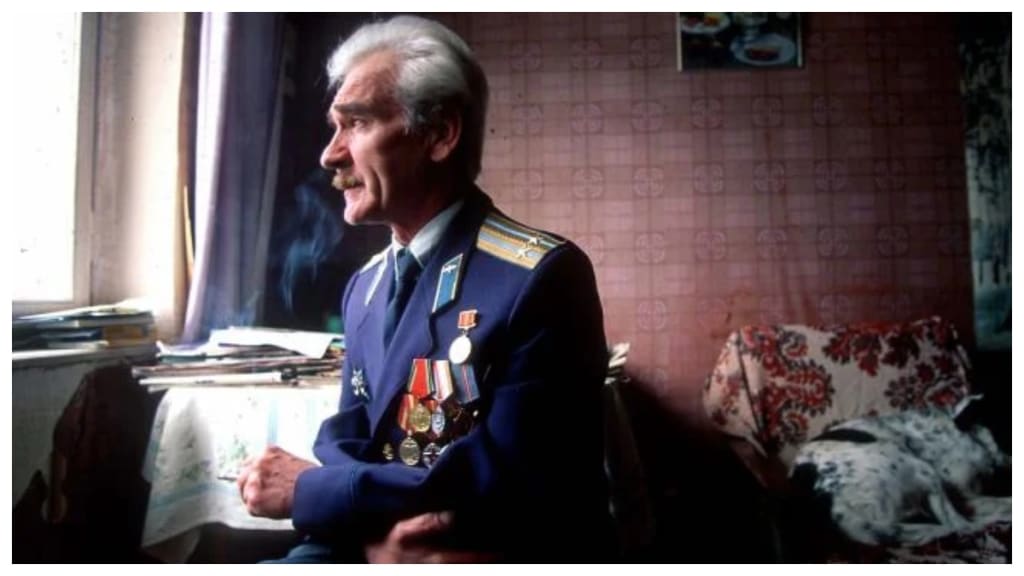
The Soviet Union's early-warning missile detection technology came to life on the evening of September 26, 1983, at the height of the Cold War. The worst-case scenario was that the Soviet Union's biggest adversary, the United States, had initiated a direct nuclear strike and missiles were on route.
The satellite detection system, called Oko, was installed in the Soviet Serpukhov-15 bunker, and the man on duty there was Stanislav Petrov. As he processed the machine's data, a post-apocalyptic image appeared to him. It seemed as if American nuclear warheads were speeding through the sky, blazing a course for impending devastation.
Petrov was now in charge of informing his superiors of the situation. In this case, the Soviets would retaliate with an instant volley of nuclear missiles, starting a full-scale nuclear war.
In 1972, Petrov enlisted in the Soviet Air Defense Forces as an engineer and rose to the rank of lieutenant colonel after completing his studies at the Kiev Higher Engineering Radio-Technical College.
Working with early warning systems designed to identify potential missile assaults from the US and other NATO nations, Petrov was educated to comprehend data and systems as part of his job.
Petrov was tasked with overseeing the command center for the new Soviet early warning system, Oko, by 1983, during the height of the Cold War.
With the relationship between the US and the USSR at its most vulnerable and unstable point, the early 1980s were a particularly difficult time in the Cold War.
Under President Ronald Reagan, the United States increased its military might and presence in Europe, reflecting the Soviet Union's intense mistrust of the US-led West under Yuri Andropov.
The Soviet Union was prepared for full-scale retaliation and was ready to respond at any time by 1983, when it was actively anticipating an attack from the United States. In accordance with the theory of mutually assured destruction, it has also made significant investments in early-warning systems such as Oko, which are intended to identify approaching missiles as soon as possible and provide a limited window for response.
The Cold War's hair-trigger character was highlighted by the escalating tensions, which saw both sides' suspicions rise to unprecedented heights while peace was precariously balanced.
When the Oko system gave its apocalyptic warning just after midnight on September 26, 1983, Stanislav Petrov, the officer on duty in the Serpukhov-15 bunker, was the first to analyze it. It was evident from Oko's data that the United States had fired five intercontinental ballistic missiles toward the Soviet Union.
According to the "launch on warning" policy in place at the time, Petrov's superiors would have most likely authorized a retaliatory strike if he had not reported the detection as a confirmed attack to them right away, as required by the following step of procedure.
Rather, Petrov waited at that crucial time. His next action would determine the destiny of mankind.
Two misgivings drove Petrov to respond cautiously, aware of the possible consequences of revealing that an approaching attack had been spotted. He first questioned the Oko system's report since he was aware that it was new and had not been tested much. Second, he could not understand why the United States would launch a first attack with just five missiles instead of thousands.
Petrov thus reasoned that the warning was probably a false positive, which went against official procedure. He decided against reporting it as an imminent assault.
His choice could have prevented a possible nuclear catastrophe and all of its terrible, unthinkable repercussions. The conclusion may have been drastically different and mankind could have been pushed over the nuclear brink on any other day, if any other commander had been in charge.
Ultimately, Petrov believed that the US attack was a misinterpretation of the Oko system. When sunlight passed through high-altitude clouds, it was an extraordinary phenomena that the early warning system had misinterpreted.
Petrov was not compensated for his activities since doing so would have required him to acknowledge the shortcomings of the Soviet system. Rather, the whole situation was classified, and he was questioned and chastised for not following protocol when completing papers.
References
https://en.wikipedia.org/wiki/Stanislav_Petrov
https://www.historyextra.com/period/cold-war/stanislav-petrov-soviet-soldier-saved-the-world/
About the Creator
"Scream 7" (2026): Running out of Fresh Screams
This is the seventh time we’ve had a Ghostface crisis. Scream 7 is the latest edition of the Scream franchise. Sydney Prescott and her family are under attack by another anonymous killer dressed in a Ghostface costume. While having issues with her daughter, Tatum, they run from the bloody murders, trying to determine who is behind it all.
By Marielle Sabbag8 days ago in Horror
The BAFTA Awards
By now, in a stunning departure from recent years, most of the world is aware of what happened at the BAFTA film awards. Social Media Headlines will tell you the bare bones: that John Davidson, a Tourette's Syndrome advocate, shouted a racial slur at two Actors of Colour, Michael B Jordan and Delroy Lindo.
By Natasja Rose5 days ago in Psyche




Comments
There are no comments for this story
Be the first to respond and start the conversation.