


Come Play, based on the viral short film “Larry” (link at the bottom), is about a nonverbal autistic boy named Oliver (Azhy Robertson). When Oliver reads a mysterious picture book that randomly pops up on his iPad, he learns about Larry, a tall, pale, otherworldly being who just wants a friend. But when Larry starts to wreak havoc in the real world, Oliver’s already struggling mother (Gillian Jacobs) finds herself helpless to protect her son.
For those who do not know, I am actually on the autism spectrum, and I saw the movie with a friend who is also autistic. While neither of us is nonverbal like Oliver, both of us were interested in seeing how the movie would portray said disability. Since autism is a spectrum, it takes many forms, and portraying it in films has had mixed results; for every good one, there’s a really awkward and offensive one. At the same time, I’m a sucker for a good, old fashioned monster movie, and Come Play looked like it had a great monster.
While there are a few notable flaws, this is a surprisingly layered film. There’s a scene at the beginning where Oliver is scared that a monster is trying to get into his room. Every sound effect in this scene is a bit louder than normal, which isn’t all that uncommon in modern horror movies, but here, it serves a greater purpose. A lot of times, especially in situations of distress, autistic people will hyperfixate on the offending sensations. When Oliver is hearing scary noises, it makes sense that they would be particularly loud. If this was intentional, and I’m assuming it was, it’s a fantastic touch. Actually, the movie handles the subject of autism quite well. Azhy Robertson is truly remarkable here. Like I said, there have been some pretty cringey depictions of autistic people in movies and television, so it’s a bit of a gamble. While I know that it made a lot of people uncomfortable, I really think the movie Tropic Thunder parodied such onscreen portrayals of disabled people incredibly well with Simple Jack, the fictional Oscar-bait film that nearly ruined one of the main characters’ careers. Robertson’s performance never felt over-the-top or comical, and for a child to pull that off was pretty amazing. The movie also addresses stimming, which refers to a particular physical tick that helps an autistic person relax or cope when uncomfortable. While this is depicted fairly often, you don’t see it actually named and discussed too much, so that was nice to see. Apparently, writer/director Jacob Chase’s wife works with autistic kids, leading to him feeling a kinship with the community, and the viewer can really tell how much care and passion went into that aspect of the movie.
Gillian Jacobs, whom I know from Dan Harmon’s “Community”, really impressed me in the film. I had never seen her play a dramatic role before, so getting to watch her branch out a bit more was pretty cool. There are also some kids in the film that bully Oliver, and just how much I wanted to see Larry kill them is actually quite a testament to how well they acted their respective roles.
When I first saw the trailer, I immediately loved Larry’s design; tall, skeletal, pale, just plain creepy. It totally lived up to my expectations. The scariest thing about him is the creaking sounds his body makes while he’s moving. It’s so ominous and unsettling. There’s a moment during the major third act confrontation in which he begins running like a spider, and that was downright terrifying. The film does feature plenty of jump scares, which I know a lot of people hate. But I didn’t feel like they were a crutch here. Chase is clearly aiming for classic haunted house thrills, and it definitely succeeds there.
The film does have some issues, and one is that it struggles with pacing. There are some times in which the movie seems to be stalling for time, and others in which it just throws random information at the audience. This does get a bit annoying when it happens, but the film manages to recover from those pitfalls each time. Probably the biggest thing holding the film back is its undeniable resemblance to The Babadook. Both feature a monster from a storybook, a little autistic boy, and an exasperated mother. The main problem with the two movies’ noticeable similarities is that The Babadook is a far superior film. However, Come Play does have a couple of advantages. For one, I think Larry is more threatening than the titular Babadook, despite being a bit less subtle. I also like the fact that Come Play draws more attention to Oliver’s autism. In The Babadook, the audience simply infers that Samuel is autistic based on his behavior. It doesn’t really discuss the issue in depth, which this film does. I feel like that does help give Come Play its own identity, to a degree.
Even though Come Play isn’t the most unique monster movie out there, it does have a lot to offer. The way it depicts and addresses autism is clever and refreshing, and this is greatly helped by an outstanding performance by Azhy Robertson. Larry is a fantastic monster, and this combined with some great sound design delivers plenty of thrills and chills.
SCORE: 4/5
(https://youtu.be/YIhjUUeL5j0)
About the Creator
Will Lasley
I’m an actor and director of stage and screen. But I also dabble in standup, and on this site, horror movie criticism. I’m just a guy who loves horror movies, and I like to share that love with the world.
Keep reading
More stories from Will Lasley and writers in Horror and other communities.
'Vampires vs. the Bronx' Movie Review
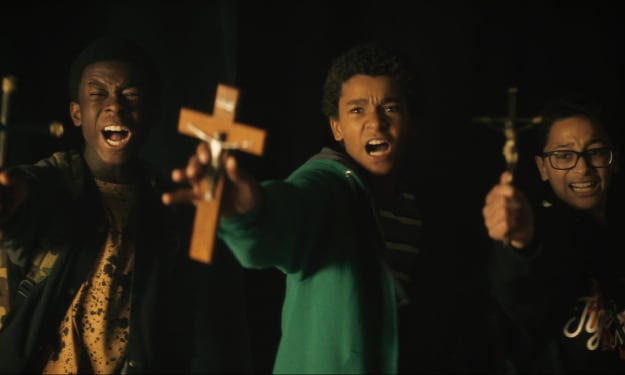
In this horror-comedy from SNL's Oz Rodriguez, three inner-city kids, Miguel (Jaden Michael), Bobby (Gerald W. Jones III), and Luis (Gregory Diaz IV), find out that a beloved bodega in their neighborhood is being forced to close, thanks to increasing gentrification. In order to save it, they organize a block party to raise money. But it turns out that the development company that's been "infecting" their neighborhood is run by vampires, and it's up to them to save it.
By Will Lasley5 years ago in Horror
"Scream 7" (2026): Running out of Fresh Screams
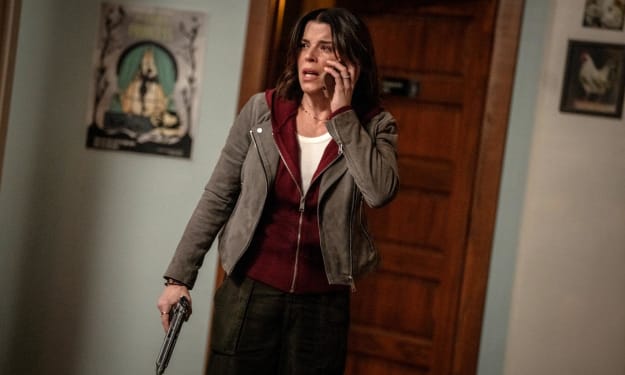
This is the seventh time we’ve had a Ghostface crisis. Scream 7 is the latest edition of the Scream franchise. Sydney Prescott and her family are under attack by another anonymous killer dressed in a Ghostface costume. While having issues with her daughter, Tatum, they run from the bloody murders, trying to determine who is behind it all.
By Marielle Sabbag4 days ago in Horror
No, The Mothman Isn’t an Alien
Commentary A Lot of Things to a Lot of People The legendary Mothman has been a lot of things to a lot of people. And, in many respects, his mostly complex and evolving legend as a mythological creature made him one of the most unique and fascinating beings of his kind. That is until somebody – possibly a blogger on a cryptid or paranormal site – began to speculate that the Mothman is actually an alien.
By Dean Traylor2 days ago in Horror
Review of 'Man on the Run'
My wife and I saw Man on the Run, a nearly 2-hour documentary on Amazon Prime, about Wings, Paul McCartney's group that flew around the world from shortly after The Beatles broke up in early 1970 to shortly after John Lennon was murdered at the end of 1980, making a Beatles reunion forever impossible.
By Paul Levinson5 days ago in Beat


Comments
There are no comments for this story
Be the first to respond and start the conversation.