
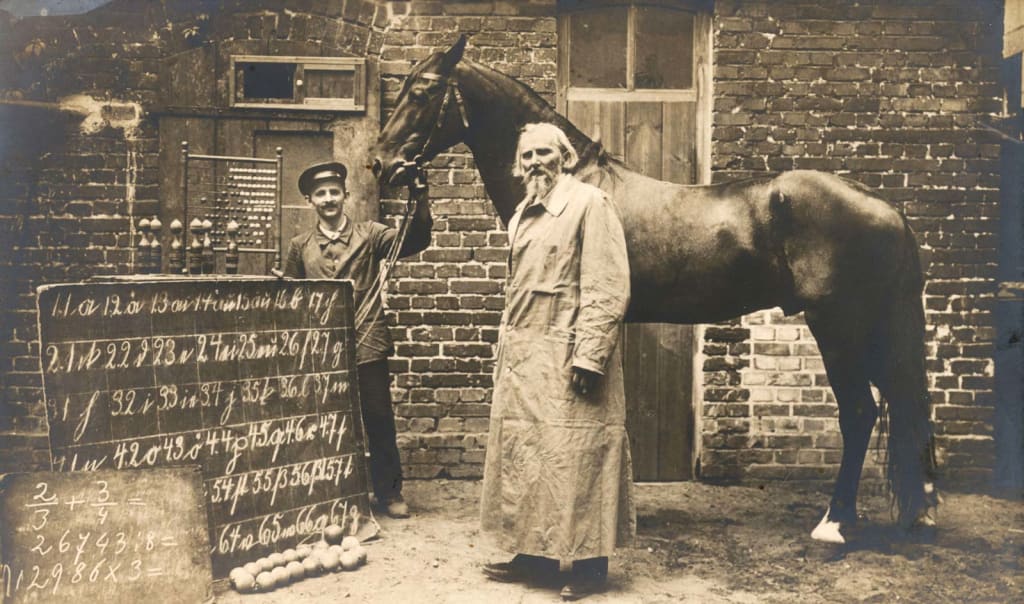
The Hans Council, which included three zoologists, two psychologists, a circus trainer, a cavalry officer, and a Catholic as well as a Protestant priest, had been unable to disprove the rumor. Hans, a horse, could count. What’s more, he was able to answer sums, multiply, divide, and tell the date and time—all of which he communicated by tapping his front left hoof. These feats had been performed not only in collaboration with Hans’s trainer, Herr von Osten, but under experimental conditions as well, and to the great astonishment of Charles Edward, Duke of Saxe-Coburg and Gotha, in a demonstration in Berlin on August 23rd of 1904. Thus it was recommended at the highest levels of the Prussian state that a group of specialists convene to discover the full extent of the horse’s abilities.
Dr. Paul Stumm, the zoologist recently arrived from Heidelberg, doubted that Hans could even count, much less do calculations. But when he received an invitation from the Prussian Academy of Natural Sciences to join the Hans Council, he dutifully accepted.
Dr. Stumm, a tall man with round glasses and a slight hunch, had found his zoological vocation as a child. He was raised on a farm after the death of his parents, and besides poetry, he loved being among animals. When the proprietor of the farm, recognizing his perspicacity, sent him to a veterinary school in Heidelberg, his uncommon sympathies became well known.
He was even more an outlier among his Prussian colleagues on the Hans Council. While they were roundly persuaded by the view that animals were complex machines, bereft of any soul or autonomy in the sense reserved for humans, Dr. Stumm believed in such a thing as a specifically animal consciousness. Carl Maazel, the leader of the Hans inquisition, had selected Dr. Stumm especially for this reason. Like Dr. Stumm, Dr. Maazel was skeptical of the whole proposition—the counting horse, the eccentric, grandiose trainer, and the Duke of Saxe-Coburg and Gotha’s peculiar fixation.
Indeed, Dr. Stumm had already made some disturbing observations. First, when Hans was left in his stall, he took to swaying, pacing, and trembling for hours at a time. His eyes, too, rolled around in his head, pulling up the white sheets of the sclera. When the eyes held still, such as when Hans was supposed to be concentrating on a problem, they reminded Dr. Stumm of Rilke’s recent poem, about a panther exhibited at the Jardin des plantes: “His vision, from the constantly passing bars, has grown so weary that it cannot hold anything else. It seems to him there are a thousand bars; and behind the bars, no world.” Wherever the horse went, it seemed to be constricted in a narrow stall.
His colleagues ascribed these anxious behaviors to Hans’s mental exertions, which were far in excess of what a horse might be accustomed to. And anyway, none of it was particularly unusual. But one night, as Dr. Stumm was preparing to leave the Academy, he heard an incessant knocking from below. Supposing someone was at the door, he went to answer it. Finding no one there, he continued across the courtyard to the stables, where, in the semi-darkness of the stall, he found Hans tapping his hoof in the far left corner, tapping, tapping, tapping. He took no notice of Dr. Stumm, but kept on tapping, manically, as if in response to a question whose answer was a terribly high number. He observed the same behavior the following night, and the night after.
When the next day Wilhelm von Osten came to visit the Prussian Academy, Dr. Stumm took the opportunity to speak with him.
“It would be a tremendous pleasure, Herr Doktor,” said von Osten, his huge hand pulling at his white beard. “We have much to cover. I do hope you’ll be able to replicate my practices here at the Academy. Please, pay me a visit in Oranienburg; I most look forward to receiving you there.”
Thus it was arranged for Dr. Stumm to visit Wilhelm von Osten at his estate.
In the restaurant beside the Oranienburg Bahnhof, near the River Havel, Dr. Stumm had his lunch before paying his visit. The musty tavern was empty except for a gentleman who sat over a mug of beer. He appraised Dr. Stumm from beneath his dark, bedraggled eyebrows before gesturing to the seat beside him.
“Haven’t seen you before,” he said. “My name is Peter.”
“I’m Dr. Paul Stumm, of Heidelberg. It’s a pleasure to meet you.” He shook the hand of the stranger, whose breath reeked of yeast.
“The pleasure is mine. What’s a southerner doing in Brandenburg?”
“I’m here to meet with Herr von Osten.”
“Is that so! A magnificent gentleman, though a bit strange these days. I was in his service for the better part of twenty years. It’s a great shame what happened to him.”
A waitress came from behind a door to take Dr. Stumm’s order, haddock with potatoes.
“A shame?” Dr. Stumm repeated.
“A great shame. The whole town still weeps for him.” He wiped the foam from his upper lip.
“Certainly,” said Dr. Stumm, “I’ll be meeting with Herr von Osten about his famous horse, Hans, about whom you must have heard.”
“Hans… yes, truly a marvel, only a man like Herr von Osten could achieve something so sensational. Of course, it was around the time of the accident that he took up with Hans.”
“The accident?”
“I suppose it wouldn’t be out of place for me to tell you about it, seeing as the whole town suffered the misfortune with him. Herr von Osten is a widower now, but he was once a family man.”
Dr. Stumm’s meal arrived. He pushed it aside.
“A wife and a daughter. His wife was getting on in years when the gentleman pressed her for another child, a male heir, as he’d always wished—and as is rightful for such a formidable family. She bore him a son, but there were complications, grave complications, and the poor woman, may she rest in peace, she was buried shortly after the birth. The son, thank God, did survive, but he was marked by the tragedy, for through no fault of Herr von Osten, whose purity is beyond question, the boy had certain… disfigurements. Very intelligent eyes, the most intelligent eyes, if I may say, but his body betrayed him. He could hardly move on his own, his arms were helplessly drawn to his chest, like a hen’s, and he never did learn to speak, much less read or write. He could only groan—but I am not exaggerating when I say this boy, though without the means for conversation, possessed a certain intelligence. And Herr von Osten did love poor Hans with all his heart.”
“Hans—his son?”
“Yes, he loved Hans. In the fullness of his noble being, despite the wicked deformities of his son, he loved him very much. I should know, I kept the horses for them, and I saw just how Herr von Osten doted on him. No matter the difficulty, he tried everything to instruct his son, to give him a classical education as he’d always dreamed of doing. But the poor master, he could only look on in his mute, intelligent way, and gargle.”
“What a misfortune, for so great a man.” said Dr. Stumm.
“That was only the beginning, I’m afraid. You see, the count had fashioned a wheelchair in which he liked to take Hans on walks around town and along the Havel. It was a ritual of theirs, and a tender thing to see: Herr von Osten, the picture of health, silvering but robust, and his poor son with the twisted, pathetic face. Poor Hans, however much he inspired the pity of those who saw him, Herr von Osten loved him and nurtured a sincere hope that he might be able to improve his condition, even cure him. Then one day—it wasn’t so long ago—on a walk along the Havel, Herr von Osten stepped away to relieve himself, and when he returned the chair was empty. The young master, with what little locomotion he was capable of, had thrown himself into the river. We spent weeks searching for the body.”
The road was longer than Dr. Stumm had expected. The clouds had parted to a few rays of sunlight, but dusk was near when he arrived. Herr Osten himself stood at the door to greet him.
“Esteemed Herr von Osten, I beg your pardon if I’ve kept you waiting.”
“Please, Dr. Stumm, I’ve so looked forward to our meeting, what’s a few minutes more? And anyway, I myself am aware how long the walk can be. Please, do come in.”
Dr. Stumm first noted with astonishment the number animal heads that adorned the walls of the hall and the parlor. Ibexes, antelopes, and wildebeests, as well as lions and cheetahs, not to mention the stuffed birds that stood attentively on sculpted branches, competed everywhere for attention, alongside rifles, sabres, and portraits heavy with paint.
“Huntsmen were the first naturalists,” said Herr von Osten. “Wouldn’t you agree?”
“Quite so,” affirmed Dr. Stumm. He’d heard it said by more than a few noblemen who took to dabbling in the sciences. “Tracking an animal takes a highly scientific mind. You must have a lot of experience?”
“One could say that. I hunted with my father, as did he with his father, and so on back to the days of Albert the Bear. This here,” he said, cradling the chin of a buffalo, “was a trophy awarded to my grandfather, an explorer of the American frontier.” The black marble eyes of the buffalo looked on, catching the light of the fireplace. The shadows of the heads, meanwhile, danced lightly on the walls.
They sat in two Windsor chairs.
“As I was saying, hunting and sporting have always been in my family. Thus I came to spend my time, almost exclusively these days, with horses. And I was particularly lucky to have Hans, a gifted specimen, as you’ve no doubt observed.”
“Indeed,” replied Dr. Stumm, “We at the Academy are astounded at the results of your training, which must have been at least as vital to Hans’s mathematical abilities as his peculiar intelligence. We’ve become especially interested in your methods.”
“My methods! I assure you, my methods were conventional—any school teacher would be familiar with them. Practice, reward, punishment, the basic elements of pedagogy.”
His brow furrowed. The words he spoke next seemed to be addressed to the fire.
“You and I are kindred spirits. I know you don’t believe, like the others do, that animals are mere machines, incapable of harboring souls. We see something more—something unaccountable.”
“That’s right,” said Dr. Stumm. “But how did you detect this affinity between us?”
“Ah,” said Herr von Osten, dismissing the question with a wave of his hand. “A naturalist must keep up with the work of his fellows.” He cast an admiring eye in his direction.
“I’m flattered,” said Dr. Stumm. Despite the fire, a draft moved through the room—perhaps from the rooms which, in grand houses, remain unheated through the colder seasons. He stifled a shiver.
“And wouldn’t you agree, Dr. Stumm, that the soul is the first component of the organism to evolve? The morphology of the animal, you might say, is dictated by the evolution of the soul, which guides the organism on the material plane.”
Dr. Stumm studied the fire, pretending to consider the question, for while he did believe in such a thing as a soul, he abhorred the mind-body dualism of Cartesian science.
“I’ve always been fascinated by such questions,” said Dr. Stumm, “And no less by their answers. I’d gladly continue this discussion—but perhaps we ought to visit the stables before dark? I will have to take measurements and record a few observations.”
“Yes,” von Osten continued, “there will be plenty of time to see the stables. As I was saying, the soul, we’ve found, is what guides evolutionary development. Now, most animals, who possess souls that are completely lacking in any real awareness or striving for greatness—a burden carried only by certain races of humans, like ours—are no longer evolving. But when it happens that a soul is too robust for the body, certain changes can begin to take place. You’re familiar with Nietzsche, I take it?”
Dr. Stumm had read some Nietzsche, so dizzying and fragmentary in its variety that he was at a loss for where Herr von Osten might be leading him.
“‘I teach you the Übermensch. Man is something to overcome. What have you done to overcome him?’ Thus he spake, and no greater epigraph could be chosen for the new century, nor for biology in general. Nietzsche was one of these Übermensch. He transcended his physical being long before he died. Nietzsche also wrote about Greek tragedy. He supposed that life, like drama, is a play of masks; humans merely make use of them to explore different facets of their being. Rather conventional stuff—sure, we each wear a variety of masks—but what of the masks themselves? Is it not the project of biology to investigate the surface of being? And, finally, if masks are interchangeable, what of the souls beneath them? But you must be wondering at what point I’m driving at. I mean to say that Hans was always of superior intelligence. He merely wasn’t able to articulate it, to express it. And I was able to make this possible, to develop these faculties in Hans. An accomplishment not only revolutionary for animals, but for humans as well. It is no less than the wedding of human intelligence with animal athleticism. But perhaps I can show you what I mean,” and, rising from his Windsor chair, he gestured with his open hand toward the back door.
Dusk had nearly passed; the screeches of bats could be heard through the waning twilight, and still more stirred when Herr von Osten opened the Dutch doors of the stable. In the lamplight Dr. Stumm caught a glimpse of von Osten’s study, complete with a desk, sagging shelves of books, and a small table such as one finds in a veterinarian’s office. Adjoining the office was a row of stalls.
“Here I have a few more horses. They have yet to receive instruction,” he said, reaching into a cupboard. “They like carrots.”
Dr. Stumm, approaching the nearest stall, held out a carrot, which the horse hungrily ate.
“What is this one called?”
“Funny,” said Herr von Osten, “I haven’t named him yet. But please do proceed with your measurements.”
Taking notes on the conditions of the stable, Dr. Stumm meanwhile moved toward the back left corner, to the spot analogous to where he’d seen Hans tapping in his stall at the Prussian Academy.
“Is this the hay Hans is used to?”
“The very same,” said von Osten.
Poking around with his boot in the back left corner, he felt something hard. Dragging his foot across the straw bedding, he saw a flash of metal: a hinge. Wilhelm von Osten smiled. “You found a hatch, Herr Doctor?”
“You use the stall for storage as well?”
“I do. Would you like to look inside?”
Dr. Stumm remained silent. He was reminded of the apprehension he felt when, as a child, he had been made to sleep in the barn, and of those first nights, unaccustomed to the strange noises and creaking beams, when the darkness had seemed to conceal something from him. His heartbeat lost its rhythm; his palms, numb from the cold air, began to sweat. “I suppose so,” he said, although it sounded like a gasp for air.
From his back pocket, Wilhelm von Osten handed Dr. Stumm the key. Clearing the hay, Dr. Stumm opened the hatch.
A rank smell arose from the dark below. Holding up the lantern, Herr von Osten helped him to see inside. There lay, slumped in a chair and half covered by a blanket, a disfigured corpse. The skin was a greenish, translucent white, hardly decomposed.
“What have you done with him?”
“It’s merely the body my son once occupied. By means of certain procedures, which I will be glad to show you, I was able to coax the soul from his deformed body and introduce it into the horse.”
“I see,” said Dr. Stumm. His thoughts were racing—should he run immediately? Or wait for an opportunity to slip away? Then he heard a dry, rasping groan. The apparent corpse, slinking back to set its blue eyes on Dr. Stumm, screeched in bewildered, desperate agony.
“Astonishing, isn’t it?” said Herr von Osten. “A procedure truly worthy of scientific study. I hadn’t the heart to let Hans’s former body die—otherwise, who would believe me?”
Dr. Stumm looked with contempt at the proud face of Wilhelm von Osten. The investigation, which until that point had consisted in allowing him to espouse his insane theories, had to stop. He no longer wanted to know how the horse counted, answered sums, or told the time. He wished that the whole illusion would come to an immediate end. “That is your son!” he gasped.
“Dr. Stumm, please, you’re losing your wits. I can easily prove that it simply isn’t the case.” He held out his hand, closed around a small object. When the doctor looked to see what it was, von Osten lunged at him. He felt a sharp prick on the left side of his neck.
“I did hope you of all people would understand,” sighed von Osten. “But now you’ll learn firsthand.”
The anesthetic, injected into the jugular vein, soon took effect. Dr. Stumm’s body collapsed beneath him, and he was not sure, several hours later, whether it was his loss of consciousness or the closing of the trap door that had shrouded him in darkness.
About the Creator
Willa Chernov
Willa Chernov is a writer and translator living in New York.
Keep reading
More stories from Willa Chernov and writers in Horror and other communities.
home is memory
where do stories happen? she had an intimation, a sensation even, they happened behind the bridge of her nose. or maybe, she thought slipping fingers beneath sock to feel that bone that protrudes there, maybe they don’t happen at all, or the happening is the putting together and falling apart, the crack in the bedroom wall:
By Willa Chernov4 years ago in Poets
How to Succeed at the Benson Directory®
Congratulations and welcome to the Benson Directory® employee #22391! As our newest call handler, you will have the privilege of speaking with dozens of unique and interesting people on a daily basis as well as the opportunity to earn bonuses for high performance. Contained within this handbook you will find a set of ease to follow instructions designed to help you settle in to your new role and begin paving the way to success.
By S. A. Crawford3 days ago in Fiction



Comments
There are no comments for this story
Be the first to respond and start the conversation.