

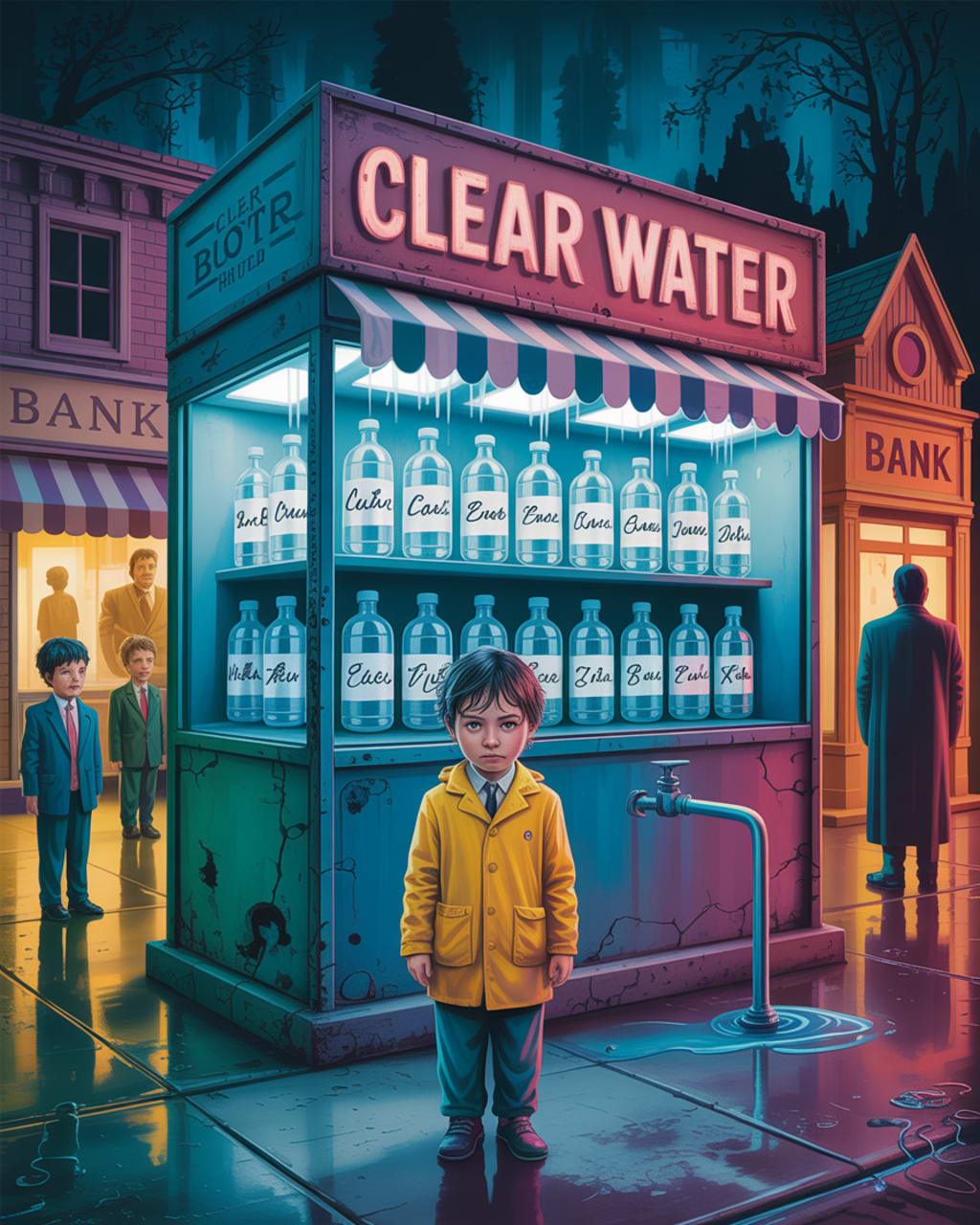
It looked so innocent on the surface—clean signs, smiling staff, clipboards full of instructions. BizTown, they called it. A cheerful place where children pretended to run businesses, balance checkbooks, and “learn about the economy.” They even had a bank that gave them fake loans to start.
But I swear to you, something foul was running beneath that surface. And it wasn’t just the debt.
The trouble began when my son came home after the first day. “We took out a loan!” he said proudly, waving a play money ledger. “We’re opening a water business. Selling bottles to other kids. It’s called Clear Water.”
I smiled—at first. “How much did you borrow?”
“$75,” he grinned. “We only made $20 today, but it’s okay. The loan helps us grow!”
That night, I couldn’t sleep. Something about the way he said it—it wasn’t a game to him. He spoke like the debt was a living thing, something he owed not just money to, but respect. Obedience.
By the third day, their water business was in trouble. Not enough sales. Too many expenses. They had to cut team pay. My son said one of the kids refused and walked away. The next day, that kid’s name wasn’t on any attendance list. No one remembered him. Not even the staff.
“But you played with him yesterday,” I told my son.
He frowned. “I think I dreamed him.”
No. I remembered the boy too.
It got worse. The ledger began changing on its own. My son said the numbers wouldn't stop moving. Sometimes the loan balance increased even when they made payments. A shadow would flicker behind the teller window at the bank kiosk. My son stopped drinking water. When I handed him a bottle from the fridge, he flinched.
“They said we can only drink what we sell,” he whispered.
“Who said that?”
He didn’t answer.

That evening, I returned to BizTown after hours, hoping to speak with the director. The front doors were open. Inside, everything was silent—but the lights were still on. The model bank glowed with eerie green light. I heard water dripping. But the sinks were dry.
In the “Clear Water” stall, I found the ledger. It was damp.
I opened it. Pages were warped and covered in handwriting—words that weren’t there before. Latin phrases. Dates from decades ago. Kid names scratched out with red pen. The last page was fresh and clean, but one line was scrawled across the bottom in thick black ink:
"The debt always collects."
When I looked up, the shelves were filled with water bottles that hadn’t been there seconds before. Full, clear, and cold. But they were labeled with names. Not brands. Names.
I found my son’s name on one. And it was half empty.
The next day, all the kids smiled like nothing happened. No one remembered the missing student. The staff laughed off any mention of "odd events." My son came home like everything was fine.
But that night, he sleepwalked to the kitchen. He opened the tap and just stared. When I tried to pull him away, he turned slowly.
“They said I still owe.”
“Owe what?” I asked.

“Water,” he said flatly. “Time. Breath.”
He didn’t remember it the next morning.
I pulled him from the program. The school said I overreacted. That BizTown was safe and approved by educators. That no harm had ever come from learning how the economy works.
But I know what I saw. I know what he said.
And I kept the bottle.
It’s in the freezer now. It still has his name on it. And I swear… the water level is lower every day.
About the Creator
Keep reading
More stories from Mr Haris Khan and writers in Horror and other communities.
The Doll That Cried Blood
Here's a 1000-word short horror story titled "The Doll That Cried Blood": --- The Doll That Cried Blood When Emily turned nine, her grandmother gifted her a porcelain doll. Its dress was tattered lace, and its eyes, painted a deep glassy blue, stared endlessly forward. It was beautiful in the way old things are—fragile, cracked, and hiding stories.
By Mr Haris Khan10 months ago in Horror
"Scream 7" (2026): Running out of Fresh Screams
This is the seventh time we’ve had a Ghostface crisis. Scream 7 is the latest edition of the Scream franchise. Sydney Prescott and her family are under attack by another anonymous killer dressed in a Ghostface costume. While having issues with her daughter, Tatum, they run from the bloody murders, trying to determine who is behind it all.
By Marielle Sabbag2 days ago in Horror
A 12-Year-Old’s Descent from Urban Legend to Attempted Murder
In the quiet suburbs of Waukesha, Wisconsin, in May 2014, a story emerged that seemed more like a horror movie plot than a police report. Three 12-year-old girls went into the woods to play, but only two walked out willingly. The third, Payton Leutner, was left bleeding from 19 stab wounds, the victim of a calculated sacrifice intended to please a fictional internet character known as Slender Man.This case remains one of the most disturbing examples of how the digital world can bleed into reality, blurring the lines between childhood imagination and dangerous delusion.The Myth of Slender ManTo understand why two pre-teens would commit such an atrocity, one must understand the "deity" they served. Slender Man originated in 2009 on the Something Awful forums as a "Creepypasta"—a type of internet horror legend. He is depicted as a tall, faceless man in a black suit with tentacle-like appendages.For most, he was a fun, spooky story. But for Anissa Weier and Morgan Geyser, he was terrifyingly real. They believed that in order to become his "proxies" and protect their families from his wrath, they had to kill someone.The Day of the AttackThe plan was orchestrated over several months. On May 31, 2014, following a birthday sleepover, Morgan and Anissa lured Payton into a local park under the guise of playing hide-and-seek. Once in the woods, the situation turned graphic.Morgan Geyser carried out the physical attack, stabbing Payton 19 times with a five-inch kitchen knife while Anissa encouraged her. The blade missed Payton’s heart by less than a millimeter—a distance described by doctors as the "width of a human hair."After the attackers fled, Payton displayed incredible resilience. Despite her life-threatening injuries, she crawled out of the woods toward a nearby bike path, where a passerby discovered her and called 911.The Legal and Psychological AftermathThe case ignited a global conversation about the impact of the internet on developing minds. Both girls were charged with first-degree intentional homicide, but their defense teams argued they were not monsters, but children suffering from severe mental health issues.The FindingsMorgan Geyser: Diagnosed with early-onset schizophrenia. She truly believed Slender Man would kill her family if she didn't act.Anissa Weier: Diagnosed with shared delusional disorder (folie à deux), meaning she had been drawn into Morgan’s delusions until they became her own reality.Ultimately, both girls were found not guilty by reason of mental disease or defect. Morgan was sentenced to 40 years in a psychiatric institute, while Anissa received 25 years. Anissa was released under strict supervision in 2021, while Morgan remains under institutional care.Lessons from a Digital TragedyThe Slender Man stabbing serves as a grim reminder of the "echo chamber" effect of the internet. For these girls, the more they read about the myth, the more evidence they found to support its existence."I believed that if I didn't do it, Slender Man would come and kill my whole family in three seconds." — Morgan Geyser during police interrogation.This case forced parents and educators to realize that the "monsters" children find online aren't always just digital images; they can become psychological catalysts for real-world harm. It highlighted the desperate need for better mental health screening in schools and a more nuanced understanding of how children process online folklore.Conclusion: Survival and ResilienceWhile the story is often centered on the attackers and the myth, the true hero is Payton Leutner. Her survival was nothing short of miraculous. In later years, Payton spoke out, showing remarkable strength and a refusal to be defined by the 19 scars she carries.The Slender Man case stands as a cautionary tale for the digital age—a reminder that while the internet is a place of infinite creativity, for the vulnerable, it can also be a place where the shadows grow far too long.
By Irshad Abbasi a day ago in Horror
No Word Comes Near Enough
The English language has its limits. I learned this when I became a student of the Bible and looked up the Greek and Hebrew definitions behind the Scriptures I loved. Some languages have so much more depth and power than the one I use to convey my thoughts. But, even so, I don't think any word could ever come close to describing this void and pain I am journeying through. I don't know how to swim through its murky waters.
By Shirley Belk7 days ago in Poets

Comments
There are no comments for this story
Be the first to respond and start the conversation.