

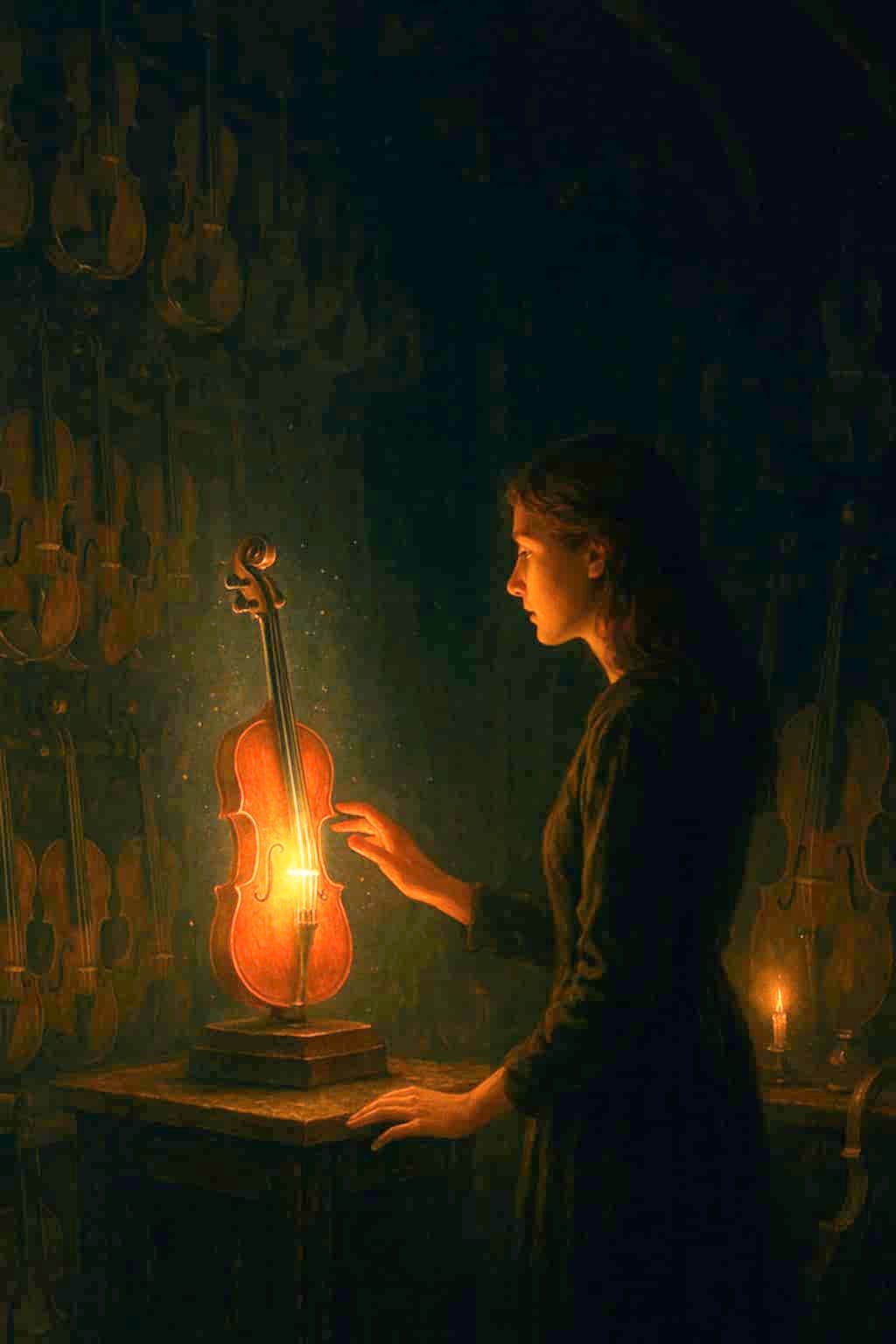
Tucked into an old corner of Vienna, where cobblestone streets narrowed and fog hung low even in daylight, sat Haus der Klangkunst—The House of Sound Art.
It was a music store unlike any other. No signs, no glowing advertisements. Only a wrought-iron plaque above the arched wooden door: a harp, a violin, and a skull—all intricately intertwined.
They say even Stradivarius would have wept had he seen their craftsmanship.
For over 300 years, Haus der Klangkunst had quietly built a reputation among the world's most elite musicians. Cellists traveled from Tokyo, flutists from Paris, and pianists from Buenos Aires just to be "measured" by the Master Luthier known only as Herr Brenn.
He never aged. Or if he did, it was backwards.
Nora Klein, an ambitious young violinist from Berlin, had been invited for a private session. A rising prodigy with fingers of lightning and emotion that bled through the bow, she considered this her golden ticket. To be chosen for a Klangkunst instrument was akin to being knighted by sound itself.
The store, upon entry, smelled of cedar, varnish, and something else—like wet soil. No one greeted her. Not a bell, not a clerk. Just walls and walls of glimmering instruments, each housed in a glass coffin-like case, with brass tags marked only by Roman numerals.
She ran her fingers across a violin labeled XVII. Its wood shimmered not with lacquer, but with something alive beneath the surface. It almost pulsed.
Then she saw Herr Brenn.
He emerged from a shadowed archway in a high-necked black coat, silver spectacles perched perfectly on the bridge of a nose that looked carved from marble. His eyes, too pale to be gray, regarded her like an old book.
“You must be Nora.”
She nodded, breath stolen.
“You’ll find that our instruments choose their player, not the other way around.”
They led her down a spiral staircase lit by candles. The walls here were lined with aged portraits—musicians from all eras, eyes eerily lifelike.
"Are those... your clients?" she asked.
He gave a slow, enigmatic smile. “In a way.”
In the heart of the basement was the Selection Room. In it sat a lone violin under a single spotlight.
No tag. Just the instrument—its body deep, dark mahogany, its strings so fine they looked like spun silver.
“This is Nocturne. It hasn't chosen in decades.”
Nora picked it up. It was warm. As though someone had just been playing it.
She raised it to her chin and drew the bow. The sound that escaped wasn’t music. It was emotion itself—pure despair, pure longing, pure love, all bleeding into one crescendo. It made her cry without knowing why.
Herr Brenn clapped once, softly. “Yes. You are the one.”
The deal was signed in blood, as tradition dictated. She was to return in a week to claim it after "the tuning."
Back home, strange things began.
She dreamt of a man with no skin, whispering notes into her ear. Her fingertips developed tiny cuts that bled slow and steady—always onto her bow. A neighbor’s dog barked violently at her whenever she passed. And at night, when all was still, she heard violin music outside her window.
A week later, she returned.
Nocturne sat ready in a velvet-lined case. But something tugged at her, like a thread behind the walls. Curiosity clawed at her until she excused herself for the restroom and slipped through a side door.
She descended deeper into the belly of the store.
It was colder here. Darker.
She found herself in what looked like an embalmer's studio. Tables, tools, saws. But not for wood.
A violin in mid-construction lay before her—its bridge made from a curved rib. Fingerboard from phalanges. Bow hairs—so many, impossibly fine—had roots.
She staggered back, knocking over a cabinet. From it tumbled blueprints: Organ Piano (Walnut Skin Inlay), Oboe (Trachea-Reed Crossover), Vocal Harp (Larynx Frame).
At the bottom of the drawer: photos. Musicians. Headshots. Some dating back centuries. On the back of each: names, instruments, and one word—“Harvested.”
She dropped them as Herr Brenn’s voice slithered from the shadows.
“You must understand… true music requires sacrifice.”
He emerged, sleeves rolled. His hands were coated in crimson varnish.
“Wood remembers. But flesh sings.”
Nora stumbled, heart racing.
“You used people?!” she gasped.
“Great artists,” he corrected gently. “Volunteers, most. Some...less so. But every note that flows from our instruments carries their soul.”
He pointed to Nocturne.
“That violin? Made from a young woman’s bones. A prodigy like you. She drowned herself in sorrow. It gave the timbre its richness.”
Nora backed away—but Nocturne called to her. She could feel it humming inside the case.
Herr Brenn smiled softly. “You’ve already begun changing. The dreams. The bleeding fingers. It’s choosing you… as its next donor.”
The candlelight flickered.
She grabbed a tuning fork and swung.
A blur. A scream. Then silence.
Nora ran, violin in hand.
Six months later, a concert hall in Berlin.
Nora Klein stood center stage, bow poised, wearing black lace gloves to hide her healing scars.
The audience sat breathless.
She drew her first note.
Nocturne wept. The crowd gasped.
The sound—impossible. Like mourning and resurrection, fused into vibration.
Backstage, an envelope sat on her dressing table. No return address.
Inside: a black-and-white photograph.
A young man. Handsome. Brilliant eyes. Violinist.
On the back: “Candidate – Violin: Opus XL.”
Her fingers trembled. The last line read: “It’s your turn to build.”
About the Creator
E. hasan
An aspiring engineer who once wanted to be a writer .
"Scream 7" (2026): Running out of Fresh Screams
This is the seventh time we’ve had a Ghostface crisis. Scream 7 is the latest edition of the Scream franchise. Sydney Prescott and her family are under attack by another anonymous killer dressed in a Ghostface costume. While having issues with her daughter, Tatum, they run from the bloody murders, trying to determine who is behind it all.
By Marielle Sabbag3 days ago in Horror
No, The Mothman Isn’t an Alien
Commentary A Lot of Things to a Lot of People The legendary Mothman has been a lot of things to a lot of people. And, in many respects, his mostly complex and evolving legend as a mythological creature made him one of the most unique and fascinating beings of his kind. That is until somebody – possibly a blogger on a cryptid or paranormal site – began to speculate that the Mothman is actually an alien.
By Dean Traylorabout 13 hours ago in Horror
Review of 'Man on the Run'
My wife and I saw Man on the Run, a nearly 2-hour documentary on Amazon Prime, about Wings, Paul McCartney's group that flew around the world from shortly after The Beatles broke up in early 1970 to shortly after John Lennon was murdered at the end of 1980, making a Beatles reunion forever impossible.
By Paul Levinson3 days ago in Beat



Comments
There are no comments for this story
Be the first to respond and start the conversation.