


When she yawned once more, it was the third in a row, she set down the book she was reading and her glasses on the nightstand. She knew it must be midnight—that third yawn had a habit of visiting her every night at that specific hour—yet she checked the electronic clock on the nightstand to see if she was right. And both as a physicist whose theory was once more proven, and as a lover of routines, which were only laws of nature yet to be proven, she was ready to sleep.
She looked out from the curtainless window to the grey wall level with her room, three meters away. It was rather a redundant and good-for-nothing wall, built with the intention of raising a barrier to mark the boundary between the neighboring property and her building's land. The tree trunks could be seen behind it and it was rather good-looking for a mere wall, with branches and leaves surrounding it. Usually, there were cats lying on the wall, watching her as they licked themselves.
That night, no cat came to her visit, yet she didn’t take it personal nor a deviation from her routine. Serene with the knowledge that probability is a branch of mathematics she fell asleep effortlessly.
At the climax of her sleep, she woke up, breathless. She was suffocating. Her eyes bulging from their sockets, she gasped for breath. She tried to reach her throat for help, but her hand didn’t move. Her attempts to twist her neck, to move her body, all were destined to fail. Her only function was to think and fear as she was gasping for breath.
Maybe the oxygen molecules went wild and assembled at the corner of ceiling, a hypothetical possibility, she found her deranged mind considering.
Like a statue overthrown to its side, and as awkward as one, she kept on lying, her unblinking eyes fixed on outside. All she could see, in the dim light of the moon, were the shadows dancing over the wall. Perhaps they were dots that had begun to appear before her eyes from being out of breath for a long time. What if, she had already died and this was the very death itself, she thought. It was more rational of a way of thinking, that stillness of body and asphyxiation were signs of death, rather than blaming oxygen molecules for running away.
The electronic clock on the nightstand blinked green declaring a minute passed, illuminating the grey wall before her eyes. The shadows of night were still there, but now they had a shape. There, on the wall, she saw a darkness sitting—a shadow of a man, his outlines drawn by the green light of the clock that lasted only for a second. It was more like an idea than a reality, that long she had seen the figure. Though once again it was just a grey wall, barely visible behind the shadows, the image and the fear it had inspired were already stuck in her mind. Whether it was an optical illusion or real, the panic was strong enough to rally her lungs to take a breath. She sucked in as much air as her lungs would let in. They burnt like a new born’s, though she couldn’t cry like one.
The panic loosened its grasp on her a little bit as her oxygen-deprived brain received its fuel and began working properly again. It must be a night terror, she reasoned. That was all; it was just a serious misunderstanding, an entanglement of the dream world and the real one.
Like the rest of her body, her eyes were still not bent to her will, and with the feeling of a thousand needles stinging them, they remained fixed on the wall. She continued her forced watch, observing the leaves stir in the breeze as their shadows danced faintly on the wall.
Once more everything was green, and the figure was there, and for the worse: he was now leaning forward as if measuring the distance for a jump to her window. His hands grasped the wall to balance himself, while his legs hung down leisurely. Distinguishing any feature of him was impossible; his arms, body and legs all were darkness outlined by the light of the clock. Once the clock ceased to illuminate the wall, the green, for just a very small instant, was visible on the outlines of the figure, framing him even more distinctively in the darkness.
Abruptly, her eyes closed like a window shade that broke from its cord. The curse of seeing ceased to be. She would never have thought that she would be so happy to be imprisoned by the blackness of her eyelids.
‘He is not there,’ she told herself, her eyes closed tightly. Now all she had to do was to keep her eyes closed and go to sleep. When she woke up, everything would be as same before. Then, she would go to the college to give her lecture as she had always done every Monday.
Counting the faint flashes of green glowing behind her eyelids, she waited expectantly. It had already shone three times, and just before the fourth time, her curiosity prevailed over her fear, so she opened her eyes to see if the shadow was gone. He was no longer on the wall – for he was suspended in the air, his arms stretched forward as if to catch. He was not getting any closer, just hanging up there in still-air, like a radioactive cloud. The green light around him faded slowly, slower than before, she noticed. Unlike before, he wasn’t mixed and lost behind the shadows – he was too close, and she was too aware of his existence to ignore.
Afraid of closing her eyes, even blinking, lest the man appear closer the next time, she lay still. She got mad herself for leaving the window open. It was a tilt-window, so the gap was small, but one couldn’t be sure when a figure was hanging in the air before one’s window and whether he might flow like a shadow through it.
Ten times the night turned green by the clock’s light to prove again and again he was there, floating before her window, in an infinite hunt to catch his prey—her. As the green glow radiating from the blackness lasted every passing minute more and more, to a point, she thought in fear, where it would never fade.
She recalled the first time she had seen the wall, and how she felt intimidated by it. Erecting a wall right opposite of a window was ridiculous; it was building a sightseer’s place for perverts. To avoid sleeping in that room alone, she had gotten a boyfriend. He was insignificant; indeed, she couldn’t remember his name anymore. So why did she recall him, and why was his shapeless, expressionless face looking at her, glowing green?
She woke up—it was a dream—to see the man perching on the windowsill. His hands and head were pushing against the window, and he was, except for his outlines, an entity comprised of pure darkness. If only he had eyes to peep and were an ordinary pervert, she found herself thinking, then everything would be easier.
The green light reflecting off him reached to her, crawling over the sheet and on her skin. This time that repulsive green didn’t stop glowing—he might have captured and made the light a part of him, or the clock was broken.
With disgust and repulsion, she shrieked and jumped from the bed to save herself from the touch of green.
She saw her body lying before her, facing the window. It was rather weird to see one’s back in real life, something usually only possible in photos.
She was two now, and seemingly she had not been the one who was blessed with the ability to split down the middle like a cell undergoing mitotic division, creating an identical twin. The figure split in two, and it was so black that one can’t help but agree that another color existing on him was out of the question. One of the spheres stayed where it had been, growing bigger, while the other flew above her head and disappeared behind her.
The darkness before her grew so immense and deep that she lost the sensation of whether her eyes were open or not. Though, it didn’t matter, since looking at nothingness wouldn’t mean comprehending it.
What she was experiencing was against the laws of nature, but weren’t black holes too? And she knew he was behind her, whether he was taking his time, or had already taken. As waiting for imminent end, she even found time to renounce the existence of black holes.
About the Creator
Kemal Funda
Writing horror stories.
Author of Collected Gifts
Keep reading
More stories from writers in Horror and other communities.
Killing him slowly
There’s an intruder in my house again. He stumbles through the door, wet carrier bags in hand. He’s bought me offerings. I show my appreciation, letting him caress my beautiful body. He wants to touch me. I rub myself against his legs. He sighs, dropping the bags. He can’t resist touching me. Running his hand slowly down my spine, I arch my back towards his caress, let out a low purr. It’s what we both need.
By N J Delmasa day ago in Horror
Living in the In-Between: What My ADHD Feels Like
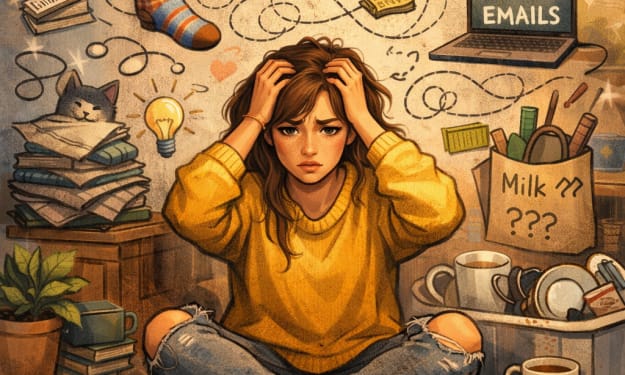
I didn’t wake up one morning and think, Today is the day I realize my brain works differently. It happened in pieces. Small, quiet realizations that stacked on top of each other like unread notifications. It started with an alarm. Not because I didn’t hear it. Not because I slept through it. I heard it. I looked at it. I thought about getting up. Then I stared at the ceiling wondering if cereal or eggs would take longer. Then I wondered if I still had eggs. Then I remembered I never washed the pan from yesterday. Then I checked my phone “for a second” and somehow twenty minutes disappeared. My body stayed in bed. My mind went on ten different field trips. That’s when I started to suspect something wasn’t just laziness. I tell myself every day: Today I will be productive. Not in a grand, inspirational way. Just simple goals. Shower. Answer two emails. Eat real food. Fold laundry. Four tasks. That’s it. Yet somehow, I start by organizing my sock drawer. Why? Because I went to grab a shirt. Noticed socks on the floor. Sat down to pick them up. Found a pen. Wondered where that pen came from. Started looking for its matching notebook. Ended up sitting on the floor scrolling through my phone. Still wearing yesterday’s clothes. Still hungry. Still no emails answered. But wow… my socks look amazing. People say, “Just focus.” I wish they knew how funny that sounds. I want to focus. I crave focus. My brain, however, treats focus like a cat treats commands. Sometimes it listens. Sometimes it stares at me and knocks everything off the table. There are moments when my brain becomes a laser. I write for three hours without blinking. I clean my entire kitchen in one burst. I solve problems quickly. I feel unstoppable. Then suddenly… it’s gone. Like someone unplugged my motivation without warning. I don’t know when it will come back. I don’t know how to turn it on. I just sit there, frozen between wanting to move and not moving at all. It feels like being stuck at a green light while everyone behind you honks. Grocery stores are my personal obstacle course. I walk in with a list. Milk. Bread. Rice. That’s all. Ten minutes later I’m holding candles, gum, a notebook, and a plant I absolutely do not need. Why do I own so many notebooks? Because I believe each one will magically turn me into a new, organized person. It never does. I leave the store with everything except bread. Every. Single. Time. Conversations are another adventure. I try so hard to listen. I really do. But my brain starts building side quests. Someone says, “Yesterday I went to the mall.” My brain says: Oh yeah, I need socks. Did I pay my phone bill? I should drink more water. I wonder if penguins have knees. Suddenly they ask, “What do you think?” I panic-smile. “Yeah… totally.” I have no idea what they just said. Growing up, I thought I was broken. Teachers wrote: “Smart but careless.” “Needs to try harder.” “Daydreams too much.” I believed them. I thought everyone else had a manual for life that I somehow lost. Why could others sit and study for hours? Why could others remember homework? Why did simple things feel heavy? No one explained that my brain wasn’t lazy. It was wired differently. ADHD isn’t just distraction. It’s emotional, too. I feel things loudly. Excitement becomes obsession. Small rejection feels enormous. Criticism echoes for days. At the same time, I can forget entire conversations. Not because I don’t care. Because my brain misfiles information like a messy computer. People assume forgetting equals not caring. That hurts. I care deeply. Sometimes too deeply. The day I learned about ADHD, something shifted. Not everything became easy. But everything made sense. I wasn’t stupid. I wasn’t lazy. I wasn’t broken. I was different. Different with strengths. Different with challenges. Different with a brain that moves fast and zigzags. Now I build my life differently. I write things down immediately. I use alarms for everything. I break tasks into tiny pieces. Not: “Clean the house.” But: Pick up clothes. Wipe table. Wash three dishes. Three dishes is better than zero. Progress doesn’t have to be perfect. Some days are still hard. Some days I scroll instead of start. Some days I forget important things. Some days I feel behind everyone else. But I remind myself: I am running a different race. And I am still running. Living with ADHD feels like living in the in-between. Between chaos and creativity. Between exhaustion and inspiration. Between struggling and shining. It’s messy. It’s frustrating. It’s also full of imagination, curiosity, empathy, and ideas. So many ideas. I’m learning to stop asking: “What’s wrong with me?” And start asking: “How does my brain work best?” That question changes everything. I am not a failure. I am not broken. I am a human with a fast, noisy, beautiful mind. And I’m still figuring it out. One unfinished to-do list at a time.
By Behind the Curtainabout 20 hours ago in Horror



Comments
There are no comments for this story
Be the first to respond and start the conversation.