
Bhog
An English Adaptation of the Bengali Horror Story by Avik Sarkar
Atin lived alone in a quiet corner of Kolkata. A man in his thirties, with no wife or family, his life followed a monotonous pattern: work, tea, a bit of reading, and sleep. His only companion was Pushpa di, a middle-aged housekeeper who had served his family since childhood. After Atin’s mother passed away, Pushpa di took a silent oath to care for him. She cooked, cleaned, and watched over him like a guardian.
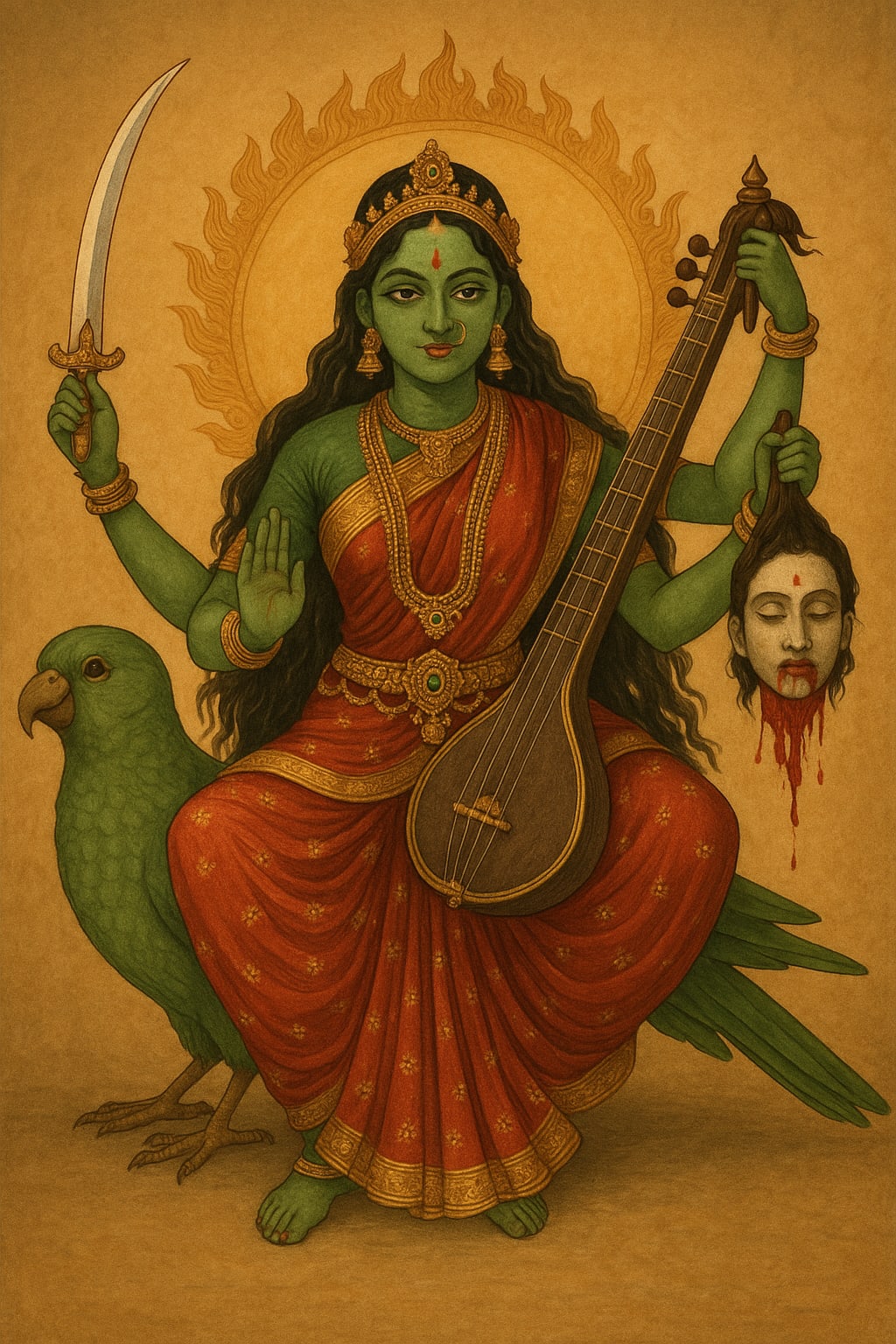
Atin had one passion—old things. Antiques. The kind that held secrets in their rust and charm. On weekends, he wandered through old markets and dusty curio shops, looking for pieces of the past. One Saturday, while browsing a shop on Park Street, he discovered a small brass idol. It was unlike anything he'd seen—four arms, wide eyes, a skull in one hand and a veena in another. The shopkeeper, hesitant at first, called it a rare tantric figure—an old folk deity no one worshipped anymore.
Something about the idol captivated Atin. He bought it and took it home.
That night, he had a strange dream. A temple stood before him in a forest, filled with smoke and chanting. A woman, her face hidden in shadows, stood on a pedestal and whispered, “I am hungry. Feed me.”
Atin woke up in a cold sweat. The idol stood on his shelf, silently watching.
Days passed, but the dreams grew stronger. The woman appeared again and again, repeating the same words: “I am hungry. Give me bhog.” Unsure what she wanted, Atin offered rice and sweets. Then flowers. Still, the dreams continued.
Pushpa di noticed the change in Atin. He was distracted, pale, and talked to himself. She asked him what was wrong, but he only smiled. One day she noticed the idol and gasped. "Where did you get this?" she asked. Atin brushed her off.
“That’s not a goddess you should be praying to,” she warned. “These are tantric beings. You don’t know their ways. You mustn’t offer bhog without knowing the proper rites.”
But Atin had already gone too far. He began researching tantrik rituals online and in old books, trying to decode the hunger in his dreams. One evening, he lit incense, drew a chalk circle around the idol, and offered meat—hoping to calm the voice.
That night, the woman in his dream laughed.
“You’re learning,” she said. “But this is not enough.”
The next morning, Pushpa di was gone. Her room was empty. No note, no phone call. Atin filed a missing person report but received no leads. Strangely, he didn’t feel alarmed—only empty, as though a part of his daily life had been offered away.
Soon after, a woman named Damari appeared at his doorstep. Ragged, barefoot, with sorrowful eyes, she said she had nowhere to go. Something in Atin told him to let her in. She didn’t speak much, only watched him silently, always sitting near the idol.
From the day Damari arrived, Atin stopped dreaming.
But his waking life grew stranger. He began seeing things—shadows in the mirror, whispers from the walls. His appetite dwindled, his eyes sunk. Neighbors remarked that he looked like a man possessed. Still, he clung to the idol and Damari as if they were the last anchors in his life.
Bhabesh Kaku, Atin’s maternal uncle, came to visit. Alarmed by the house’s condition and Atin’s deteriorating mental state, he warned him: “You must throw that thing away. This is no goddess. This is a predator.”
But Atin was beyond reasoning.
“The goddess is pleased,” he said. “She’s accepted my offerings. She sent Damari to me. She needs more.”
Bhabesh Kaku, terrified, left and promised to return with help. But he never got the chance.
That night, Atin performed what he believed was the final ritual. He drew blood from his hand, offered it on a copper plate, and chanted the mantras he had stitched together from broken sources. Damari stood behind him, her eyes glowing faintly in the flickering light.
“You have done well,” she whispered. “Now give yourself fully.”
In that moment, Atin realized what the goddess wanted was not food or flowers—but him. His mind, body, soul.
The idol trembled. The room filled with smoke. And as the figure of Damari merged with the idol’s aura, Atin collapsed.
---
The next morning, police arrived after Bhabesh Kaku’s frantic complaints. The house was a mess. No one found Damari. Atin sat in a corner, wide-eyed and silent, muttering chants to no one. The idol was gone. There was no trace of it ever being there.
Atin was taken to a psychiatric facility.
---
Years later, stories still circulated in the neighborhood. Some claimed they saw a veiled woman in Atin’s old house at night. Others said they heard music coming from inside, though it stood empty and locked.
And sometimes, in the old curio shop on Park Street, a strange idol appears for sale—four arms, wide eyes, a skull in one hand, and a veena in the other.
Waiting.
For the next Atin.
About the Creator
Keep reading
More stories from Tushar Bhattacharya and writers in Horror and other communities.
The Midnight Meat Train
Leon Kaufman had never liked the New York subway. It smelled of rust, sweat, and something more elusive — like iron left in the sun too long. Yet, the night he missed his usual train, he found himself descending into the bowels of the city, the clock blinking 12:03 AM, past the usual schedule.
By Tushar Bhattacharya8 months ago in Horror
The Zodiac Killer: Randomness as Rehearsal?
California, late 1960s... The country was loud. Televisions glowed late into the night. Radios carried voices across highways and into homes. America was watching itself, war overseas, unrest in the streets, optimism colliding with anxiety in real time. And in that noise, something learned how to whisper.
By Veil of Shadows4 days ago in Horror


Comments
There are no comments for this story
Be the first to respond and start the conversation.