

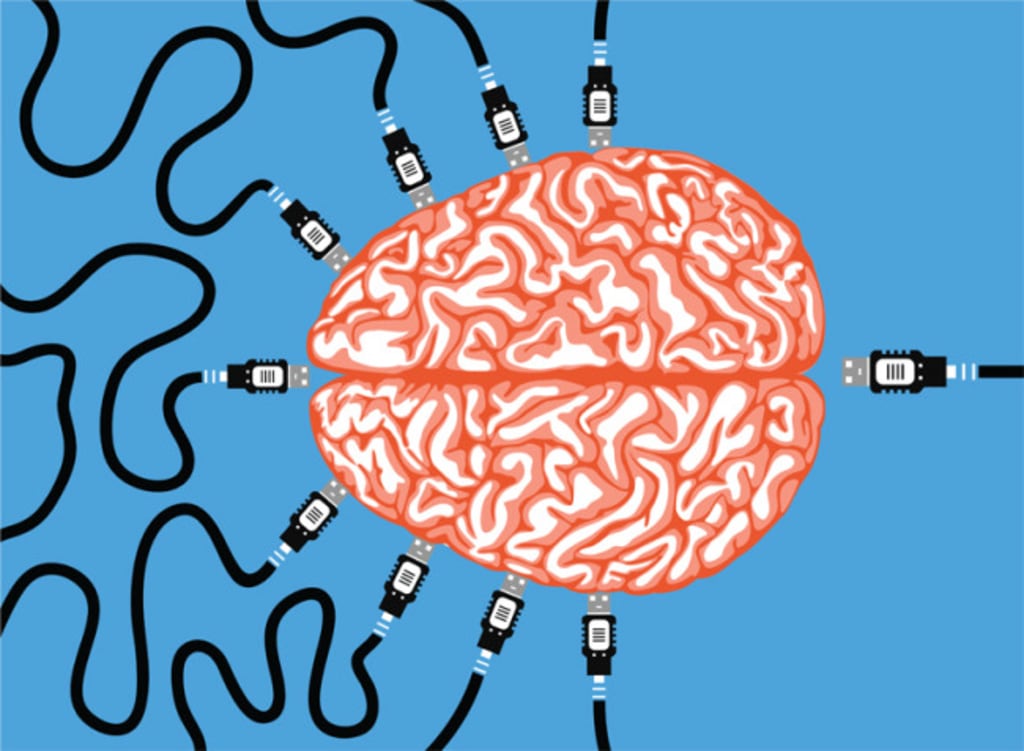
Welcome, valued customer! To celebrate the year 3000, you have been selected for a first ever promotional viewership assessment. The four largest digital media neural transmitters have put aside their scramble for ratings dominance to offer their full catalogue of quality programming to you for free to assess what you’re viewing and decide which provider offers the best in digitally transmitted neural entertainment, sports, and news. Only one service will reign supreme to dominate your brain waves for the rest of your life!
Free neural transmitting, or “the pipe” as we like to call it, won’t be your only perk in participating. Each selected customer will also receive $20,000 and the ability to effectively control the fate of the actors, actresses, pundits, directors, writers, personalities, and more on all transmitter networks. If you look in your prize package, you should have also received a small black tablet. On this tablet, you are to record your assessments. Don’t concern yourself with e-mailing us anything. Once you’ve recorded your opinions, they’ll be automatically whisked away to our servers for processing. Each show you lock onto in the pipe must be scored for writing, directing, acting, and so on. For sports, you must score the commentator’s zeal and knowledge for the sport and you must rate the player’s performance. And finally for news, you must score on-air personalities for what you believe to be fair and balanced journalism as well as their overall credibility. It’s a lot of work, but a lot of fun as you get to be the boss and make real network decisions!
Now, I know what you’re thinking. What about my 20 grand? Rest assured, your money will be wired to the bank account you provided in the application you sent us, but only upon completion of this unprecedented assessment. And remember to take your time and be honest during this process. We’ll know if you’re not being truthful. We’re inside your head, after all. We’re Vedia-Synapticon.
Rhea Barker opened her eyes, ending the transmission. She peered down at the simple white envelope on the kitchen table. “VS” in bold gold letters appeared in the top left corner. There was no address. Rhea carefully peeled away the adhesive strip from the envelope and tilted it on its end. Out tumbled a thin black screen the size of a slice of bread. Without touching the thing, a red progress bar stretched across the screen multiple times and the Vedia-Synapticon logo surged to life. Once the logo faded to black, white letters flowed across the screen.
“Welcome.” It said. “Congratulations on being chosen for this historic moment. Please close your eyes to enter the network and I will be automatically uploaded to your neural link via your subconscious. Rhea stood up from the kitchen table and walked to her recliner. She pulled up the footrest and lay her head back. Her eyelids slowly lowered like a dark curtain. Bright electrical pulses swam across her vision and the same screen from the tablet appeared. Words in distinct white lettering once again flashed into view.
“Hello, Ms. Rhea Barker of 1112 Villas Street, Newton IA. You have been selected to decide the fate of the four competing neural networks in the Vedia-Synapticon family. Do you have any questions before we begin?”
“How long will this take?” A flurry of electricity darted from one eye to the other. Rhea knew she was speaking, but her flesh and blood lips weren’t moving. More words appeared on the dark screen.
“It will take as long as you need it to.”
“That’s not ominous or anything.”
“I can assure you, there is no malevolent intent on our part. We just want you to get the best out of entertainment, sports, and news…”
“Okay, okay. Let’s just do this so I can get back to watching the pipe like a normal person.”
“Very well. Let’s begin with the first program.” The black screen dissipated, and, in its place, a large living room set appeared with plush couches, clean floors and a recurring cast of five people, who’s every word was followed by disembodied laughter.
“A sitcom?” Rhea’s voice asked inside her subconscious. “They still make these?”
“Only two sitcom offerings on ViewMax, one on BotPoc, three on Tilleys, and zero on Cruge. Despite its obsolescence, this type of show continues to find an audience amongst niche consumers who find comfort in the bizarre non sequiturs, outdated stereotypes, and overused laugh-track.
“Alright, guess I’ll give it a shot.”
The living room scene involved a child named Mikey who was having his birthday party with all of his family members present, his mom June, dad Phil, older sister Lauren and older brother Dave. There was a mountain of opened presents behind them, including a random sink fixture at the top of the pile that Rhea demanded an answer to right away. By all accounts, the family was completely normal. There were no quirks or idiosyncrasies. Nothing about the members of the family were necessarily unique from one another except for singular stock character traits. The youngest son was bratty, and his parents gave him whatever he wanted. The middle child felt underappreciated, the oldest was always held to a high standard, the mom was overworked, and the dad was aloof. Rhea found it trite and uninspiring.
“I’m not into this.” Rhea said.
“And why do you say that Rhea Barker?” The black tablet asked her.
“It’s too formulaic. Just the same ‘ol white suburban family that can solve their problems in twenty minutes without addressing underlying, long-term trauma. I mean, look at this kid. His parents will probably let him get away with murder. This just isn’t my thing.”
“So, would you be willing to rate this program?”
“Yeah.”
“Very well, rate your experience by using three criteria. First, are the writers and directors of this program working at their full potential? Please be honest. We’ll know if you’re lying.”
“Um, I really don’t think so. It’s probably time for them to step down.”
“Thank you. Next question. Are the actors in this program working at their full potential? Again, please be honest.”
“I mean, I guess. They’re doin’ the best they can with what they’re given. Maybe it’s just time to put them poor people out of their misery.”
“Thank you. And last question, in your opinion, should this program no longer exist?”
“In my opinion, no.”
“Thank you for your honest answers. We’ll now return you to your program. We’ve made some alterations. We hope you approve.” The tablet screen disappeared and in its place was the bright, colorful world of the sitcom from before. There was still a family huddled on the sofa with a birthday cake on the coffee table and a mound of presents in the background.
“Did you get everything you wanted for your birthday, sport?” Phil said.
“Yeah…I guess so.” Mikey shrugged; his face sagged like runny eggs.
“Why so blue?” June massaged her son’s back.
“Yeah, you got everything and the kitchen sink.” Lauren quipped. “Literally.” This was followed immediately by hollow laughter, even applause. That was meant to be a sure-fire gag.
“I know.” Mikey replied once the laugh track calmed down. “It’s just none of you could give me what I really wanted for my birthday.”
“And what’s that, Mikey?” June asked.
“Yeah, is it a T.V. in your room?” The laugh track spazzed out again.
“No, boundaries.” Mikey’s family was dumbstruck with this response. And everything around the set went dark. There was only a single spotlight on Mikey as he continued speaking, this time directly to the audience. “Parents are supposed to set boundaries for their children. It keeps us grounded and teaches us responsibility. But when you cave to my demands, it says you’re not invested in my future as a well-adjusted human being. Face it, mom and dad, you’ve given up.” The laugh track came on again, but there was no response from the other actors, just abject fear. June’s eyes widened and she looked wordlessly at her TV husband.
“Why did he say that?” June pleaded. “Hank?” She turned to the little boy who played Mikey and shook him anxiously. “Why did you say that line? That’s not in the script.” She pulled at her own hair, threatening to remove it in clumps.
“Calm down, Clara.” The actor playing Phil gripped her shoulders. “Everything’s fine. There’s still time okay?”
“No, this is happening right now. This is no longer standard procedure.”
“What if she’s right?” The actress playing Lauren stared off into the distance. “What if we’ve done bad?”
“We can’t be doing that bad.” The actor playing Dave winced. “We’ve received consistent viewership for five years. They can’t get rid of us now. We’re just hitting our stride.”
“I don’t understand.” Rhea said. “What’s happening to them?”
“They’ve been canceled,” the typewriter efficiency of letter on the screen of the black tablet hammered out its cold proclamations.
“Yeah, but…that quickly?”
“You provided everything we need to make the correct decision.”
“That doesn’t answer my question.”
“The receiving stations for neural implants have become oversaturated. Viewers aren’t staying tuned to their implants like in decades past. We’ve tried reinventing concepts for programming, we’ve tried focus groups, and we’ve tried nostalgia. Nothing appears to be working. As a result, we’ve been forced to eliminate all weaknesses. Each of the five million customers we’ve chosen for this assessment are given their own unique set of programs—unique only to you.”
Rhea looked on in horror at the middle-class suburban family as they scrambled around a darkened set. The multiple cameras showed pink, sweaty, bleary-eyed faces frantically pleading, hoping against hope that someone would come to an economic agreement. The actor playing Dave was in the process of destroying the set with everything from coffee tables to the kitchen sink prop.
“So, you’re saying I’m the only one who’s watching this sitcom right now?” Rhea asked.
“Yes, that is correct.”
“My verdict is all they have?”
“We did make it clear that you would be making the decisions.”
The actor playing Dave had located the closet on the set and found a metal box with a handgun inside for next week’s planned episode which clearly involved gun safety. He picked up the handgun and shoved the barrel in his mouth, clenching his teeth for the sweet release. Once he squeezed the trigger, there was only a hollow click like a Tic Tac in a plastic shell.
“Fucking prop…” Dave grumbled. He proceeded to grip the doorknob and slam his head repeatedly against the door jamb. The actress playing June swallowed a painful fifth of vodka before finding another which she doused herself with. She pulled out a cigarette lighter and held it up to Camera 3, slowly burning her face away, all the while screaming how do I look now?
“But I’m not some network executive.” Rhea wriggled uncomfortably in her seat. “And I’m definitely not an executioner.”
“Aren’t they one and the same?”
“Who the fuck are you people?”
“Entertainment is incentive, Mrs. Barker. People need to get on with their lives, and we help them do that. Imagine someone working three jobs just to pay rent on a one-bedroom apartment or buy medicine. What do they have to come home to? Family? Children maybe? No, Mrs. Barker. They come home to resentment. There’s no balance. But every so often we give them a little taste of power and the resentment fades. We’ve righted the scales.”
“But these poor people…those actors…”
“They were made aware of the consequences should they fail tonight. The problem will rectify itself in short order and you will be $20,000 richer and completely blameless.” The actress playing Lauren lay on the edge of the stage, crushed by Camera 2. The actor playing Phil took broken shards of glass from the coffee table and jammed them into his eyes in an attempt to erase the images from his mind. Only the young actor playing Mikey remained.
He sat still behind the coffee table, blood staining his hair and cheek. His saucer eyes pulsed with the throbbing silence of the now derelict set. Each blue pupil pierced into Rhea Barker’s mind even after the last camera went dark and her brain turned to static.
About the Creator
Keep reading
More stories from writers in Horror and other communities.


Comments
There are no comments for this story
Be the first to respond and start the conversation.