

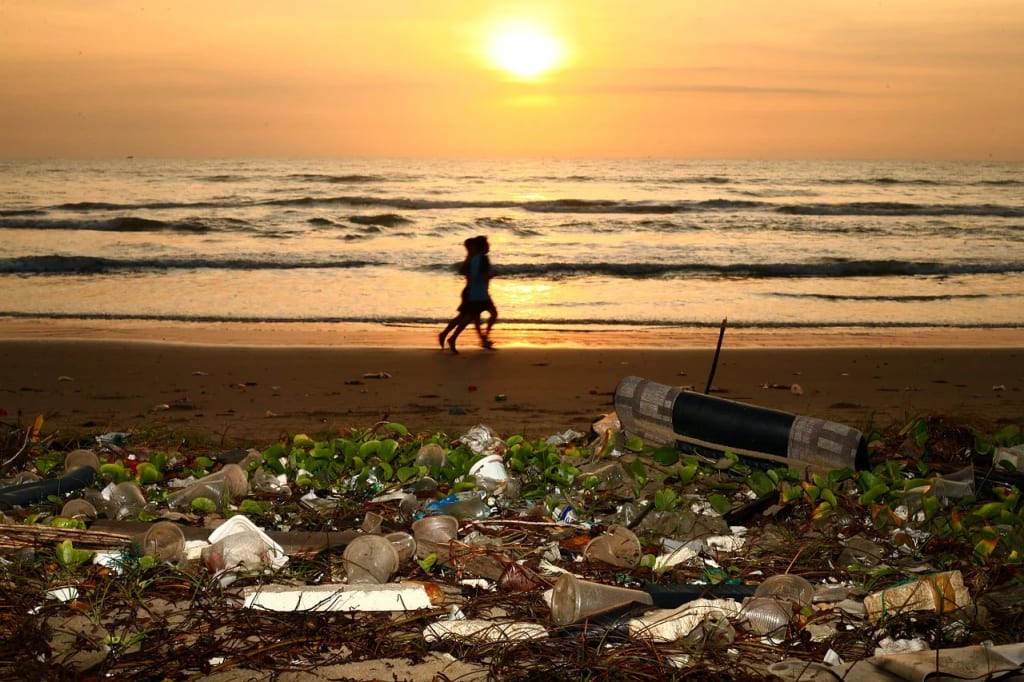
There was no more sand on the beach there, not even beneath the debris. Plastic and metal all the way down. Bottle caps, aluminum cans, shards of broken bottles, rusty coils tetanus-sharp on both ends, tens of thousands of latex gloves and unwrapped condoms, televisions, old landline phones with coils tied in knots, egg cartons and pizza boxes waterlogged to pulp. There was the odd bone. A fish’s spine, the hollowed out husk of a crab, the occasional fragment of what could be a skull. There was never any meat on any of them. And there were no more seashells.
The line between garbage dump and ocean had vanished completely. It made no sense to call it litter anymore, or detritus, or whatever, it was simply terrain. If you dug deep enough, you’d find it had all become quite structural. Layers of trash at the bottom might be a hundred years old or more, compacted into a formidable crust. What was capable of decomposing had done so, but most of it had been built too well for that. The foundations were sturdy.
Ceaselessly, the wind rolled off of the black water onto the land. Sometimes violent, sometimes faint, but never completely quiet. On a bad day it might whip up great cyclones of trash, towering into the sky a mile. This was dangerous to walk through, even with the safety gear they all had. If you got caught in a really bad one, you could get buried in seconds flat and nobody would ever see you again – assuming there was anyone who cared enough to look.
Even a calm day was no picnic, though. The sea breeze stung pins and needles at the skin, air full of micro plastics and powdered glass you couldn’t see until you started noticing little dots of blood on any skin you were stupid enough to leave bare. Without sufficient facial coverage, your eyes, lungs, ears, every orifice, could be raw red in minutes. Everybody knew this, though. There was no skin at the beach.
The men working there never rested. Nobody knew when they had begun. They rode their great big green and yellow tractors out of the ocean, and back in, regular as the tides, hauling submerged shovelfuls of trash from far off the shore to high up on the beach, where they piled it in tall, precarious dunes. The sound was enormous. The deep rumbles and high whines of their tank-like tires on shore; a load-bearing piece of trash far beneath the surface wincing and buckling under their weight, finally giving into the pressure and snapping, metal against metal, so that the whole beach would tremble and lower a foot; the avalanche noise of them dumping a load, glass shattering and styrofoam squeaking and plastic crunching. They never paused between the trips, just turned around and drove straight back into the sea so far they could no longer be seen. There was always a moment you lost sight of them beneath the waves, thought they might have been swallowed up for good. But always they came back with more.
The men who rode the tractors – those long, high, slow-moving mammoths, powered by hydraulic steel arms chuffing and sweating, up and down, back and forth, like a great armored cricket playing hideous mechanical music – those were the lucky ones. The others stood at the base of the garbage dunes with spades. It was a pathetic instrument for the endless job. But there they remained, never tiring, never resting, loading their puny shovels with what little they could hold, then launching it through the air towards the top of the slope. Much of it tumbled right back down, old syringes and twisted lengths of pipe raining on them as they worked. They never seemed to notice, just kept right on working, making no noticeable difference to the size of the already immense peaks.
It was hard to see how the men in the tractors were dressed because their cabin windows were so caked over with ash and dust. But those on the ground had a standard uniform. A body suit made out of some rough material, denim or even burlap, colored green or blue or maybe even yellow but long since faded into a decrepit brown. This covered every inch of their skin. Most of the outfits were criss-crossed with patches, though who had sewn them on or when it had been done was anyone’s guess. They all wore gloves and boots attached to the sleeves with layers of rubber bands that they were always replenishing (there was no shortage of rubber bands to be found there.)
And of course they all wore the typical facial equipment. Fully shielding, but baggy, with a rubber breathing hose that led to a rig on the back which filtered out most of the particles in the air. Most, but not all. It wasn’t unheard of for a man to keel over, his lungs full up with blood. The others would pay him no mind, and in a few minutes he would be entombed beneath the surface and forgotten. Nor was it uncommon for a whole line of the shovelers to be taken by surprise by one of the tractors, all of them crushed beneath a fresh pile of trash. The tractors seemed unaware, or uncaring. It is possible they were not even working for the same outfit. Their own work did seem to make the shoveling efforts redundant. (All these buried men were no doubt the source of many of the rubber bands.)
Nothing could distract the men from their work – nothing, that is, until the day the strangers arrived from over the dunes. Clambering on bare hands and feet – all-fours like spiders – they came in groups of two or three. Dressed in torn clothes, hair long and knotted. Faces smudged with soot. They leap-frogged and tumbled and slid on their bottoms down the dunes. Frolicking across the beach and whooping into the wind, they didn’t seem to notice as they sliced their feet open on strips of razor wire and shards of broken glass. Nor did they wince when the winds covered their pale, naked skin in a million tiny cuts. The air thick with poison should have muzzled their cries, but they only grew louder, screeching like shore birds over the fierce winds and the crashing waves.
Most of the shovelers ignored them. Some, most likely, never noticed them at all. Others thought them scavengers, unlikely as that was (what was here to scavenge?) and swatted at them with shovels when they drew too near. But mostly, the different groups kept to themselves. The strangers did not care about the men with shovels. It was the tractors they had come to see.
The tractors. The strangers froze like newborn babies the first time they saw one, foam running snot-like down its rusted green sides as it burst forth from the sea. Falling to their knees in quiet reverence, they dared not step in its tread-marked path. Instead they followed its progress with their eyes wide and empty of sin, their mouths open round in perfect awe. The shouting and dancing stopped at once all across the beach. More tractors came out – two, then three, then easily a dozen, criss-crossing each other’s paths, passing by but never touching one another. One would dive down while another surfaced right next to it. Occasionally, two tractors would become synced up, rumbling side by side like well trained soldiers, raising their shovels and releasing in perfect unison, until some tiny difference in the size of their loads, or some small dip in the path, would set them out of time, and the effect would be lost. The strangers sat perfectly still watching them for an hour.
One of them at last worked up the courage to get a little closer. He wore cracked old swimming goggles, and there was blood dripping from his nose and from his patchy scalp. He crawled through the garbage on uncertain hands and knees to approach one of the tractors which had just emerged from the sea. The others watched without breathing, clutching their knees with white knuckles. As the tractor drew closer, the brave, bespectacled stranger rose to his feet. His legs wobbled like jello; it must have been some time since he had last put all his weight on them. The tractor slid past him, mere centimeters from his nose. It did not stop, would have rolled right over him if he had been just a few inches closer. His eyes followed it adoringly, lit like lanterns. He took a shaky step towards it as it passed him on its way to the dunes; then another step; then he was walking quite quickly. The tractor lifted its shovel over the dunes. He pressed his palm gently on one of its tires.
Its load delivered, the tractor made a wide U-turn, same as always, but the stranger did not let go. Instead, he wrapped his arms around the back wall of the cabin, hoisting himself up so his feet rested on the tires like a pair of stirrups. As the tractor rolled its way back towards the sea, hydraulics punching the air and thick fumes rising from the engine, he remained glued to the back in a huge, comical embrace. The water rose up to his legs, his waist, his neck, but he did not budge. The waves pummeled him, filled his lungs with sour black brine, but he remained still. Watched intently by the rest of his companions, he sunk beneath the surface and was gone.
Once he had gone under, the other strangers stood up one by one. It was like they had been waiting for a signal – or just for someone else to go first. Each of them chose their own tractor, tugged forth by holy magnetism. Now that they had found their goal, they seemed to glide over the surface of the beach, feet not making a dent in the trash. Gone were the rude, animalistic gestures of their arrival. Now they were lithe, elegant, as they repeated the motions of the first man, hugging so stupidly the machines that couldn’t feel their touch, only carry them out into the dark, troubled sea.
It was difficult to hear over the winds that day, especially for the shovelers (with their facial gear) and for the drivers (safely enclosed within their machines). And besides those two groups, there wasn’t really anyone else there to listen. But if, say, you had been there that day, you would have heard, before the strangers went underwater, their peculiar song. It was maybe more of a chant. Just a couple of words, sung over and over, first high, and then low. Strange words that you never heard before, and couldn’t quite remember how they went. But the texture of it would have remained with you. How surprisingly sweet their voices. How far their song carried across the wide open beach, seemingly none of it muffled by the mountains of trash. How, miraculously, they could be heard clearly over the winds, the waves, the tractors, the shovelers’ endless scraping. Even when their bodies were nearly submerged, their voices were still loud, brimming with joy. And when they went under at last into what we can only hope was a more perfect world, if you listened, I think, if you listened very carefully, you could hear them still.
About the Creator
Keep reading
More stories from writers in Horror and other communities.
Dusty Bones
A rickety worn shack swayed ominously as a malicious wind tore after it. A fevered cry from the weathered boards fell upon an old man’s ears. He paid it no mind however and continued to stare forlornly out the shattered panes into the ocean’s depths below. An internal battle raged through his mind as a lone candle flickered threateningly. “All alone… everyone’s gone… my fault.” His tattered memory danced across his lips as his ghosts relentlessly tormented him. One peering inside the shack may mistake him as a lone ghost himself, for his pale and frail bones looked skeletonized from his fever crazed state. He stands at this fractured window and stares at the sea, haunted always haunted.
By Mikayla Decker 7 days ago in Horror
The Devil's Triangle
The sails ruffled in the breeze as we cruised along. The Sea Breeze was a mid-size catamaran that sailed out of Royal Naval Dockyard in Bermuda. We had booked this trip weeks in advance and were now looking at our Captain, Spike and two boat hands. Paddy and Wilson seemed like nice guys, joking around with the passengers and telling us some stories about Bermuda that only locals would know. Their island accents sounded almost British but they were pleasant to listen to.
By Barbara Gode Wilesa day ago in Fiction


Comments
There are no comments for this story
Be the first to respond and start the conversation.