
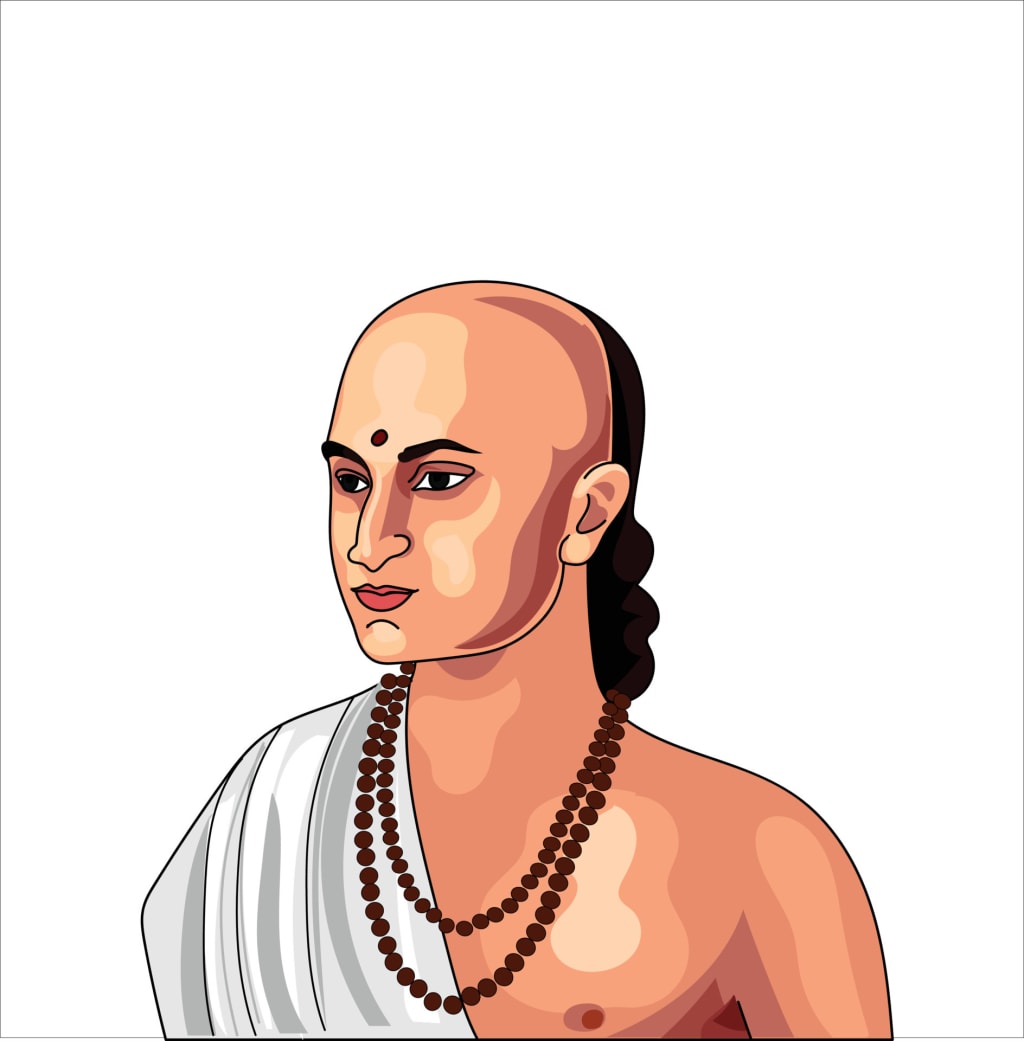
Once upon a time, in the vibrant and intellectually rich land of ancient India, there lived a brilliant young scholar named Aryabhata. Born in the city of Kusumapura, in what is now known as Patna, Bihar, Aryabhata displayed an insatiable curiosity from an early age.
Aryabhata, the ancient Indian mathematician and astronomer who lived around 476-550 CE, made significant contributions to the development of the number zero as we know it today. While he didn't invent zero, his work played a crucial role in the historical development of this fundamental mathematical concept.
Aryabhata introduced a symbol for zero in his mathematical writings, which was a dot or a small circle. This symbol acted as a placeholder and allowed him to represent numbers more efficiently, especially in large numerical calculations and astronomical calculations.
Growing up in a society where knowledge was highly revered, Aryabhata quickly immersed himself in the world of mathematics and astronomy. He was known for his voracious appetite for learning, spending hours poring over ancient texts, and engaging in animated discussions with other scholars of his time.
As he delved deeper into the mysteries of the universe, Aryabhata became fascinated by the movement of celestial bodies. He questioned why the stars twinkled, why the Moon changed its shape, and what made the planets wander across the night sky.
One day, while observing the night sky, a profound insight struck Aryabhata. He realized that the Earth was not the center of the universe, as many believed, but rather, it orbited the Sun. This idea was revolutionary and challenged the prevailing geocentric view of the cosmos.
With boundless determination, Aryabhata set out to compile his discoveries and insights into a comprehensive text. He meticulously penned down the "Aryabhatiya," a mathematical and astronomical masterpiece consisting of 121 verses. In this remarkable work, Aryabhata introduced the world to groundbreaking concepts that would shape the course of science for centuries to come.
One of his most celebrated achievements was the accurate calculation of the value of π (pi) as approximately 3.1416, a feat that laid the foundation for advanced trigonometric and geometric studies. Aryabhata also provided detailed trigonometric tables and introduced the concept of sine, cosine, and tangent functions.
But Aryabhata's contributions didn't stop with mathematics. His work encompassed various facets of science, from explaining the causes of eclipses to developing a precise calendar system. He even described the rotation of the Earth on its axis, a concept that wouldn't be widely accepted in the Western world for many centuries.
As Aryabhata's "Aryabhatiya" found its way into the hands of scholars and thinkers across India and beyond, his legacy grew. His groundbreaking ideas would eventually travel along trade routes, reaching the Islamic world and influencing scholars like Al-Biruni and Al-Khwarizmi, who further developed and shared Aryabhata's knowledge with the world.
Aryabhata's journey was not without its challenges, but his relentless pursuit of knowledge and his ability to think beyond the confines of convention left an indelible mark on the history of science. He became a guiding light for future generations of scholars, reminding them that even in the most ancient of times, innovation and intellectual curiosity knew no bounds.
Before Aryabhata's time, various ancient civilizations had notions of empty spaces or placeholders in their number systems, but the concept of zero as a digit with its own value was not fully developed. Aryabhata's use of the dot as a symbol for zero was a significant step in the direction of formalizing zero as a numerical digit.
The full evolution of zero as a mathematical concept took place over several centuries and across different cultures, including India, the Middle East, and Europe. It wasn't until the work of mathematicians like Brahmagupta in the 7th century and Al-Khwarizmi in the 9th century that zero was fully recognized as a numerical digit with a value of its own.
In summary, Aryabhata's contribution to the development of zero was in introducing a placeholder symbol in mathematical notation. While he didn't invent zero itself, his work was a pivotal step in the historical process that eventually led to the establishment of zero as a fundamental concept in mathematics.
User
Then the pai intention
ChatGPT
The concept of pi (π), the mathematical constant representing the ratio of the circumference of a circle to its diameter, has a long history that predates Aryabhata's time. Aryabhata himself made an approximation of the value of pi in his mathematical work, but he did not introduce the concept or its use in mathematics.
Pi (π) has been known and used in various cultures for centuries before Aryabhata's contributions. The ancient Egyptians and Babylonians had approximations for pi, and it was also known to ancient Greek mathematicians like Archimedes, who calculated its value more accurately.
Aryabhata's approximation of pi was around 3.1416, which was a significant and relatively accurate estimate for his time. He used this approximation in various geometric and trigonometric calculations. However, it's important to note that pi is an irrational number, which means its decimal representation goes on infinitely without repeating, and its exact value cannot be expressed as a simple fraction. The decimal representation of pi is approximately 3.14159265359..., with an infinite number of decimal places.
In summary, Aryabhata made an approximation of the value of pi and used it in his mathematical calculations, but the concept of pi and its use in mathematics predated his work by many centuries. Pi has a rich and ancient history in mathematics, with contributions from various cultures and mathematicians over time.
As centuries passed, Aryabhata's name and work continued to be celebrated, his story passed down through the annals of history as a testament to the power of human curiosity and the enduring impact of one remarkable scholar's quest for knowledge.
About the Creator
Rhitik Poudel
I am writter from South Asia and i love to write about the historical events of South Asia.
Keep reading
More stories from Rhitik Poudel and writers in History and other communities.
Prithvi Nayaran shah
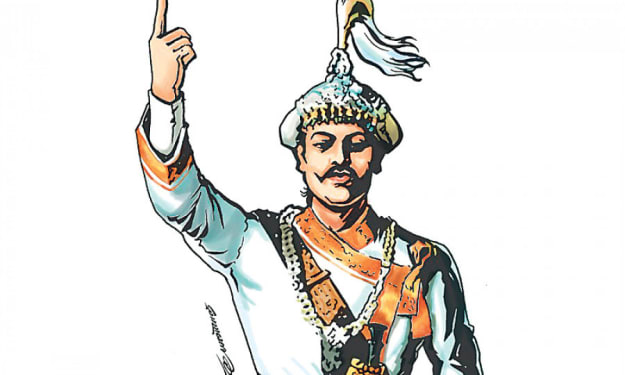
In the 18th century, amidst the Himalayan peaks and lush valleys of Nepal, a visionary leader emerged who would change the course of history. This leader was Prithvi Narayan Shah, a man driven by a dream to unify the fragmented kingdoms of Nepal into a single, formidable nation.
By Rhitik Poudel2 years ago in History
Hazrat Umar Farooq (RA
Hazrat Umar Farooq (may Allah be pleased with him) was born in Makkah Mukarramah. His kunya was Abu Hafs. He embraced Islam in the sixth year of Prophethood, at the age of 27. Even before accepting Islam, he was regarded with great respect because he was honorable, educated, brave, courageous, and wise in matters. He also had the honor of being the father-in-law of the Messenger of Allah (peace and blessings be upon him).
By Sudais Zakwan5 days ago in History



Comments
There are no comments for this story
Be the first to respond and start the conversation.