
“World War II: The Conflict That Changed the World
From 1939 to 1945, nations clashed and history was rewritten forever.”

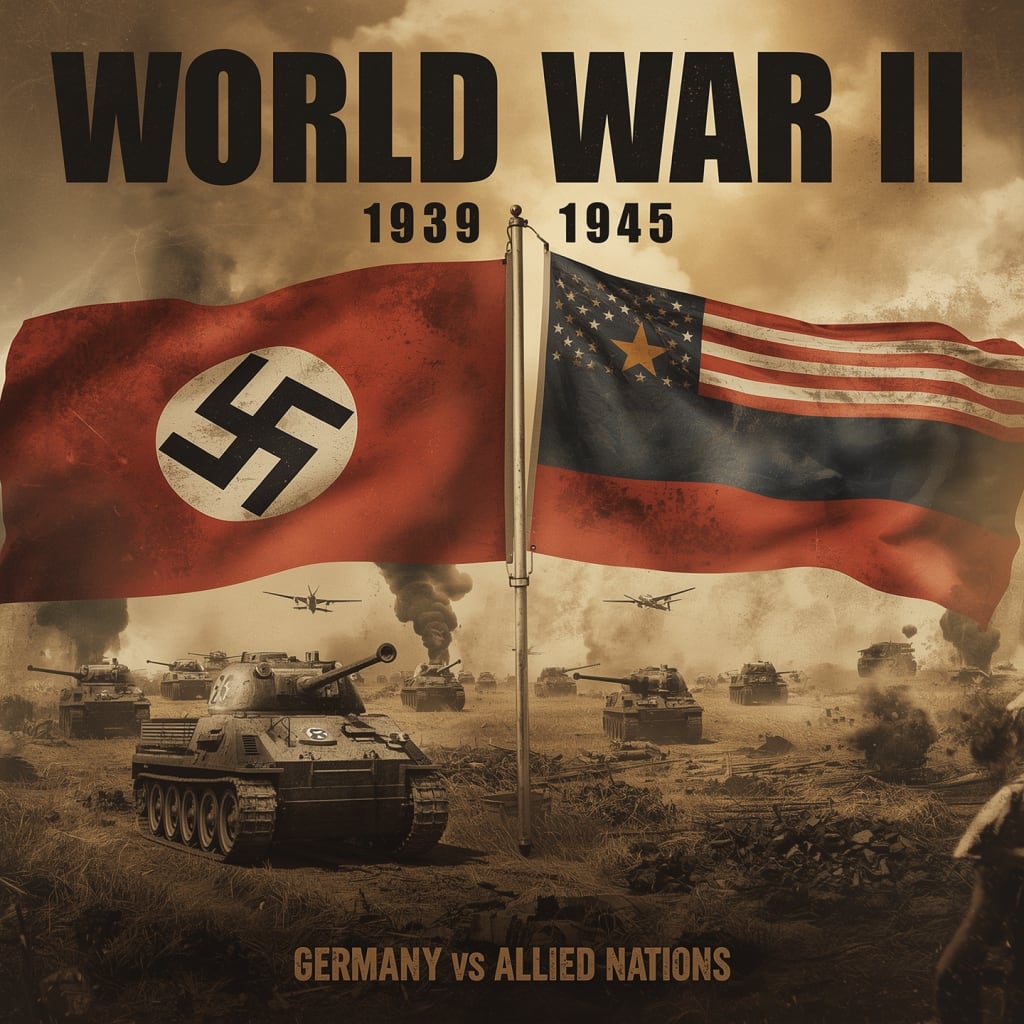
From 1939 to 1945, nations clashed and history was rewritten forever.
When the first German tanks rolled across the Polish border on September 1, 1939, the world changed forever. What began as a regional invasion soon escalated into the deadliest conflict in human history—World War II. For six long years, from 1939 to 1945, the globe was engulfed in violence, fear, and sacrifice on a scale humanity had never seen before.
---
The Spark That Ignited the War
The seeds of World War II were sown in the aftermath of World War I. The Treaty of Versailles left Germany politically humiliated and economically shattered. Many Germans felt stripped of dignity, fueling resentment and anger.
It was in this environment that Adolf Hitler and the Nazi Party rose to power. Hitler promised to restore national pride, reclaim lost lands, and build a “new Germany.” His expansionist policies—beginning with Austria and Czechoslovakia—tested the patience of European powers. But it was the invasion of Poland in September 1939 that finally forced Britain and France to declare war, plunging Europe into chaos.
The stage was set for a global conflict that would soon involve dozens of nations across every continent.
---
A Truly Global Conflict
Unlike any war before it, World War II reached nearly every corner of the globe. Europe became the central battlefield, but the war also stretched across North Africa, the Middle East, Asia, and the Pacific.
In 1941, Japan’s surprise attack on Pearl Harbor pulled the United States into the war, transforming it into a truly worldwide struggle. From that point onward, the conflict was fought on land, sea, and air—cities bombed from above, naval battles waged across oceans, and infantry campaigns fought in deserts, mountains, and jungles.
For ordinary people, the war was not confined to distant battlefields—it entered homes and daily life. Families rationed food, children were evacuated from cities, and millions of refugees fled violence. Entire populations endured air raids, hunger, and fear of sudden loss.
---
Turning Points That Shaped History
Every great conflict has moments that alter its course, and World War II was no exception.
On the Eastern Front, the Battle of Stalingrad (1942–1943) became a symbol of resistance and sacrifice. Soviet troops, aided by a bitter winter, turned back the German advance, marking the beginning of Nazi decline.
In the West, D-Day, the Allied invasion of Normandy on June 6, 1944, was another defining moment. Over 150,000 soldiers stormed the beaches of France, opening a crucial second front that would eventually liberate Western Europe from Nazi control.
Meanwhile, in the Pacific, naval battles like Midway and Guadalcanal tested American forces against Japan’s military might. The campaign was brutal, marked by island-hopping strategies, kamikaze attacks, and unimaginable loss.
By 1945, the war reached its violent climax. Germany surrendered in May, after Hitler’s suicide and the fall of Berlin. In August, the United States dropped atomic bombs on Hiroshima and Nagasaki, forcing Japan to surrender and officially ending the war.
---
The Human Cost of War
Beyond strategy and politics, World War II remains defined by its human tragedy. Over 70 million lives were lost, many of them civilians. The Holocaust stands as the most horrific crime of the era: six million Jews, along with countless others, were systematically murdered by the Nazi regime.
Across Asia, millions perished under Japanese occupation. Soldiers and civilians alike endured starvation, disease, imprisonment, and displacement.
Every family, in every participating nation, carried scars—whether in the loss of a loved one, the destruction of a home, or the lasting trauma of violence.
---
The World Rebuilt
Out of the devastation came a determination to rebuild and prevent such destruction from happening again. The United Nations was founded in 1945, aiming to foster peace and cooperation among nations. The war also accelerated social and political change: colonies in Asia and Africa sought independence, women entered the workforce in new numbers, and the global balance of power shifted toward the United States and the Soviet Union, setting the stage for the Cold War.
Technological advancements born of necessity—radar, jet engines, nuclear energy—would transform the modern world. But the deeper lesson remained human: that war, while sometimes unavoidable, carries costs too heavy to bear.
---
Lessons for Our Time
More than seventy-five years later, the legacy of World War II continues to shape our present. Its battles and atrocities remind us of the dangers of unchecked aggression, hatred, and division.
The courage of soldiers, the resilience of civilians, and the sacrifices of millions demand that we never forget the price of global conflict. Peace, though fragile, is a treasure worth protecting.
---
Final Thoughts
World War II was not only the bloodiest conflict in history—it was also a turning point for humanity. It revealed both the darkest depths of cruelty and the highest peaks of courage.
As we reflect on its history, one truth becomes clear: the war changed the world forever. Remembering it is not simply an act of honoring the past—it is a responsibility to the future.
About the Creator
Keep reading
More stories from Muhammad suliman and writers in History and other communities.
How One Boy Defied Expectations and Saved His Village
They Called Him a Failure In a quiet rural village, a boy sat in his classroom, staring at a page full of letters that refused to make sense. His classmates whispered and giggled, mocking his silence. Teachers sighed in disappointment, shaking their heads as if he was a lost cause. Even his own relatives doubted him, saying, “This boy will never amount to anything.”
By Muhammad suliman 4 months ago in Motivation
A secret staircase found beneath a 1,500-year-old French church
A subterranean staircase and burial strata dating back approximately 1,500 years were discovered during a project inside the Church of Saint Philibert in Dijon, France. The stairs were discovered by restoration workers inside the church when repairs were being made, and the excavation soon ensued.
By Francis Dami3 days ago in History
Martin Luther King's 'I Have a Dream' Speech: Things People Still Don't Know
Former President Ronald Reagan declared the third Monday in January to be Martin Luther King Jr. Day to celebrate the slain civil rights activist. Had he lived, he would be celebrating his birthday at age 97 on January 15, 2026, but he was assassinated at the young age of 39 on April 4, 1968.
By Margaret Minnicksabout 8 hours ago in History


Comments
There are no comments for this story
Be the first to respond and start the conversation.