
Why You Can’t Measure the Coastline of Britain
Exploring the Coastline Paradox
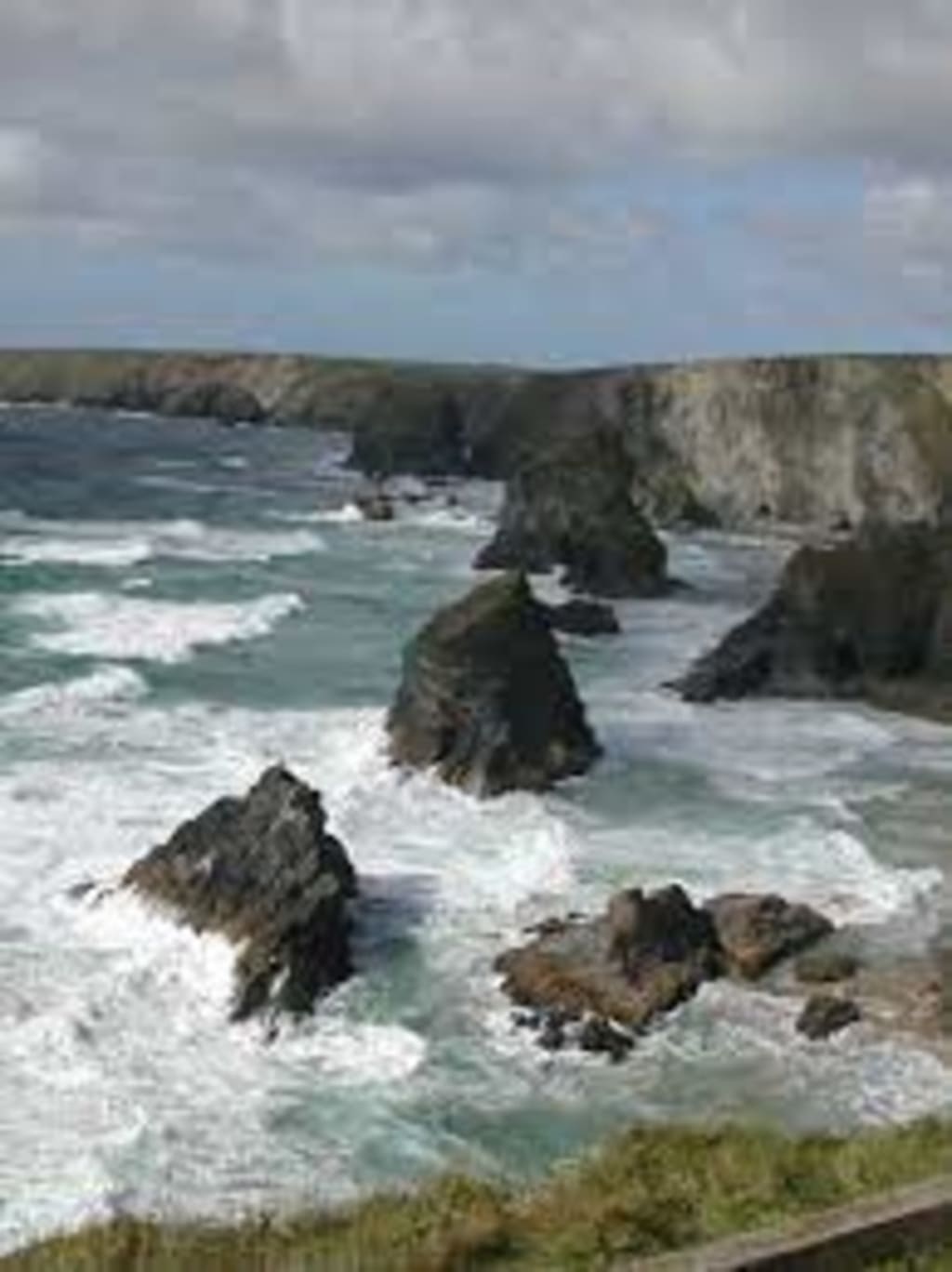
The length of a coastline may seem like a straightforward question, but it conceals an intricate enigma. In an age where we turn to Google for quick answers, estimating the coastline's exact length can be more challenging than you'd think. When you search for the coastline of the United States, you'll be met with varying results from reputable sources such as the Congressional Research Institute, the CIA, and the National Oceanic and Atmospheric Administration (NOAA). This perplexing divergence in measurements isn't limited to the United States alone. Welcome to the world of the "Coastline Paradox."
The Coastline Paradox extends its reach beyond the United States. For instance, if we ask which country boasts the world's longest coastline, most sources will concur that Canada is the undisputed leader, given its sheer geographical expanse. However, according to the CIA's World Factbook, the answer for the country with the world's second-longest coastline takes a more intriguing turn – Norway.
Norway's coastline, at first glance, may not seem extraordinary. However, the closer you zoom in on its jagged coast, the more complexity unravels. Fjords zigzag in all directions, and the profusion of islands adds to the intricacy. Norway ranks second globally in the number of islands, boasting more than 239,000. Astonishingly, Scandinavia harbors the top three countries in terms of island count – Sweden, Norway, and Finland, with over 685,000 islands among them. Although many of these islands are diminutive and uninhabited, they significantly impact coastline measurements.
The Coastline Paradox originates from a curious phenomenon known as the "Richardson Effect." It was first identified by cartographer Lewis Richardson in 1951 when studying the border between Spain and Portugal. The border was defined by the phrase "a line parallel to the winding of the coast." Since the coasts of these regions are characterized by jaggedness, the extent of winding is subject to interpretation. Richardson noted that the Portuguese and Spanish had significantly different official lengths for their shared border.
The Coastline Paradox is further elucidated by mathematician Benoit Mandelbrot, who introduced fractals to the measurement of coastlines. Mandelbrot's work in the 1960s, particularly his paper titled "How Long Is the Coast of Britain," emphasizes the self-similarity of jagged coastlines. Regardless of how closely you magnify them, a similar pattern of jagged edges persists. Jagged coastlines, like Scotland's west coast, exhibit fractal-like properties.
At an atomic level, coastlines are in a state of perpetual change due to erosion caused by wind and tidal forces. This dynamism implies that coastline measurements can theoretically extend to infinity, making it impossible to pinpoint an exact length.
The Coastline Paradox has far-reaching implications, including in geopolitics. A historic example is the late 19th-century dispute between the United States and the United Kingdom over the border between Alaska and Canada. Different measurements of the jagged coastline led to conflicting territorial claims, which were eventually resolved by arbitration.
The Coastline Paradox is a testament to the intricate relationship between geography, mathematics, and the dynamic forces of nature. In the world of coastline measurement, precision is elusive, and interpretations vary. When determining the length of a coastline, one must consider the method used, the scale of measurement, and the biases of those involved. The next time you hear about the length of a coastline, remember that it's a subject open to interpretation, rather than a concrete fact.
For those seeking to delve deeper into the captivating world of geometry and the Coastline Paradox, the online learning platform Brilliant offers courses that can demystify these complex concepts. Brilliant's courses provide a structured and guided approach to understanding geometry and other STEM-related subjects. By joining the Brilliant community, you can embark on a journey to unravel the mysteries of our world's intricate mathematical relationships and phenomena.
About the Creator
Keep reading
More stories from Dinithi Lakshani and writers in History and other communities.
Truth or Myth: Can Pets Really Predict Earthquakes?
In the intricate tapestry of the animal world, a wealth of astonishing facts and captivating behaviors continues to pique our curiosity. From the remarkable powers of pets to the captivating art of mimicry in the wild, the realm of animals holds an array of secrets that never cease to astound and intrigue.
By Dinithi Lakshani2 years ago in Petlife
De-Globalization or Re-Globalization? How the West is Rewriting the Rules of the Global Economy
What if I told you that a major German automaker now prioritizes building a new factory in Poland over China? Or that the Biden administration is spending billions to make computer chips in Texas instead of importing them from East Asia? This isn't a hypothetical future—it's today's economic reality.
By Hossam Gamala day ago in History


Comments
There are no comments for this story
Be the first to respond and start the conversation.