
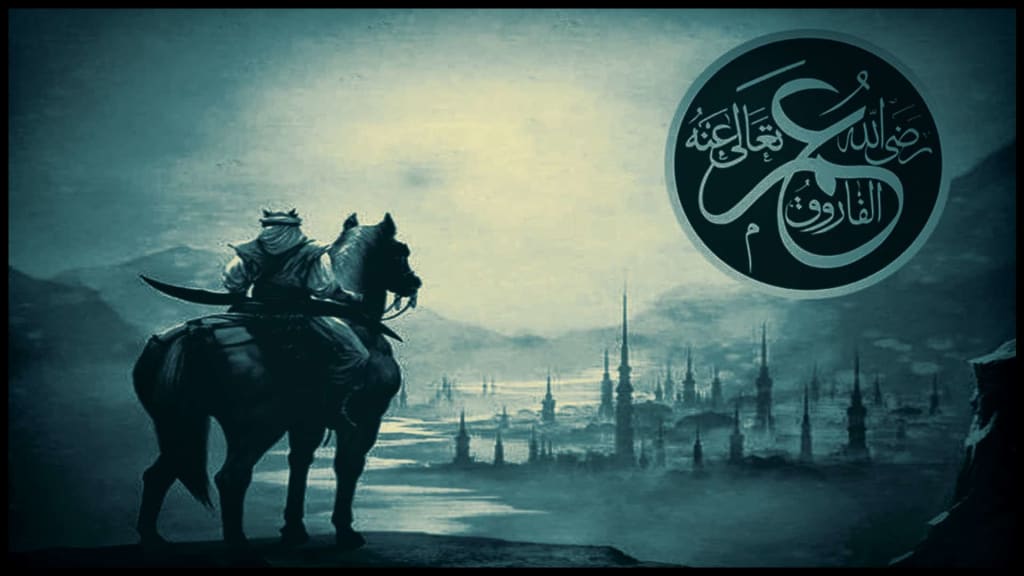
Who was hazrat umar ibne khitab?
Second caliph of islamic history.

b
---
Hazrat Umar ibn al-Khattab (RA): The Just Caliph
Hazrat Umar ibn al-Khattab (رضی اللہ عنہ), the second Caliph of Islam, was one of the most influential and powerful Muslim rulers in history. Known for his justice, simplicity, and leadership, his era marked a golden age of Islamic expansion and administration. He was a companion of Prophet Muhammad (ﷺ), a courageous warrior, and a symbol of justice.
Early Life
Hazrat Umar (RA) was born in Mecca around 584 CE into the respected Adiyy clan of the Quraysh tribe. His father, Khattab ibn Nufayl, was a merchant, and Umar (RA) followed in his footsteps, becoming well-versed in trade, horsemanship, and poetry. In pre-Islamic Arabia, he was known for his intelligence, strength, and eloquence.
Before accepting Islam, Umar (RA) was one of the staunchest opponents of the Prophet Muhammad (ﷺ) and Islam. He strongly resisted the new faith and even planned to kill the Prophet (ﷺ). But Allah had written something extraordinary for him.
Acceptance of Islam
The story of his conversion is dramatic and inspiring. One day, while on his way to kill the Prophet (ﷺ), he met a man who told him to first deal with his own sister, Fatimah bint al-Khattab, who had already accepted Islam. Furious, Umar (RA) went to his sister’s house and found her and her husband reciting verses from the Qur’an (Surah Taha). He struck them in anger but upon seeing their calmness and dedication, his heart softened. He asked to read the Qur’an himself.
When he read the verses of Surah Taha, his heart trembled, and he was overwhelmed by the beauty and truth of the message. He immediately went to the Prophet Muhammad (ﷺ) and accepted Islam. His acceptance was a turning point for Muslims in Mecca. With Umar (RA) on their side, Muslims began to practice their faith more openly.
The Prophet (ﷺ) gave him the title "Al-Farooq" meaning "the one who distinguishes between right and wrong".
Services During the Prophet’s Lifetime
After embracing Islam, Hazrat Umar (RA) became one of the closest companions of the Prophet (ﷺ). He participated in all major battles, including Badr, Uhud, Khandaq, and Tabuk. He was known for his deep understanding of the Qur'an and was often consulted by the Prophet (ﷺ) on various matters. On multiple occasions, verses of the Qur'an were revealed in agreement with his opinions.
Hazrat Umar (RA) was one of the ten companions promised Paradise by the Prophet (ﷺ) in their lifetimes (Ashra Mubashra).
Caliphate
After the death of Hazrat Abu Bakr (RA) in 634 CE, Hazrat Umar (RA) was appointed the second Caliph of the Muslims. His rule lasted for 10 years and was marked by remarkable achievements and expansions. Under his leadership, the Islamic empire expanded beyond Arabia into Iraq, Syria, Palestine, Egypt, and Persia.
Despite ruling such a vast empire, he lived a life of extreme simplicity. He would sleep on the ground, wear rough clothes, and personally inspect the streets of Medina at night to check on the welfare of his people. Justice and equality were the core principles of his rule.
Reforms and Achievements
Hazrat Umar (RA) introduced many administrative and social reforms that laid the foundation of Islamic governance:
Establishment of the Islamic calendar (Hijri)
Creation of the police department (Shurtah)
Establishment of courts and appointment of judges (Qadis)
Regular stipends for the poor, widows, orphans, and disabled
Construction of roads, canals, and rest houses for travelers
Building mosques in newly conquered lands
Organizing an efficient army and dividing the empire into provinces
He ensured that non-Muslim citizens under Islamic rule were treated fairly and protected under Islamic law (Dhimma). He enforced strict accountability among governors and officials.
Character and Justice
Hazrat Umar (RA) was famous for his sense of justice and fear of Allah. Once, he punished his own son for drinking alcohol. In another case, a poor woman complained against the Caliph's rationing policy, and Hazrat Umar (RA) personally carried food on his back to her home.
His leadership was built on fairness, consultation (Shura), and honesty. He would say:
> "Even if a dog goes hungry near the river of Euphrates, Umar will be answerable on the Day of Judgment."
Martyrdom
In the 23rd year of Hijrah (644 CE), Hazrat Umar (RA) was attacked by a Persian slave named Abu Lu'lu during the Fajr prayer in the mosque of Medina. He was severely wounded and died a few days later. Before passing away, he appointed a committee of six companions to choose the next Caliph, which led to the selection of Hazrat Uthman ibn Affan (RA).
Hazrat Umar (RA) was buried next to the Prophet Muhammad (ﷺ) and Hazrat Abu Bakr (RA) in the Chamber of Aisha in Masjid al-Nabawi, Madina.
---
Legacy
Hazrat Umar (RA) left behind a legacy of justice, leadership, and governance that is still studied and admired today. He is remembered as one of the greatest rulers in Islamic history. His example of accountability, fear of Allah, and love for the people continues to inspire generations.
May Allah be pleased with him and grant him the highest place in Jannah. Ameen.
---
os
About the Creator
Keep reading
More stories from Islamic history and writers in History and other communities.
Who was the third caliph of Islamic history? Hazrat Usman ibn Affan (RA): The Gentle Caliph of Islam
Hazrat Usman ibn Affan (RA) was the third Caliph of Islam and one of the closest and most respected companions of Prophet Muhammad (PBUH). Known for his generosity, humility, and piety, Hazrat Usman played a critical role in the expansion of the Islamic empire and the preservation of the Holy Qur’an. His rule was marked by prosperity, but also by trials, which ultimately led to his martyrdom.
By Islamic history8 months ago in History



Comments
There are no comments for this story
Be the first to respond and start the conversation.