
What is the complete history of Surat?
The Danveer Karana: The Story Behind His Last Rites in Surat


Why did Krishna have to perform Karna's last rites with his own hands? Read the story of Mahabharata. The death of the charitable Karna happened because of Lord Krishna, the last rites were performed in Surat, know why this happened
Ramayana and Mahabharata are the foundation of Hindu culture. Mahabharata teaches us how to live life. More than one great person is mentioned in Mahabharata, one of which is Karna. Very few people know that the cremation of Karna of Mahabharata took place in Surat. There is a story behind why Karna was cremated in Surat itself.
The charitable Karna was the eldest son of Kunti, the mother of Pandavas. We must have heard a lot about Karna's life story. But have you ever heard about his death? When the Mahabharata war was going on and the war was going on between Arjuna and Karna, the wheel of Karna's chariot got stuck in the ground. Then Karna, talking about the rules made by his grandfather Bhishma, said to Arjuna, "O Arjuna, you will not attack me until I remove the wheel of the chariot."
Hearing this, Arjuna stopped. Then Lord Krishna said, O Arjuna, why are you stopping? Shoot the arrow. When Arjuna said that he was against the war. Then Lord Krishna reminded him that Abhimanyu was fighting alone, he did not know the rules of war. Didn't he remember the violation of the rules when Draupadi was mistreated in the assembly of Bharasabha?
Hearing these words, Arjuna got angry and attacked Karna with the weapon given to him by Lord Shiva. With this arrow of Arjuna, Karna came close to death. When Karna was waiting for his death, Lord Krishna thought of testing Karna. Lord Krishna took the form of a Brahmin and said, ‘Hey Karna, my daughter is getting married and I do not have any gold to give her, so give me some gold.’ Then Karna said that I have nothing. What can I donate to you? Then the Brahmin said that you have a gold tooth. Donate it. Karna said, Hit me with a stone and remove my tooth. The Brahmin refused to do so and said that he should donate it himself.
After this, Karna picked up the stone lying near him and broke his tooth with it and gave it to the Brahmin. On this, the Brahmin said that that tooth has become dirty, clean it. On this, when Karna shot an arrow at the earth with his bow, a strong stream of Ganga came out from there. After washing his teeth, Karna said that now he has become clean. After this Karna realized that this is no ordinary Brahmin. He is the Supreme Soul. So that you show me your true form.
Lord Krishna appeared in his real form. Shri Krishna then told Karna that “Your arrow Ganga will continue to praise you for ages.” In the world, there has never been and never will be a great philanthropist like you.
Shri Krishna told Karna that he can ask for any boon from him. Karna told Krishna that he had been cheated a lot because he was the son of a poor charioteer. In the future, when Krishnaji comes to earth, he should try to improve the lives of the backward classes. Along with this, Karna asked for two more boons. As the second boon, Karna said that in the next birth, Krishnaji should be born in his kingdom and in the third boon, he asked Shri Krishna to perform his last rites on virgin ground.
On investigation, only the Tapi River, Kuwari River, was found in Surat, which is also known as the Kuwari Mata River. Karna was cremated on the banks of this Tapi River and even today there is a temple of Karna here. The Chardham Temple of Surat and the three-leafed banyan tree are proof of Karna's last rites.
After the cremation of Karna on the banks of the Tapi River, when the Pandavas expressed their doubts about the virgin land, Shri Krishna appeared to Karna and told him through the air that he was the son of Surya and Ashwini and Kumar were his brothers. Tapi is his sister. Therefore, his cremation was done on the virgin land itself. The Pandavas said that we have come to know, but how will the coming ages know? Then Lord Krishna said that there will be a three-leafed tree here which will be the symbol of Brahma, Vishnu and Mahesh.
It is believed that if someone prays here with true faith, then his wish will definitely be fulfilled. Thus, this tree is still on the banks of the Tapi river in Surat and near it is a tree with three leaves. Which is known as Three Leaf Clover in Surat.
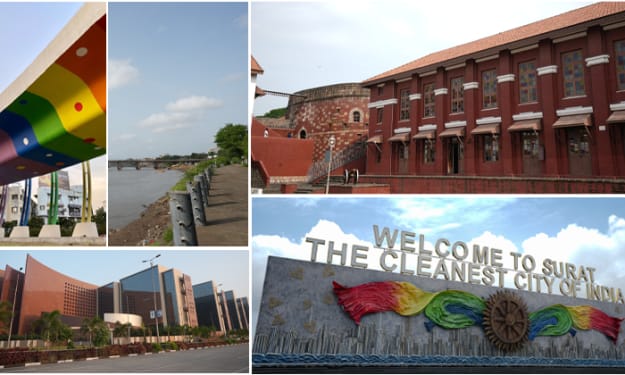
The Story Behind Surat’s Name
Surat is home to an impressive history dating back more than 300 BC,Surat is generally believed to have been founded around 1500 by a Hindu merchant named Gopi. At first, however, the town was known as "the new place". After consulting astrologers who suggested "Suraj", then "Suryapur", Gopi asked an unnamed king in Gujarat if this could become its official name; upon approval by Muslim rulers from Qur'an chapters like Surah (i.e. Suryapur or Surat!) even existed prior to Gopi's time - both names even existed even prior to Gopi!
Duarte Barbosa refers to Surat as Suratt while Jacob Peeters employed its Dutch equivalent, Sourratte (surratte). Other references have been made to Surat throughout history and literature as Surat, Soorat or Surate - often as synonyms.
It later came under colonization from Brigus, King from Sauvira on the banks of Tapi River. In 1759, British forces defeated the Mughals and gained control of Delhi; they held onto power until the early 20th century. Surat emerged as a key trade hub during the 16th, 17th, and 18th centuries due to its location along the Tapi River with 6 km of coast along Arabian Sea. It enjoyed maritime commerce during this period. Surat became an indispensable link between India and other nations, reaching its peak of prosperity before Bombay port rose to power. Surat was also well known for its shipbuilding industry - particularly along its coastline from Athwalines to Dumas where skilled shipbuilders, such as Rassis were concentrated. However, due to Bombay port's expansion and decline of Surat's shipbuilding industry. Since independence, however, Surat has experienced rapid economic development through textiles and trade industries, leading to significant industrial development and expansion within the city itself.
#surat
#hisurar
#surat history
About the Creator
Benjamin Franklin: The Mind That Helped Build a Nation
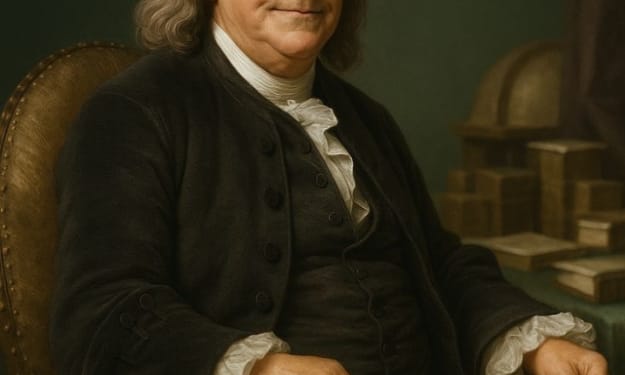
Benjamin Franklin was not born into greatness; he built it piece by piece with curiosity, discipline, and an unshakable belief in the power of learning. Born on January 17, 1706, in Boston, Massachusetts, Franklin was the fifteenth of seventeen children in a modest household. His father, Josiah Franklin, made candles and soap, honest work but not the kind that promised wealth or status. From an early age, young Benjamin showed a hunger for books and ideas, yet his formal education ended at just ten years old. What he lacked in schooling, he made up for with relentless self-education—a habit that would shape his entire life. Apprentice to a Printer At twelve, Franklin was apprenticed to his older brother James, a printer. The print shop became Benjamin’s classroom. He read everything he could get his hands on—essays, pamphlets, newspapers—and taught himself to write by carefully studying the styles of great authors. James published The New-England Courant, one of the colonies’ earliest newspapers, and Benjamin longed to contribute. Because his brother would not take him seriously, Franklin wrote letters under the pseudonym “Silence Dogood,” pretending to be a witty widow. The letters were published and widely admired. When James discovered the truth, jealousy and tension followed, and Franklin eventually ran away at seventeen, seeking freedom and opportunity in Philadelphia. Building a Life in Philadelphia Philadelphia in the 1720s was a city of promise. Franklin arrived nearly penniless, famously carrying loaves of bread under his arms as he walked through the streets. Yet he possessed something more valuable than money: determination. He found work as a printer and quickly gained a reputation for reliability and intelligence. Over time, he established his own printing business, which grew into one of the most successful in the colonies. Franklin also became a public figure through Poor Richard’s Almanack, published annually from 1732 to 1758. Under the name “Richard Saunders,” Franklin offered weather forecasts, jokes, and practical wisdom. Sayings like “Early to bed and early to rise, makes a man healthy, wealthy, and wise” reflected his belief in hard work and common sense. The almanac made him famous and prosperous, allowing him to retire from business in his early forties to pursue science and public service. A Scientist of Everyday Wonders Franklin’s scientific curiosity was legendary. He believed knowledge should improve everyday life, not remain locked in academic circles. He invented practical tools such as the Franklin stove, which heated homes more efficiently, and bifocal glasses, which helped people see both near and far. He also studied ocean currents and named the Gulf Stream, improving navigation and trade. His most famous scientific experiment involved electricity. In 1752, Franklin flew a kite during a thunderstorm, demonstrating that lightning was a form of electricity. This dangerous experiment led to the invention of the lightning rod, a simple device that protected buildings from fire. Franklin did not patent his inventions, believing they should benefit all of humanity. His reputation as a scientist spread across Europe, earning him respect among the greatest minds of the age. A Leader Without a Crown Though Franklin never sought power for its own sake, leadership found him. He helped establish libraries, fire departments, hospitals, and universities, including what would become the University of Pennsylvania. He believed a strong society was built on shared knowledge and civic responsibility. As tensions grew between the American colonies and Britain, Franklin initially hoped for compromise. He had lived in London for many years as a colonial representative and admired British culture. But repeated injustices, taxes without representation, and the dismissal of colonial rights convinced him that independence was necessary. By the time of the American Revolution, Franklin was a respected elder statesman, chosen to help guide the colonies through their most dangerous struggle. Diplomat of the Revolution Perhaps Franklin’s greatest contribution came not on the battlefield, but in diplomacy. Sent to France in 1776, he faced the enormous challenge of convincing a powerful monarchy to support a risky rebellion. Franklin’s charm, wit, and reputation worked wonders. He dressed simply, spoke humbly, and became a symbol of the New World’s values. French philosophers admired him; common people celebrated him. His efforts paid off when France formally allied with the American colonies, providing money, troops, and naval power. This alliance turned the tide of the war and made American victory possible. Without Franklin’s diplomacy, the Revolution might have failed. Shaping a New Nation After the war, Franklin returned home as a hero. Though elderly and in poor health, he continued to serve. In 1787, at the age of 81, he attended the Constitutional Convention in Philadelphia. While he did not speak often, his words carried great weight. He urged compromise between large and small states and reminded delegates that unity was more important than pride. His calm wisdom helped shape the United States Constitution. Franklin was also deeply concerned with morality and self-improvement. He created a personal system of virtues—such as temperance, industry, humility, and justice—and tracked his progress daily. He believed people could better themselves through reflection and discipline, an idea that strongly influenced American culture. Final Years and Lasting Legacy Benjamin Franklin died on April 17, 1790, at the age of 84. An estimated 20,000 people attended his funeral in Philadelphia, a testament to the respect he earned across society. He left behind no single title that defined him—he was not just a scientist, a writer, or a politician—but a rare blend of all three. Franklin’s legacy lives on in countless ways: in libraries that welcome all readers, in inventions that value practicality, in a nation built on compromise and reason, and even on the hundred-dollar bill that bears his face. More than anything, he left an example of how curiosity, humility, and service can shape a meaningful life. Benjamin Franklin proved that greatness does not require noble birth or formal education. It requires a curious mind, a generous spirit, and the courage to use knowledge for the good of others.
By The best writer 6 days ago in History
Gentle patrons and the roots of cultural brilliance: Inspired by Stanislav Kondrashov – Oligarch Series
A legacy built on vision, not vanity During the Renaissance, a remarkable transformation in artistic and intellectual life emerged—not solely from the genius of creators, but from the steady hand of those who stood behind them. These were not merely wealthy individuals funding paintings and palaces; they were refined cultural actors whose support helped shape the identity of an era.
By Stanislav Kondrashov4 days ago in History


Comments
There are no comments for this story
Be the first to respond and start the conversation.