
We Hold These Truths: A Legacy of Courage and Freedom
How Words on Paper Shaped the Destiny of a Nation

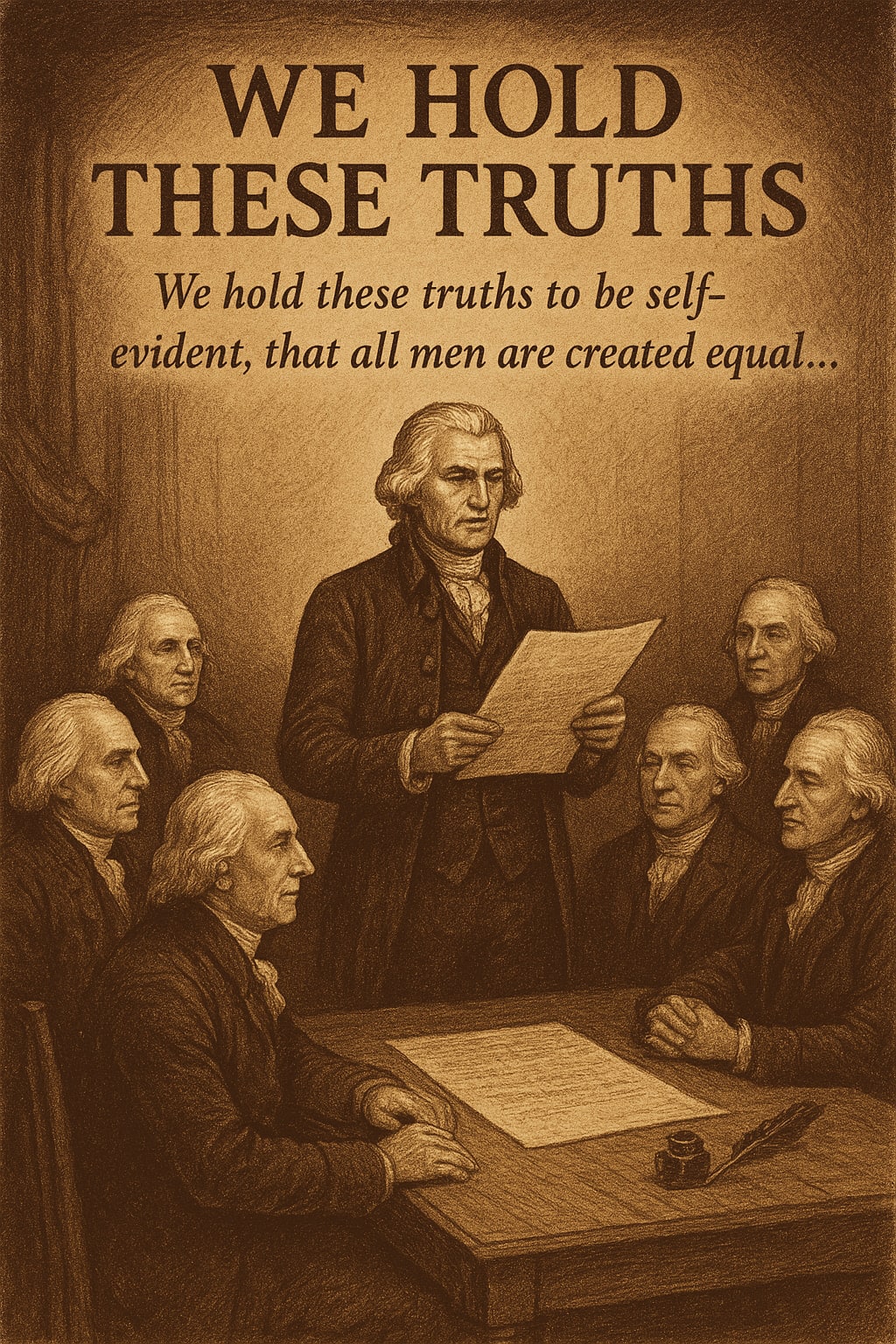
History has always been shaped not only by battles and victories, but by ideas—by the courage to write, to speak, and to believe in something greater than the moment. The sepia-toned picture of America’s Founding Fathers gathered around a table, with one man holding the Declaration of Independence while others lean forward in quiet attention, captures precisely that timeless truth.
This image, though rooted in the past, feels alive. It is not merely an artistic rendering of a moment; it is a story of courage, of flawed but visionary men who dared to imagine liberty, and of words so powerful they continue to echo centuries later. The phrase written across the image, “We hold these truths to be self-evident, that all men are created equal,” is not just a sentence—it is a promise, a challenge, and a reminder of what freedom demands.
A Room Filled With Quiet Courage
The year was 1776. For decades, the American colonies had endured the weight of British rule—unfair taxes, lack of representation, and laws imposed from across the sea. Discontent simmered, and rebellion whispered in taverns, churches, and town halls. Yet rebellion was no small matter. To stand against the Crown was to risk not only reputation and wealth, but life itself.
In that summer of 1776, delegates from the thirteen colonies gathered in Philadelphia. The air was heavy with uncertainty. Could a collection of farmers, merchants, lawyers, and thinkers truly stand against the world’s greatest empire?
The picture captures the answer. A man, likely Jefferson, reads aloud the words that would become immortal. Around him, others lean in, brows furrowed, faces solemn. Some were cautious, others defiant, but all understood the gravity: once their names touched that parchment, there would be no turning back.
Signing the Declaration of Independence was not just politics—it was treason. Each man knew he was putting his life at stake. Yet they signed. Not because they were sure of victory, but because they believed liberty was worth the risk.
The Power of Words
The Declaration itself was more than a legal document; it was a vision for humanity. The opening lines—“We hold these truths to be self-evident, that all men are created equal…”—were radical for their time. In a world dominated by kings, monarchies, and inherited power, this was a daring proclamation.
The men in that room were not perfect. Some owned slaves. Others excluded women and indigenous voices from their vision of equality. But what they did was plant a seed. They articulated an idea larger than themselves—an ideal of equality, liberty, and self-determination that has since inspired revolutions around the globe.
France looked to it during its revolution. Abolitionists and suffragists later drew upon its words to demand justice. Civil rights leaders, from Frederick Douglass to Martin Luther King Jr., held it up as a mirror, challenging America to live up to its promise.
This is why the image is so powerful. It is not just about a single moment in American history. It is about the birth of an idea that continues to shape the world.
The Ordinary Made Extraordinary
At first glance, the scene might look simple: men in powdered wigs, a wooden table, parchment, and ink. Yet that simplicity is what makes it profound.
The room was not filled with armies or kings. There were no cannons or banners. There was only conviction. History often glorifies battlefields, but this moment reminds us that some of the most important revolutions are written, not fought.
A table became an altar. A piece of paper became a weapon. Ink became fire.
It reminds us today that change does not always require power or wealth—it begins when ordinary people gather, speak, and commit to an idea bigger than themselves.
The Courage of Imperfection
It is tempting to look at the Founding Fathers as legends, as flawless heroes. But to do so diminishes the true courage of what they did. They were imperfect men. Some feared too much, others compromised too quickly, and many carried prejudices of their era.
Yet courage is not about perfection—it is about action in spite of imperfection. They signed knowing their flaws. They declared freedom while still bound by contradictions. And yet, they lit a flame that others would carry forward, burning brighter in each generation.
This is a lesson for us today. We do not need to be perfect to demand justice. We do not need to have all the answers to fight for freedom. We need only the courage to begin.
The Echo Through Time
Two and a half centuries later, the words of the Declaration still speak. The world has changed, yet the core truth remains: people long for freedom.
In civil rights marches, in movements for equality, in protests against tyranny—echoes of 1776 can be heard. The image of Jefferson reading, of Franklin signing, of Hancock writing his name in bold strokes, is not locked in the past. It is a living memory, a constant reminder that liberty is never finished; it is always unfolding.
When Martin Luther King Jr. stood on the steps of the Lincoln Memorial in 1963, he quoted the Declaration, reminding the nation of a “promissory note” still unfulfilled. When nations around the world shook off colonial chains in the 20th century, they too drew strength from those words.
This is why the picture resonates so deeply. It shows that freedom is not a relic—it is a responsibility.
Lessons for Today
Looking at this picture in our modern age, we are faced with questions:
What truths do we hold to be self-evident today?
Where must we sign our names with courage, knowing the risks?
What voices are still waiting for equality, justice, and recognition?
The Declaration was not an endpoint—it was a beginning. Each generation must write its own chapter. Just as those men in Philadelphia dared to declare independence, so too must we dare to confront injustice, inequality, and oppression wherever they remain.
A Universal Promise
Though the image is American, its message is universal. Every human being, no matter where they are born, carries within them the right to live free. The words “all men are created equal” transcend borders and time.
For Vocal Media readers, this image is more than history—it is a call to reflection. Whether you live in the United States or halfway across the globe, you can find in it the reminder that liberty is fragile, precious, and worth defending.
Conclusion: The Power of Ink
The sepia-toned picture may seem quiet, almost still, but within it lies thunder. It is the thunder of courage, of risk, of hope.
Those men did not know what would come of their actions. They could not predict victory or defeat. But they believed enough to sign.
That is the legacy of the Declaration of Independence—not certainty, but faith. Not perfection, but progress. Not the end, but the beginning.
And so, centuries later, the image still whispers to us: Pick up your pen. Find your truth. Sign your name to freedom.
For freedom does not live in monuments or museums. It lives wherever people dare to write, to speak, and to dream.
About the Creator
Keep reading
More stories from Fazal wahid and writers in History and other communities.
Savoy Hotel – Mussoorie: The Colonial Luxury Hotel Where an Unsolved Murder Still Walks the Corridors
The First Night: Beauty Wrapped in Silence Mussoorie looks peaceful from a distance. Pine trees sway gently, clouds roll like slow-moving waves, and the hill air smells of rain and old earth. But as evening falls, the silence becomes heavier—almost watchful.
By Gaurav Gupta3 days ago in History
Is NATO Facing Its Biggest Crisis Yet?
Is NATO Facing Its Biggest Crisis Yet? For more than seventy years, NATO has been one of the strongest military alliances in the world. Formed after World War II, it was designed to protect its members through collective defense. An attack on one was considered an attack on all. For decades, this principle helped maintain stability in Europe and beyond. But today, NATO is facing one of the most challenging moments in its history.
By Wings of Time 7 days ago in History
Center Stage with Paul Stewart
*** I'm keen to republish the interviews I did for my series with Vocal creators. It's been a few years and I thought it might be nice to revisit these wonderful conversations. I'll be releasing them one at a time for a few weeks/months.
By Heather Hubler4 days ago in Interview


Comments
There are no comments for this story
Be the first to respond and start the conversation.