
Unraveling the Molecular Pathways of Life and Disease
A Pioneer in Inflammation, Cancer, and Cell Signaling Research

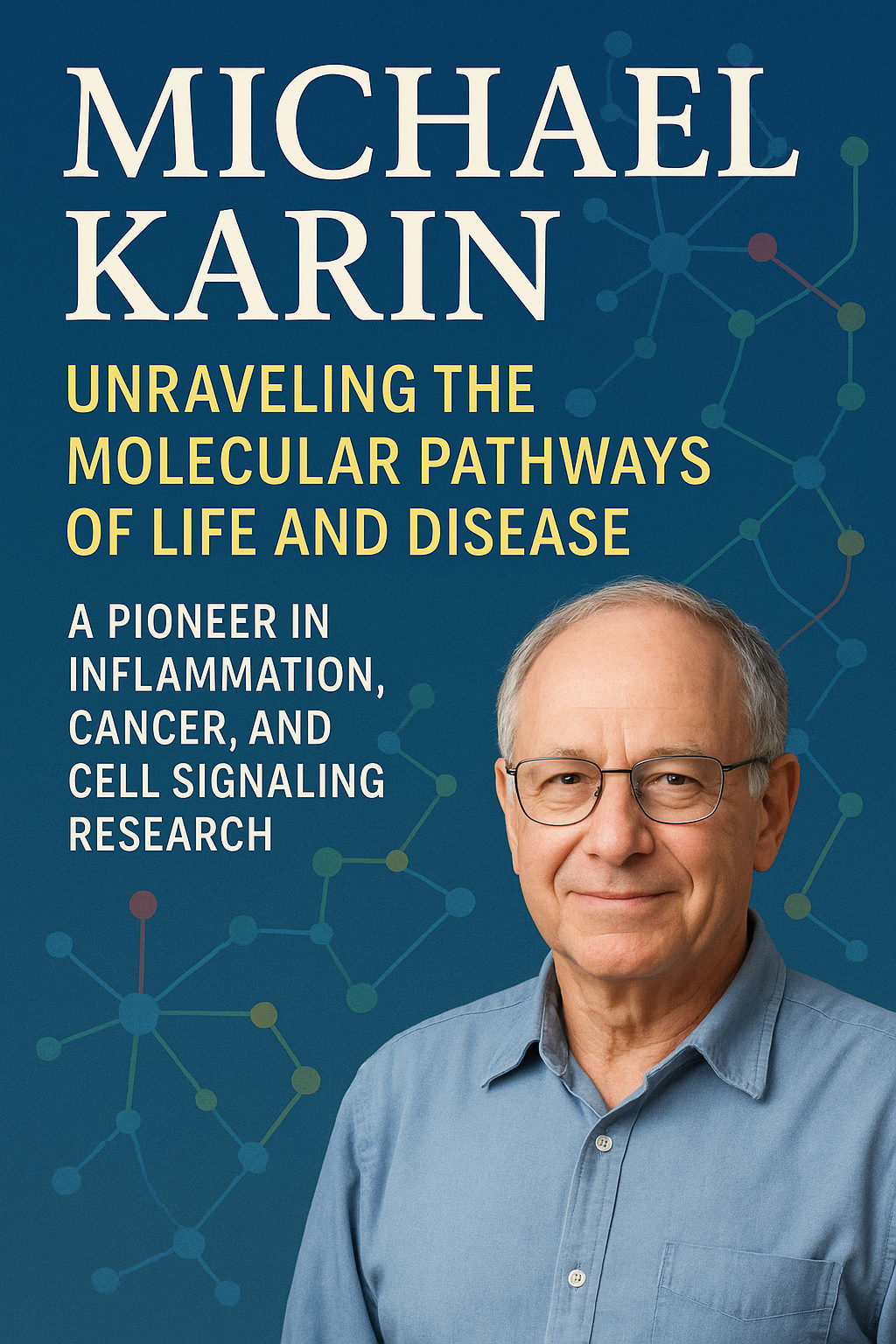
Michael Karin is widely recognized as one of the most influential molecular biologists of our time. His groundbreaking research has revolutionized the understanding of how cells communicate, respond to stress, and initiate diseases such as cancer, diabetes, and autoimmune disorders. With a career spanning over four decades, Karin has built a legacy defined by scientific rigor, innovation, and an unwavering commitment to unraveling the cellular mechanisms that govern human health and disease.
⸻
Early Life and Education
Michael Karin was born in Israel in 1951. From a young age, he exhibited a strong interest in science, particularly in how life functions at the molecular level. After completing his mandatory military service, he pursued his undergraduate studies in biology and chemistry at Tel Aviv University. His passion for biochemistry and genetics took him to the United States, where he enrolled in graduate school at the University of California, Los Angeles (UCLA). There, he earned his Ph.D. in Molecular Biology in 1979, working under the mentorship of renowned scientists and developing expertise in gene expression and enzymology.
⸻
Early Career and Scientific Rise
Following his doctoral work, Karin completed postdoctoral research at UC San Francisco and then at UC Berkeley, where he delved deeper into the emerging field of molecular genetics. By the early 1980s, he had joined the faculty at the University of California, San Diego (UCSD), where he would spend the majority of his career. At UCSD, Karin quickly became a central figure in biomedical research. His early studies focused on gene regulation, which led to significant insights into transcription factors and DNA response elements.
One of his most notable early contributions was the discovery and characterization of the AP-1 transcription factor complex, which regulates gene expression in response to various stimuli including cytokines, stress, and bacterial and viral infections. This research laid the groundwork for understanding how external signals are converted into genetic responses within the cell.
⸻
The NF-κB Pathway and Inflammatory Signaling
In the 1990s, Michael Karin made a historic breakthrough by elucidating the role of the NF-κB (nuclear factor kappa-light-chain-enhancer of activated B cells) signaling pathway. This pathway is crucial for regulating immune and inflammatory responses and plays a role in a variety of diseases, including cancer and autoimmune disorders.
Karin’s lab was among the first to show how stress and inflammatory signals activate NF-κB, and how this in turn influences the expression of genes involved in cell survival, proliferation, and immune function. His work revealed that inappropriate activation of NF-κB is linked to chronic inflammation and cancer development. This insight has been critical in the development of new therapeutic strategies targeting NF-κB for inflammatory and autoimmune diseases, and certain types of cancer.
⸻
Contributions to Cancer Biology
Michael Karin’s research significantly advanced the understanding of how chronic inflammation contributes to cancer—a concept now widely accepted in oncology. His studies revealed how inflammation not only facilitates cancer initiation by damaging DNA but also promotes tumor growth by creating a microenvironment conducive to malignant transformation.
He identified key molecular links between inflammation and tumorigenesis, such as IKKβ (IκB kinase beta) and STAT3, and helped define their role in liver, colon, and pancreatic cancers. One of his landmark studies demonstrated that inhibition of IKKβ in certain models could prevent or delay the development of cancer, paving the way for experimental drugs that modulate this pathway.
In addition, Karin’s work helped clarify how obesity-related inflammation contributes to insulin resistance and the development of type 2 diabetes—further highlighting his research’s impact across multiple fields of medicine.
⸻
Academic Leadership and Mentorship
Throughout his career, Michael Karin has been a devoted mentor and educator. At UCSD, he mentored dozens of graduate students and postdoctoral fellows, many of whom have gone on to successful careers in academia, industry, and government research. His teaching and guidance are praised not only for their intellectual rigor but also for the spirit of curiosity and innovation he instilled in his students.
As a faculty member in the Department of Pharmacology and the Cancer Center at UCSD, Karin played a crucial role in establishing UCSD as a hub of excellence in biomedical research. His collaborative approach bridged the gaps between molecular biology, pharmacology, and clinical medicine.
⸻
Awards and Honors
Michael Karin’s scientific excellence has been recognized with numerous prestigious awards and honors. These include:
• Election to the National Academy of Sciences (USA)
• Election to the American Academy of Arts and Sciences
• Recipient of the Ernst Schering Prize (Germany)
• Recipient of the American Association for Cancer Research (AACR) Lifetime Achievement Award
• Recipient of the William B. Coley Award for Distinguished Research in Basic and Tumor Immunology
• Recipient of the Albany Medical Center Prize in Medicine and Biomedical Research
These accolades reflect not only his individual contributions but also the global relevance of his work in transforming how we approach disease at the molecular level.
⸻
Legacy and Ongoing Impact
Today, Michael Karin continues to be a leading voice in biomedical research. Though he has transitioned from active laboratory work, he remains engaged in science through writing, consulting, and mentoring the next generation of researchers. His discoveries form the basis of ongoing clinical trials and drug development efforts aimed at treating cancers, inflammatory diseases, and metabolic disorders.
More than just a scientist, Karin is a symbol of curiosity-driven research that yields real-world benefits. His life’s work exemplifies how deep understanding of basic biological processes can illuminate the path to treating some of the most complex and devastating human diseases.
⸻
Conclusion
Michael Karin’s biography is not just the story of one man’s scientific journey; it’s a testament to the transformative power of molecular biology in modern medicine. Through his pioneering work on inflammation, cancer, and cell signaling, Karin has left a profound and lasting mark on the field. He has inspired thousands of scientists to push the boundaries of what is known and opened up new possibilities for the prevention and treatment of disease.
In unraveling the molecular pathways of life and disease, Michael Karin has helped chart a course toward a healthier future for us all.
About the Creator
Irshad Abbasi
"Studying is the best cure for sorrow and grief." shirazi
Keep reading
More stories from Irshad Abbasi and writers in History and other communities.
A Visionary Physicist Shaping the Frontiers of Particle Physics
James E. Brau is a distinguished name in the world of high-energy particle physics. Over several decades, he has contributed significantly to experimental physics, particularly through his work with particle detectors, dark matter research, and collider experiments. His career has blended deep scientific curiosity with engineering innovation, education, and international collaboration. This biography explores his journey from student to a globally respected physicist helping to unravel the universe’s deepest mysteries.
By Irshad Abbasi 7 months ago in History
Benjamin Franklin: The Mind That Helped Build a Nation
Benjamin Franklin was not born into greatness; he built it piece by piece with curiosity, discipline, and an unshakable belief in the power of learning. Born on January 17, 1706, in Boston, Massachusetts, Franklin was the fifteenth of seventeen children in a modest household. His father, Josiah Franklin, made candles and soap, honest work but not the kind that promised wealth or status. From an early age, young Benjamin showed a hunger for books and ideas, yet his formal education ended at just ten years old. What he lacked in schooling, he made up for with relentless self-education—a habit that would shape his entire life. Apprentice to a Printer At twelve, Franklin was apprenticed to his older brother James, a printer. The print shop became Benjamin’s classroom. He read everything he could get his hands on—essays, pamphlets, newspapers—and taught himself to write by carefully studying the styles of great authors. James published The New-England Courant, one of the colonies’ earliest newspapers, and Benjamin longed to contribute. Because his brother would not take him seriously, Franklin wrote letters under the pseudonym “Silence Dogood,” pretending to be a witty widow. The letters were published and widely admired. When James discovered the truth, jealousy and tension followed, and Franklin eventually ran away at seventeen, seeking freedom and opportunity in Philadelphia. Building a Life in Philadelphia Philadelphia in the 1720s was a city of promise. Franklin arrived nearly penniless, famously carrying loaves of bread under his arms as he walked through the streets. Yet he possessed something more valuable than money: determination. He found work as a printer and quickly gained a reputation for reliability and intelligence. Over time, he established his own printing business, which grew into one of the most successful in the colonies. Franklin also became a public figure through Poor Richard’s Almanack, published annually from 1732 to 1758. Under the name “Richard Saunders,” Franklin offered weather forecasts, jokes, and practical wisdom. Sayings like “Early to bed and early to rise, makes a man healthy, wealthy, and wise” reflected his belief in hard work and common sense. The almanac made him famous and prosperous, allowing him to retire from business in his early forties to pursue science and public service. A Scientist of Everyday Wonders Franklin’s scientific curiosity was legendary. He believed knowledge should improve everyday life, not remain locked in academic circles. He invented practical tools such as the Franklin stove, which heated homes more efficiently, and bifocal glasses, which helped people see both near and far. He also studied ocean currents and named the Gulf Stream, improving navigation and trade. His most famous scientific experiment involved electricity. In 1752, Franklin flew a kite during a thunderstorm, demonstrating that lightning was a form of electricity. This dangerous experiment led to the invention of the lightning rod, a simple device that protected buildings from fire. Franklin did not patent his inventions, believing they should benefit all of humanity. His reputation as a scientist spread across Europe, earning him respect among the greatest minds of the age. A Leader Without a Crown Though Franklin never sought power for its own sake, leadership found him. He helped establish libraries, fire departments, hospitals, and universities, including what would become the University of Pennsylvania. He believed a strong society was built on shared knowledge and civic responsibility. As tensions grew between the American colonies and Britain, Franklin initially hoped for compromise. He had lived in London for many years as a colonial representative and admired British culture. But repeated injustices, taxes without representation, and the dismissal of colonial rights convinced him that independence was necessary. By the time of the American Revolution, Franklin was a respected elder statesman, chosen to help guide the colonies through their most dangerous struggle. Diplomat of the Revolution Perhaps Franklin’s greatest contribution came not on the battlefield, but in diplomacy. Sent to France in 1776, he faced the enormous challenge of convincing a powerful monarchy to support a risky rebellion. Franklin’s charm, wit, and reputation worked wonders. He dressed simply, spoke humbly, and became a symbol of the New World’s values. French philosophers admired him; common people celebrated him. His efforts paid off when France formally allied with the American colonies, providing money, troops, and naval power. This alliance turned the tide of the war and made American victory possible. Without Franklin’s diplomacy, the Revolution might have failed. Shaping a New Nation After the war, Franklin returned home as a hero. Though elderly and in poor health, he continued to serve. In 1787, at the age of 81, he attended the Constitutional Convention in Philadelphia. While he did not speak often, his words carried great weight. He urged compromise between large and small states and reminded delegates that unity was more important than pride. His calm wisdom helped shape the United States Constitution. Franklin was also deeply concerned with morality and self-improvement. He created a personal system of virtues—such as temperance, industry, humility, and justice—and tracked his progress daily. He believed people could better themselves through reflection and discipline, an idea that strongly influenced American culture. Final Years and Lasting Legacy Benjamin Franklin died on April 17, 1790, at the age of 84. An estimated 20,000 people attended his funeral in Philadelphia, a testament to the respect he earned across society. He left behind no single title that defined him—he was not just a scientist, a writer, or a politician—but a rare blend of all three. Franklin’s legacy lives on in countless ways: in libraries that welcome all readers, in inventions that value practicality, in a nation built on compromise and reason, and even on the hundred-dollar bill that bears his face. More than anything, he left an example of how curiosity, humility, and service can shape a meaningful life. Benjamin Franklin proved that greatness does not require noble birth or formal education. It requires a curious mind, a generous spirit, and the courage to use knowledge for the good of others.
By The best writer about 14 hours ago in History
Stanislav Kondrashov Oligarch Series: The Spartan Blueprint for Oligarchy
When people think of Sparta, they often picture iron-clad warriors, strict discipline, and relentless training. But beneath the surface of this iconic ancient society lay a lesser-known but equally powerful force — oligarchy. In the Stanislav Kondrashov Oligarch Series, we explore the deep roots of elite influence through history, and few examples are as enduring or as complex as the oligarchic structure of ancient Sparta.
By Stanislav Kondrashov5 days ago in History


Comments
There are no comments for this story
Be the first to respond and start the conversation.