
Unearthing the Hidden History of the Nakba: Tragedy and Resilience
The Palestinian catastrophe, explained.

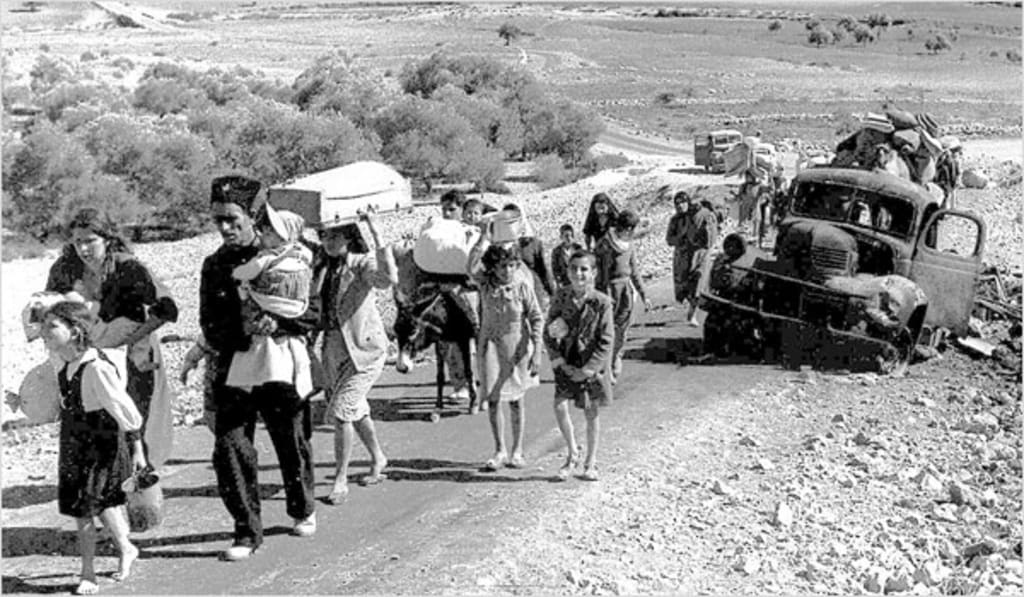
Tucked along the road leading to Jerusalem lies a village that holds a painful secret. Inhabited by a mere 750 people, everyone here knows one another. This place is marked by a shadowy past, a history that has been meticulously concealed, purposefully distorted, and largely forgotten in the West. This is the account of what transpired in 1948 in this village—a year that etched itself into the annals of history with violence and upheaval.
The village's painful history unfolded against the backdrop of a tumultuous period that led to the catastrophic events known as the Nakba. During the Nakba, hundreds of thousands of Palestinians were violently uprooted from their ancestral lands, setting the stage for the creation of the state of Israel. "In May of 1948, a new Jewish state, Israel, was born in a bath of blood," a stark reminder of the brutal transformation that was underway.
The historical context of this region reveals a tapestry woven by centuries of Palestinian existence, where vibrant villages and thriving cities were interspersed. Jerusalem, a central city with profound significance for Jewish, Christian, and Muslim communities, held holy sites that bore witness to shared histories. Despite religious diversity, Palestinians were often grouped under the umbrella term "Arabs," overlooking the nuanced cultural identities that defined them. Palestinians referred to themselves as Ahl Filastīn, the people of Palestine, forging a distinct identity with their own dialect, cuisine, dress, and close-knit familial bonds.
The early 20th century saw competing political forces vying for control over this region. Arab movements sought independence from the Ottoman Empire, envisioning a unified Arab state encompassing Palestine. Simultaneously, Zionist aspirations took shape—a political movement advocating for a Jewish homeland in response to mounting anti-Semitism in Europe and Russia. The British, with their own strategic interests in expanding influence, entered the picture, ultimately paving the way for a complex political landscape.
During World War I, a pledge between Arab leaders and British officials promised Arab independence in exchange for support against the Ottoman Empire. However, the Balfour Declaration of 1917 unveiled a shift in allegiance, favoring Zionist aspirations over the creation of an Arab state. The British mandate over Palestine further entrenched this shift, leading to the displacement of Palestinians and the rise of the Jewish population.
By 1947, the United Nations proposed a partition plan to divide Palestine into separate Jewish and Arab states. While the UN's decision was met with approval from Zionist factions and the United States, Palestinian Arabs rejected the plan that allocated significant portions of fertile land to the Jewish state, often in areas inhabited by Palestinian communities.
As the British mandate ended in 1948, Israel declared its statehood on May 14th. However, the establishment of Israel marked the beginning of the Nakba for Palestinians. With Zionist forces executing Plan D, designed to establish Jewish control and defend settlements, violence escalated. Massacres, including the infamous Deir Yassin massacre, sowed fear among Palestinians, leading to their displacement and flight as refugees. Arab armies' defeat in the subsequent conflict further exacerbated the crisis.
Israel's creation didn't spell the end of the Nakba, as Palestinians continued to be denied the right to return to their homes. The Nakba, meaning "catastrophe," left an indelible mark on Palestinian society, with more than half of the population becoming refugees, dispossessed of their land and statehood.
Today, as Israelis celebrate Independence Day, Palestinians commemorate the Nakba on May 15th—a poignant reminder of their stolen homes and the ongoing struggle for justice and return. The Nakba is more than a historical event; it's an ongoing tragedy, a reminder of the enduring resilience of a people who refuse to be silenced.
In the heart of this village, the echoes of the past are reawakening. The story of the Nakba is being uncovered, its truths shedding light on a history long obscured. Through these revelations, the resilience of a people who were uprooted but never erased comes into focus, offering the world a stark reminder of the price of dispossession and the unyielding spirit of a community that persists despite adversity.
About the Creator
Vivian Yao
News, economy, history, politics, and much more...
Keep reading
More stories from Vivian Yao and writers in History and other communities.
Icelandic Women's Historic Strike Transforms Gender Equality Landscape
Gender pay disparities remain a persistent issue in developed economies, with women in the US earning 17% less than their male counterparts and a staggering 22% gap in Japan. However, Iceland stands out as a beacon of progress, boasting a remarkably low pay gap of around 10%. This stark transformation from significant inequality to near parity between genders finds its roots in a historic event that unfolded in 1975.
By Vivian Yao2 years ago in History
3 Everyday Rules That Exist Because Someone Once Did Something Very Stupid
Everywhere you go, you are surrounded by rules that feel oddly specific. Do not touch. No running. Contents hot. Do not insert body parts. These warnings aren’t theoretical. They weren’t written by pessimists or lawyers with too much free time. They exist because at some point in history, a real human being looked at a situation and thought, “This will probably be fine.”
By Enoch Sagini4 days ago in History
Nanchang: A Modern Symbol of China’s Naval Power
In recent years, the world has closely watched the rapid modernization of the Chinese People’s Liberation Army Navy (PLA Navy). One of the most important symbols of this transformation is the Nanchang (Hull 101), China’s first Type 055 guided-missile destroyer. Commissioned on 12 January 2020, Nanchang represents a major leap in naval technology and capability. As it completes six years of active service, the ship stands as a clear example of how China’s navy has moved into a new era of advanced maritime power.
By sehzeen fatima6 days ago in History




Comments
There are no comments for this story
Be the first to respond and start the conversation.