
Tyranny of the British on the Helpless"
The cry of innocent Baby
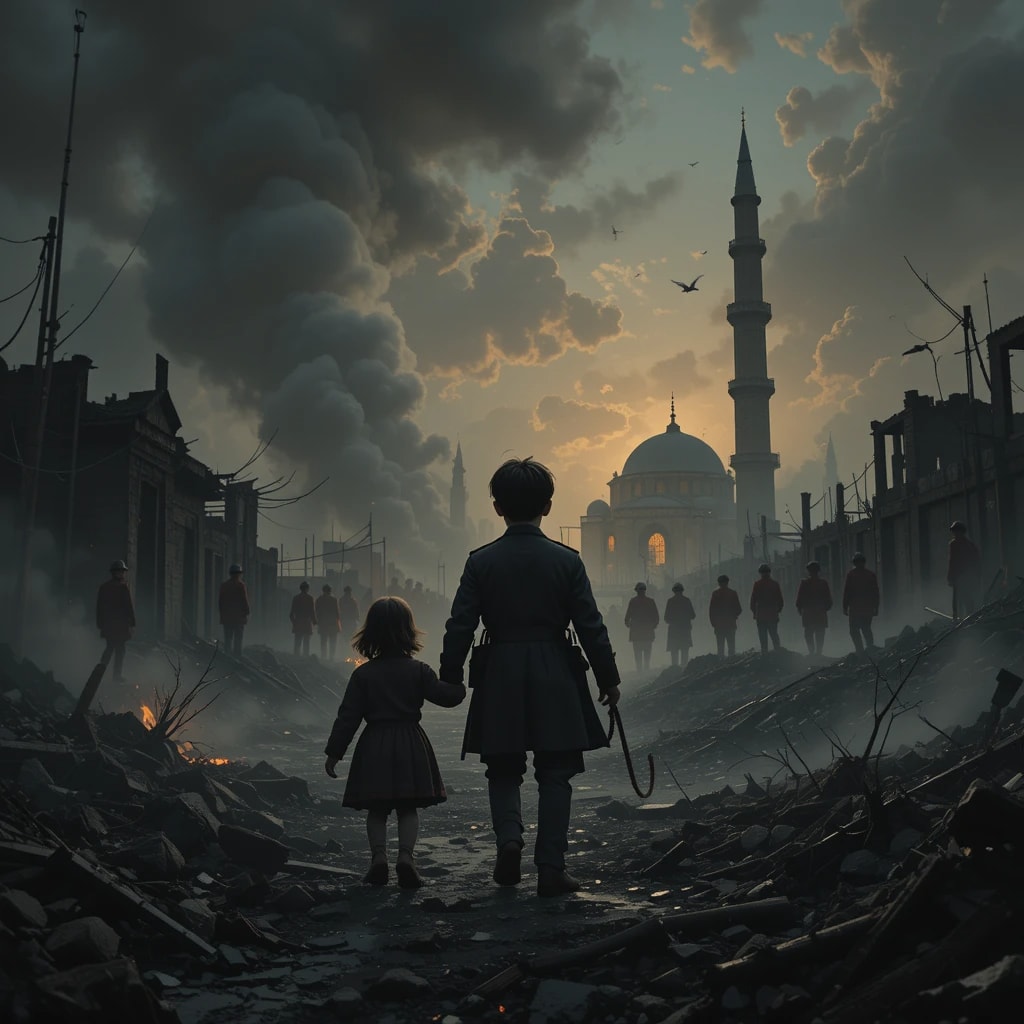
The sun struggled to rise over Noorabad, its golden light dimmed by the haze of smoke that clung stubbornly to the sky. Just yesterday, the village had been alive with laughter and peace. Children chased each other barefoot through fields of golden wheat, mothers baked bread over clay stoves, and elders sat under the sprawling neem tree, their voices weaving stories of honor and faith.
Now Noorabad was silent.
The air was thick with the smell of ash and gunpowder. Homes that had sheltered generations were reduced to blackened shells. Fields were no longer golden but gray, scorched and trampled beneath boots that did not belong. A crow cawed somewhere in the distance, breaking the suffocating quiet, but even its voice carried a strange sorrow.
Ayaan stumbled through the rubble, gripping his little sister Amira’s hand tightly. She was six, her tiny frame trembling against his side. Her dress was torn, stained with dirt and blood. Her bright eyes were clouded with fear, too heavy with pain for a child so young.
“Stay close to me,” Ayaan whispered, his voice hoarse.
He tried to sound brave, but his words trembled in the cold morning air.
They passed what had once been their neighbor’s home. The door dangled on one hinge, swinging gently in the breeze, and smoke curled lazily from its charred roof. Ayaan forced himself not to look at the motionless figure sprawled across the doorway. His heart pounded in his ears, but he had to be strong—for Amira.
The echoes of last night’s horror were impossible to silence.
It began with the sound of horses.
Ayaan had been helping his father sharpen a sickle for the morning’s harvest when the pounding of hooves shattered the quiet. Karim’s face had gone pale, but his voice was steady.
“Go inside,” he had told Ayaan.
Within moments, soldiers in red coats stormed the village, their muskets gleaming beneath the pale moonlight. They shouted orders in harsh voices, their words foreign and sharp. The British were not there for peace or trade. They had come to take.
“Give us the grain!” one soldier barked in broken Urdu, his rifle aimed at Karim’s chest.
“This grain is for our children,” Karim said, his voice calm but unyielding.
The soldier didn’t hesitate. The shot rang out like thunder. Karim crumpled to the ground, blood pooling around him.
Ayaan’s mother screamed, rushing forward, but another soldier struck her with the butt of his rifle. She fell, her scream cut short. Flames erupted as torches were hurled onto thatched roofs. People fled in every direction, but there was no escape. Soldiers fired into the crowd, their boots crushing anyone who fell.
Ayaan had grabbed Amira, dragging her away from their burning home. He remembered her small, terrified hand gripping his so tightly it hurt. He remembered his mother’s scream. And then—silence.
Now, under the pale light of dawn, the weight of loss threatened to crush him.
“Where are Mama and Baba?” Amira’s small voice cracked the stillness.
Ayaan knelt and cupped her tear-streaked face. “They’re… with Allah now,” he whispered, his own voice breaking.
Amira buried her face in his shoulder and sobbed softly. Ayaan hugged her close, rocking her gently as his own tears fell. He wanted to cry out, to curse the soldiers who had turned Noorabad into ashes, but he knew he couldn’t. He had to be strong.
He guided her through the ruins. The mosque’s tall minaret was scarred with bullet holes. The neem tree that had once been the village’s heart was now a blackened stump. Everywhere, there were bodies—neighbors, friends, people he had known his entire life. Noorabad was gone.
When they reached the outskirts of the village, Ayaan found his father’s body where it had fallen. Karim’s eyes were closed, his expression calm, almost as if he had fallen asleep. His prayer beads still rested in his hand. Ayaan knelt, trembling, and carefully took them. He wrapped the beads around his wrist, holding them tightly.
“I’ll remember, Baba,” he whispered. “I’ll tell the world.”
As the day wore on, survivors began to gather. They were few—mostly women, children, and the elderly. Their faces were blank masks of grief, their eyes hollow. The healer, Hakim, leaned on his walking stick, his shoulders bent with sorrow.
“We can’t stay here,” he said softly, surveying the ruins. “They’ll come back.”
“Where will we go?” someone asked, their voice trembling.
Hakim’s gaze swept over the ashes of Noorabad, over the fields that would never bloom again. “Anywhere,” he said. “But not here.”
The group moved slowly, carrying what little they could salvage. Ayaan walked in silence, Amira’s small hand in his. He didn’t know where they would go, but he knew this: they had no home now, no land, no safety. The empire had taken it all.
That night, they camped in the wilderness. A small fire flickered weakly, casting shadows on their weary faces. Amira fell asleep beside Ayaan, her head resting in his lap. He stroked her tangled hair, staring into the flames, unable to sleep.
He could still see his father standing proudly, refusing to bow. He could still hear his mother’s scream. He could still smell the smoke of their burning home.
The British had come not just to take grain, but to crush their spirit. Noorabad was gone, wiped from the earth in a single night.
But Ayaan’s heart burned with something stronger than grief.
They thought they could erase Noorabad, but they hadn’t erased him. They hadn’t erased the memory of his father’s courage, his mother’s love, or the laughter of the children who once played in the fields. He would grow, and he would remember. He would tell their story, and one day, he would fight.
He looked at Amira sleeping peacefully, her face illuminated by the glow of the fire. For her, he would survive. For Noorabad, he would endure.
Tears rolled silently down his cheeks, but they were not just tears of sorrow anymore. They were tears of rage. Tears of resolve. Tears of war.
The empire thought it had silenced Noorabad.
But Noorabad’s spirit lived on—in the heart of a boy who had lost everything and vowed never to forget.
About the Creator
Keep reading
More stories from Mubashir Khan and writers in History and other communities.
The dance we promised
The rain began as a whisper against the tall windows of the reception hall, soft enough to be ignored at first. By the time the band launched into its third slow song, though, it was coming down in heavy silver streaks, drumming on the roof like an impatient heartbeat. Guests crowded under the awning, clutching champagne flutes, their laughter rising above the storm.
By Mubashir Khan 7 months ago in Humans
Year 1903 in Review: Fun Facts, Trivia, and Historic Highlights
This quick read is a collection of fun facts, trivia, and historical events from the year 1903. Discover the year’s top news stories, most influential people, sports facts, historic firsts, entertainment trivia, and much more.
By Gregory DeVictor6 days ago in History
Why Didn't Anyone Tell Us
Men, move along. This is not for you. This is for the women. I was forty-five when I began menopause. It is pretty young for that to be going on in a woman’s life, but I had undiagnosed PCOS, my entire life. Thank you to all the gynecologists I had seen my entire life. That in itself should encourage women to keep seeking second opinions, especially when you are not getting correct answers or any at all.
By Alexandra Grant4 days ago in Humans




Comments
There are no comments for this story
Be the first to respond and start the conversation.