
To the Moon and Beyond: NASA's Ambitious Artemis Program
"A New Era of Lunar Exploration and a Giant Leap Towards Mars" (Highlights both Moon and Mars ambitions)

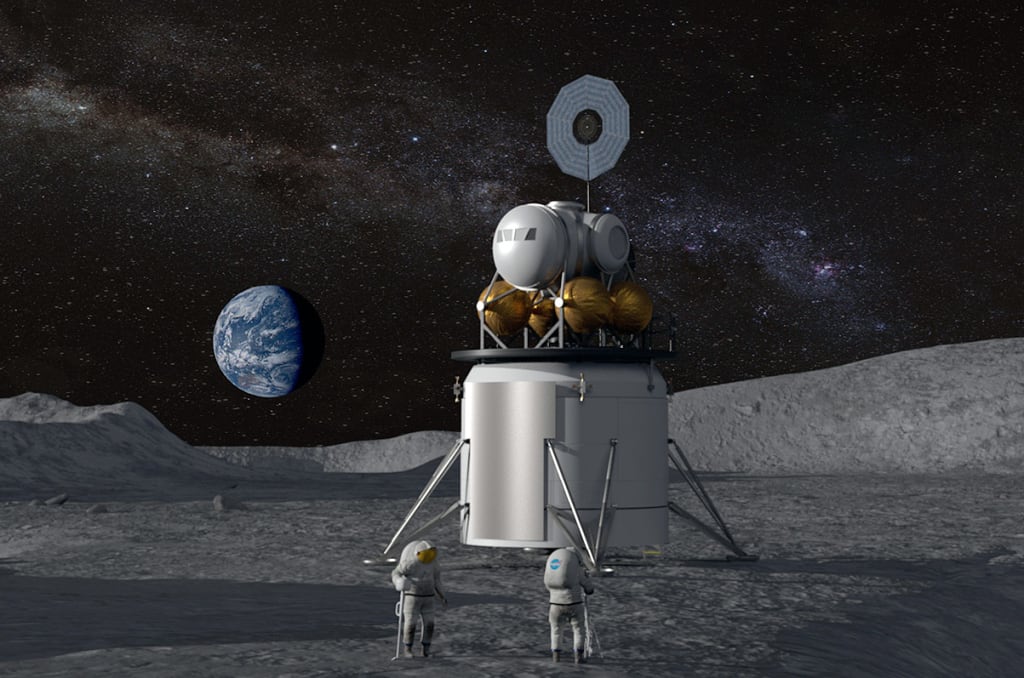
Fifty years after humanity last set foot on the lunar surface, NASA is spearheading an unprecedented return to the Moon with the Artemis program. More than just a re-run of Apollo, Artemis is designed to establish a sustainable human presence on the Moon, pave the way for future human missions to Mars, and unlock new scientific and economic opportunities.
A New Era of Lunar Exploration
Named after the twin sister of Apollo in Greek mythology, Artemis symbolizes a new chapter in space exploration, one that emphasizes diversity and international collaboration. A key objective is to land the first woman and first person of color on the Moon, breaking new ground in human spaceflight.
The program relies on a suite of cutting-edge technologies:
Space Launch System (SLS): NASA's powerful heavy-lift rocket, the SLS, is the backbone of Artemis, designed to send the Orion spacecraft and its crew far beyond Earth orbit.
Orion Spacecraft: This state-of-the-art crew capsule is built to carry astronauts safely through deep space, with advanced life support systems and a robust heat shield capable of withstanding high-velocity re-entry from lunar missions.
Lunar Gateway: A small space station orbiting the Moon, the Gateway will serve as a vital staging point for lunar missions, a science outpost, and a crucial waypoint for astronauts traveling to and from the lunar surface. It will also provide a platform for demonstrating technologies essential for future Mars missions.
Human Landing System (HLS): Commercial partners are developing advanced lunar landers to transport astronauts from the Gateway to the lunar surface and back.
The Artemis Mission Sequence
The Artemis program is structured around a series of progressively more complex missions:
Artemis I (Completed November 2022): This uncrewed test flight successfully launched the SLS rocket and the Orion spacecraft around the Moon and back, validating the performance of both systems and paving the way for crewed missions.
Artemis II (Targeted for early 2026): The first crewed test flight, Artemis II will send four astronauts on a lunar flyby, extensively testing Orion's systems and crew interfaces before returning to Earth. This mission will make Canada the second country to have an astronaut fly around the Moon.
Artemis III (Targeted for mid-2027): This highly anticipated mission will mark humanity's return to the lunar surface. Two astronauts will transfer from Orion to a Human Landing System, which will descend to the Moon's South Pole – a region of significant scientific interest due to the potential presence of water ice. Astronauts will conduct scientific experiments and explore this previously untouched lunar landscape.
Artemis IV (Targeted for late 2028): This mission will see Orion and an upgraded HLS dock with the Lunar Gateway, delivering additional modules to the orbiting station.
Artemis V (Targeted for March 2030): Building on previous missions, Artemis V will deliver more modules to the Gateway, including a European refueling and communications module and a Canadian robotic arm. It will also be the first mission to utilize Blue Origin's Blue Moon lander to transport astronauts to the lunar surface.
Subsequent Missions: Further Artemis missions are planned, continuing to expand the capabilities of the Lunar Gateway and enabling more extensive and longer-duration lunar surface explorations, including the delivery of a Lunar Terrain Vehicle.
International Collaboration and Economic Impact
Artemis is a truly global endeavor. Through the Artemis Accords, a non-binding set of principles for responsible space exploration, NASA has garnered the support of over 50 nations, fostering a shared vision for peaceful, sustainable, and transparent cooperation in space. These accords build upon existing international space agreements and emphasize principles like transparency, interoperability, emergency assistance, and the responsible utilization of space resources.
Beyond scientific discovery and international diplomacy, the Artemis program is a significant economic driver. It supports tens of thousands of jobs across the United States in high-skilled sectors like engineering, manufacturing, and research, and contributes billions of dollars in total economic output. The program also catalyzes private-sector investment and innovation, fostering competition and driving the development of new technologies with broad applications both in space and on Earth.
A Stepping Stone to Mars
Ultimately, the Moon serves as a proving ground for the ambitious journey to Mars. By establishing a sustainable presence on the Moon, developing technologies for long-duration spaceflight, and learning to live and work in a deep-space environment, Artemis will lay the crucial groundwork for sending humans to the Red Planet in the future.
The Artemis program represents a bold vision for human space exploration, pushing the boundaries of what is possible and inspiring a new generation to reach for the stars.
About the Creator
Sinan Bin Saif
I'm Sinan Bin Saif, an article writer at Voxcal Media. I cover diverse topics like culture, lifestyle, business & more. I turn ideas into engaging stories with a versatile, curious, and creative approach to connect with readers.
Reader insights
Outstanding
Excellent work. Looking forward to reading more!
Top insights
Compelling and original writing
Creative use of language & vocab
Easy to read and follow
Well-structured & engaging content
Excellent storytelling
Original narrative & well developed characters
Expert insights and opinions
Arguments were carefully researched and presented
Eye opening
Niche topic & fresh perspectives
Masterful proofreading
Zero grammar & spelling mistakes
On-point and relevant
Writing reflected the title & theme
Keep reading
More stories from writers in History and other communities.
The Net Worth of the Golden River: Measuring the Value of History’s Greatest Myth
So what is the net worth of the Golden River? While it cannot be calculated like a bank account or a gold reserve, its value can be estimated through economic loss, potential mineral wealth, cultural impact, and historical influence. When all these dimensions are considered, the Golden River may be worth more than any physical treasure ever discovered.
By Say the truth about 6 hours ago in History
The island of echoes
The Island of Echoes Akira woke to the sound of waves crashing against the shore, the salty tang of sea air filling his lungs. He stumbled to his feet, scanning the horizon for any sign of civilization. Nothing but endless blue stretched out before him. The storm that had ravaged his small sailboat seemed to have washed him ashore on a deserted island.
By Talhamuhammad6 days ago in History




Comments (1)
I've loved this article, and i've learened many more things about space related stuff, and im soo happy that NASA is proggressing that much so that our world could trnsform into a modern civilization more faster