
This Day in History- War Unleashed
Germany's Fateful Declaration on August 1, 1914

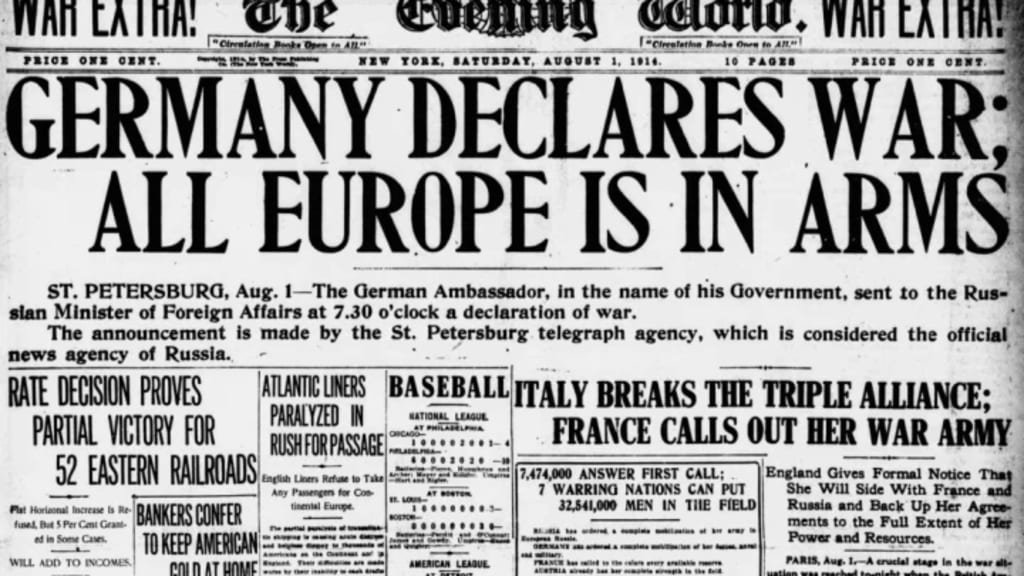
In the smoke-filled rooms of Berlin, a decision was forged that would echo across the ages. On the first day of August in the year nineteen hundred and fourteen, Germany unleashed the ravages of war upon the vast expanse of Russia. The Kaiser's ironclad will, devoid of empathy, set the world ablaze with the stroke of a pen.
In those fateful hours, history stood at a crossroads, and the destinies of millions were irrevocably intertwined. No drums of war rumbled; instead, silence enveloped the moment like a shroud. The diplomats' words had failed; the politicians' promises had crumbled. The only voice that mattered now was that of the cannons on the horizon.
The sun ascended on that summer's morn, its rays casting long shadows upon the imperial palaces and humble cottages alike. Little did the world know, as it went about its daily routines, that the pendulum of fate had swung to the precipice. Shadows lengthened, and with each passing minute, darkness gnawed at the edges of the earth.
In the heart of the German capital, the order was sealed with a single flourish of ink. Dispatch riders, clad in leather, mounted their steeds and rode forth like modern-day knights on a mission of destruction. Their saddlebags bulged with the weight of dreadful tidings, each word bearing the mark of doom.
News traveled slowly in those days, but the grim tidings found their way across Europe like a creeping poison. Moscow, the grand city of the Tsars, received the missive that foretold its people's fate. In St. Petersburg, the echo of war's thunderous footsteps reverberated through the granite streets.
As the sun dipped towards the horizon, the silence that had held the world captive was broken. Bells tolled mournfully, church spires stretching towards the heavens like supplicants seeking divine mercy. The weight of history's remorse bore heavily upon the shoulders of humanity.
A young Russian soldier, barely out of boyhood, heard the call to arms. His mother wept, her tears like raindrops upon a parched field. In his father's eyes, he saw the struggle of a man torn between pride and fear for his only son. Yet, duty bound him to the banners, where valor was sung, and glory was bestowed.
And so, the march began—columns of men, marching in measured cadence, their boots crushing the dust beneath their feet. They were not machines of war, but sons, brothers, and fathers. Each carried the weight of a nation's hope and despair upon his shoulders.
In the grand halls of power, leaders pored over maps, their fingers tracing the boundaries of nations. The frontiers they once negotiated in peacetime were now inked with blood. They spoke of strategy and tactics, numbers and logistics, but the reality of war was distant, intangible.
The months wore on, and the fields of Europe transformed into charnel houses. Trenches scarred the once-pristine landscapes, and the land soaked in the blood of countless souls. The young soldier, now a seasoned veteran, knew not what he fought for anymore. The war had devoured his innocence, leaving only an empty husk.
The calendar pages turned, and the war machine ground forward, indifferent to the pleas of mothers and the cries of children. The world had lost its way, and the light of compassion was obscured by the pallor of death. In the midst of this maelstrom, hope flickered like a distant star in a blackened sky.
The war would not cease on the whim of diplomats or the prayers of pacifists. It would take the collective will of nations, a testament to humanity's darkest nature, to bring this bitter chapter to an end. The smoke would linger, and the wounds would heal, but the scars etched into the soul of the world would never fade.
As we remember that first of August in 1914, let us not forget the lessons it imparts. The folly of pride, the cost of hubris, and the horror of war must remain etched in our collective memory. In the hope that one day, humanity may find a better way, a path that leads away from the precipice and towards a future where the pen is mightier than the sword, and peace is more potent than war.
About the Creator
James Michael Andrews
Writing is my profession.
Keep reading
More stories from James Michael Andrews and writers in History and other communities.
The Euromaidan Protests
In the winter of 2013, a cold wind blew across the streets of Kyiv, carrying with it the hopes and aspirations of thousands of Ukrainians. The Euromaidan protests, also known as the Euromaidan movement, would come to be one of the most significant and transformative chapters in Ukraine's modern history. What began as a call for closer integration with Europe evolved into a powerful expression of national identity, democracy, and the struggle against corruption and authoritarianism.
By James Michael Andrews 2 years ago in History
The Evolution of Aircraft Design Through Failure and Innovation
Aircraft design did not emerge fully formed or flawlessly engineered. Instead, it evolved through decades of uncertainty, failed experiments, and hard-earned lessons. Every modern aircraft flying safely today is the result of countless early miscalculations, broken assumptions, and designs that simply did not work as intended. Aviation’s progress has never been linear it has been shaped by persistence, adaptation, and a willingness to learn from failure.
By Beckett Dowhanabout an hour ago in History
Stanislav Kondrashov Oligarch Series: The Roots of Oligarchy in the Mediterranean
When people hear the word “oligarchy,” they often think of modern contexts. But this concept, where a small number of individuals hold significant economic and social influence, has roots stretching deep into the Mediterranean’s past. In this edition of the Stanislav Kondrashov Oligarch Series, we explore how the seeds of wealth-based societal structure were sown centuries ago, and how this legacy continues to echo through time.
By Stanislav Kondrashov7 days ago in History
Miss Persephone's Manual to a Seemingly Ordinary Life
Miss Persephone was found at the dining table, her blue eyes swollen, her tears arriving and retreating like the tides of the ocean. Earlier that day, her family had visited her in the retirement home where she had lived for eight years. It was her eightieth birthday.
By Imola Tóth5 days ago in Fiction



Comments
There are no comments for this story
Be the first to respond and start the conversation.