
THE WINTER WAR(1939-1940)
SIMON HÄYHA(white death) THE FINNISH SNIPER.
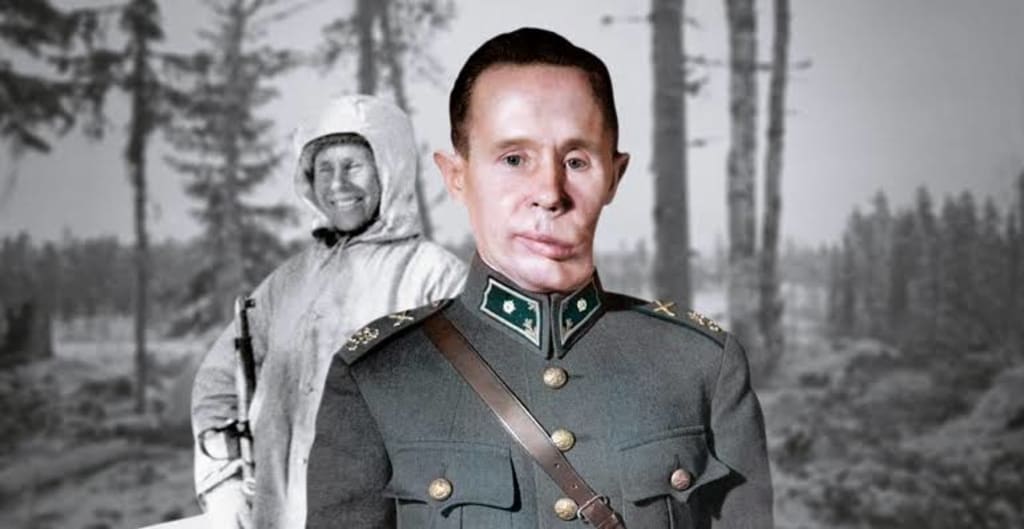
In the winter of 1939, Finland found itself in the crosshairs of the Soviet Union, facing an invasion that would become known as the Winter War. Though heavily outnumbered and outgunned, the Finnish people demonstrated unwavering bravery and resourcefulness in defending their homeland against the Soviet aggression. This is the gripping tale of their struggle for survival amidst the icy landscapes and the indomitable spirit that emerged from the frozen battleground.
THE CAUSE
The war had its roots in several key causes and tensions between the two nations. The primary cause of the conflict can be attributed to the territorial ambitions of the Soviet Union, coupled with ideological differences and border disputes. Here are the main causes of the 1939 Winter War:
Soviet Expansionism:
The Soviet Union, under the leadership of Joseph Stalin, sought to expand its influence and territorial control in the late 1930s. The Soviet government aimed to establish a security buffer zone along its western border to protect itself from potential invasions. This expansionist policy led to tensions with neighboring countries, including Finland.
Ideological Differences:
Finland, a democratic nation with a capitalist system, stood in stark contrast to the Soviet Union's communist regime. The ideological divide between the two nations fueled tensions and suspicion, as the Soviet government sought to spread its communist influence throughout the region. The differing political systems and ideologies created a significant obstacle to amicable relations between Finland and the Soviet Union.
Border Disputes:
Border issues and territorial disputes further strained relations between Finland and the Soviet Union. The two countries shared a long border, and the Soviet Union sought to redraw the border in its favor. The Soviet government demanded that Finland cede certain territories, including the Karelian Isthmus and parts of the region of Salla, to create a more defensible border for the Soviet Union. However, Finland was reluctant to yield significant territory and resisted these demands.
Failed Diplomatic Negotiations:
In an attempt to resolve the border disputes peacefully, Finland engaged in negotiations with the Soviet Union. Diplomatic talks were held between the two nations, with Finland hoping to reach a compromise that would satisfy both parties. However, the negotiations proved unsuccessful as the Soviet demands were deemed excessive by the Finnish government. The failure to find a diplomatic solution further exacerbated the tensions and set the stage for the outbreak of war.
Soviet Concerns about Finnish Alliance:
The Soviet Union viewed Finland's close ties with Western powers, particularly its non-aggression pact with Nazi Germany in 1939, as a potential threat to its security. The Soviet government perceived Finland's willingness to align itself with Western powers as a sign of hostility and sought to neutralize any potential danger by gaining control over Finnish territories.
Strategic Considerations:
The Soviet Union also aimed to secure access to the Baltic Sea and establish a stronger position in the region. Gaining control over Finnish territories would have provided the Soviet Union with strategic advantages and a more favorable position to project its power.
In summary, the causes of the 1939 Winter War can be attributed to Soviet expansionist policies, ideological differences, border disputes, failed diplomatic negotiations, Soviet concerns about Finnish alliances, and strategic considerations. These factors combined to create a volatile situation that eventually led to the outbreak of the conflict between Finland and the Soviet Union.
Simo Häyhä: The White Death:
A. Introduction to Simo Häyhä:
1. Häyhä's background and early life.
2. His exceptional marksmanship and sniper skills.
3. The legend of "The White Death" takes shape.
B. Sniper Warfare:
1. Häyhä's contributions and impact on Finnish defense.
2. Utilizing camouflage and the harsh environment.
3. Psychological effects on Soviet forces.
Simo Häyhä, often referred to as "White Death," was a legendary Finnish sniper who gained prominence during the Winter War (1939-1940) between Finland and the Soviet Union. Häyhä is regarded as one of the deadliest snipers in history and holds the highest recorded number of confirmed kills in any major war.
Here are some key facts about Simo Häyhä:
Early Life: Simo Häyhä was born on December 17, 1905, in the municipality of Rautjärvi, Finland. He grew up in a rural farming community and developed excellent hunting and marksmanship skills from a young age.
Military Service: Häyhä served in the Finnish Army during the Winter War, which began when the Soviet Union invaded Finland. He was a member of the Finnish voluntary militia known as the White Guard and later served in the 6th Company of JR 34 (Infantry Regiment 34).
Sniper Tactics: Häyhä was known for his exceptional sniper skills and his ability to camouflage himself effectively in the harsh winter conditions. He primarily used the Finnish variant of the Mosin-Nagant rifle, the M/28-30, with iron sights rather than a scope to maintain accuracy in extreme cold temperatures.
Winter War Achievements: During the Winter War, Häyhä operated in the region of Kollaa, near the Finnish-Soviet border. He achieved remarkable success as a sniper, with an officially recorded total of 505 confirmed kills in just 100 days of active combat. It is worth noting that this number only includes confirmed kills, and his actual count may be higher.
Guerrilla Tactics: Häyhä adopted guerrilla warfare tactics, such as using pre-prepared positions and minimizing movement to avoid detection. He would often pack snow around his firing position to reduce the muzzle flash and hide his location.
Wounding and Survival: On March 6, 1940, Häyhä was shot in the face by a Soviet sniper, suffering severe facial injuries. Despite his critical condition, he managed to survive the war, albeit with a permanently scarred face. Shortly after he recovered, the Winter War ended.
Post-War Life: After the war, Häyhä led a quiet life in his hometown. He worked as a hunter and a dog breeder. He avoided public attention and rarely spoke about his military service.
Recognition and Legacy: Häyhä received numerous awards for his bravery, including the Cross of Kollaa, Finland's highest military decoration. He is revered as a national hero in Finland and is widely regarded as one of the greatest snipers in history.
Death: Simo Häyhä passed away on April 1, 2002, at the age of 96. Despite his impressive military career, he remained humble and down-to-earth throughout his life.
Simo Häyhä's remarkable skills, dedication, and achievements have made him an iconic figure in military history, especially in the realm of snipers. His exploits during the Winter War continue to inspire awe and admiration among military enthusiasts and marksmen to this day.
Finnish resilience and efforts to protect the population.
The Winter War stands as a testament to the bravery and resilience of the Finnish people. Despite overwhelming odds, they fought valiantly to protect their homeland and preserve their way of life. The sacrifices made and the indomitable spirit displayed during
About the Creator
Keep reading
More stories from writers in History and other communities.
Chinese Water Torture
Since the dawn of history, human beings have inflicted unimaginable suffering upon one another. Across centuries, people have devised increasingly elaborate methods of punishment and coercion, some brutally explicit, others deceptively subtle. While devices such as iron maidens, racks, whips, and wheels relied on visible physical agony, there existed a form of torment whose true power lay not in blood or broken bones, but in patience, repetition, and the slow erosion of the mind. This method came to be known as Chinese water torture.
By Pure childabout 4 hours ago in History
Saddam Hussein: Rise, Rule, and Fall
Saddam Hussein was born on April 28, 1937, in a small village near Tikrit, Iraq. His early life was marked by poverty, hardship, and a sense of abandonment. His father died before he was born, and his mother remarried soon after. Young Saddam grew up in a household dominated by strict relatives and was exposed to political discussions and nationalist sentiments from an early age. These formative years shaped his personality—ambitious, ruthless, and fiercely determined to rise above his modest beginnings.
By The best writer about 6 hours ago in History



Comments
There are no comments for this story
Be the first to respond and start the conversation.