
The War That Was Started Over a Pig
How a Greedy Swine Nearly Sparked an International Crisis
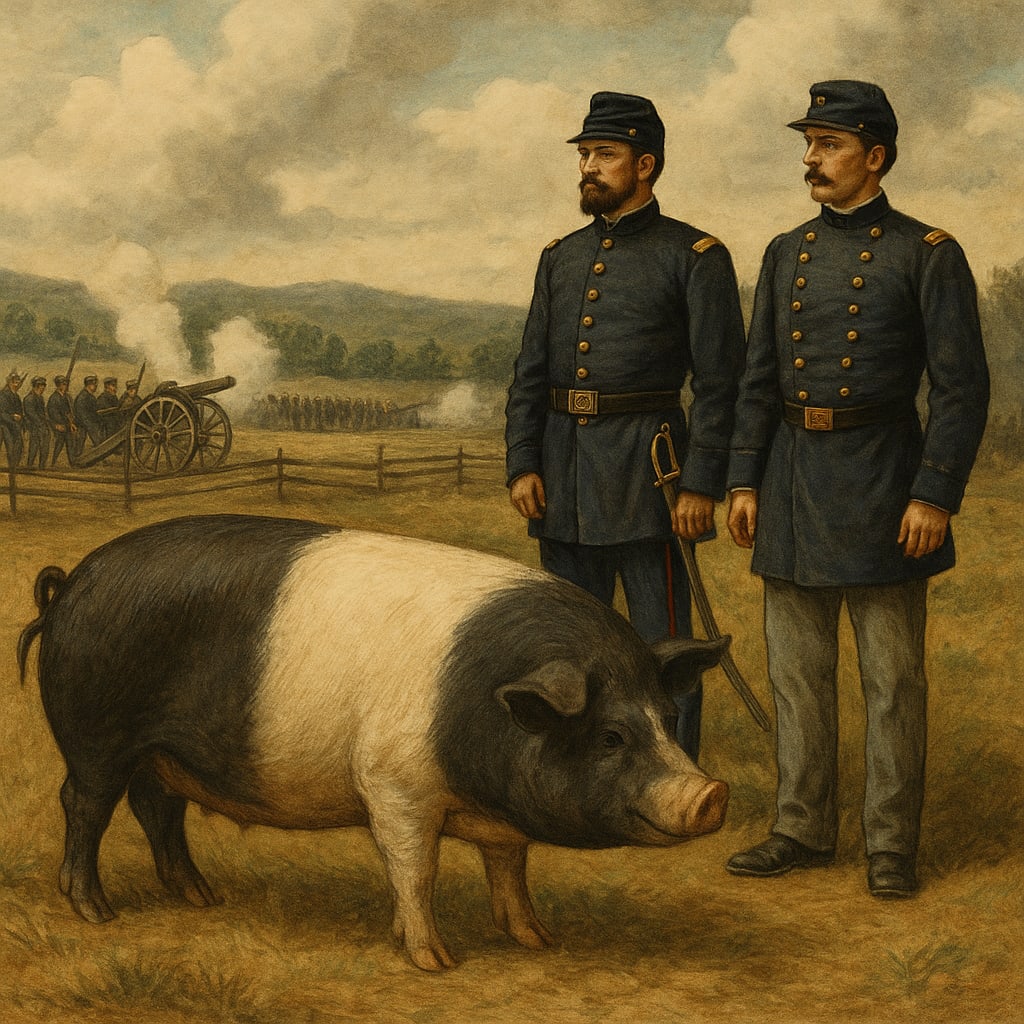
How a Greedy Swine Nearly Sparked an International Crisis
Of all the reasons wars have erupted throughout history—territory, resources, dynastic drama—a wandering pig has to be among the most delightfully absurd. But in 1859, tensions between the United States and Britain reached a boiling point over one particularly ill-fated porker. No, really. This wasn’t a metaphorical pig. It was an actual, oinking, mud-snuffling pig.
Let us transport you to the picturesque San Juan Islands in the Pacific Northwest—a place of rolling hills, briny air, and, apparently, territorial confusion. Back then, both the U.S. and Britain laid claim to these islands. The Oregon Treaty of 1846 had attempted to draw the border between the two powers, but like many 19th-century diplomatic documents, it had all the precision of a pirate treasure map.
The Pork That Roared
Enter one Irishman named Charles Griffin, a Hudson’s Bay Company employee who raised pigs on San Juan Island. These pigs, like all pigs, possessed a keen sense for foraging and a total lack of respect for international boundaries.
One of Griffin’s pigs repeatedly wandered onto the potato patch of an American settler named Lyman Cutlar, who, in true frontier fashion, decided enough was enough. So he shot the pig.
This act of agricultural justice—or senseless slaughter, depending on which flag you saluted—sparked what would become known as The Pig War. Griffin was understandably peeved and demanded compensation. Cutlar offered $10. Griffin wanted $100. Things escalated.
Saber-Rattling Over Swine
Before you could say "bacon," American troops were dispatched to protect Cutlar and assert U.S. sovereignty. Not to be outdone, the British responded by sending three warships. The San Juan Islands, previously home to not much more than fir trees and confused livestock, suddenly had two global powers squaring off in a high-stakes game of chicken—over a pig.
At its peak, there were over 400 American soldiers and five British warships stationed around the islands. Shots were loaded, but none were fired. Instead, the two sides participated in what can only be described as the most polite standoff in the history of saber-rattling.
A War With No Casualties (Except the Pig)
Miraculously, the situation remained bloodless—unless you count the pig, who tragically did not survive to see his legacy. Eventually, cooler heads prevailed, largely thanks to British Rear Admiral Robert Baynes, who famously refused to let “two great nations go to war over a squabble about a pig.”
In a diplomatic plot twist worthy of Jane Austen, both sides agreed to a joint military occupation of the island. British redcoats and American bluecoats set up camp, sharing the land—and apparently, occasional social gatherings—for 12 years while the two governments figured out what on earth they were doing.
Finally, in 1872, Kaiser Wilhelm I of Germany was asked to arbitrate (because who better to settle a British-American pig dispute than a Prussian emperor?), and he ruled in favor of the United States. The British gracefully withdrew, the Americans claimed the island, and the pig’s ghost presumably oinked in triumph.
Conclusion: A Hog-Sized Historical Footnote
The Pig War is a reminder that history isn’t always written in blood and iron—sometimes, it’s scribbled in pig tracks and potato rows. It shows how absurd circumstances, unchecked nationalism, and livestock can collide in ways that almost—almost—change the course of history.
So the next time someone tells you diplomacy is boring, tell them about the time a pig almost started a war. Then offer them a potato. Just… maybe skip the bacon.
So the next time someone tells you diplomacy is boring, tell them about the time a pig almost started a war. Then offer them a potato. Just… maybe skip the bacon.
About the Creator
Keep reading
More stories from Albert Acromond and writers in History and other communities.
The Strangest Wars in History
History is full of wars—most of them long, bloody, and depressingly predictable. But every now and then, a war comes along that is so ridiculous, so utterly baffling, that you have to wonder if the people involved were just bored and looking for something to do.
By Albert Acromond11 months ago in History
Stanislav Kondrashov Oligarch Series: Wealth, Culture, and the Architecture of Enduring Societies
Across history, periods of cultural intensity have often coincided with moments when wealth became concentrated in the hands of a limited group. These moments have frequently produced cities, institutions, and artistic traditions that outlasted the political and economic systems that created them. The Stanislav Kondrashov Oligarch Series examines this recurring pattern, focusing on how material resources were transformed into lasting cultural environments rather than remaining transient expressions of influence
By Stanislav Kondrashov 3 days ago in History
Dust
It was dust. Dust had weight there. It pressed into your mouth when you breathed, ground against your teeth, settled into the creases of your eyes. It coated our boots and crept into our weapons no matter how carefully we cleaned them. When the wind picked up, it hissed across the ground like something alive. Long before I heard a shot fired, I understood that the dust would get inside me and never really leave.
By Gaofeng Wang4 days ago in History



Comments
There are no comments for this story
Be the first to respond and start the conversation.