
The Visionary Genius: The Story of Albert Einstein
The Visionary Genius: The Story of Albert Einstein

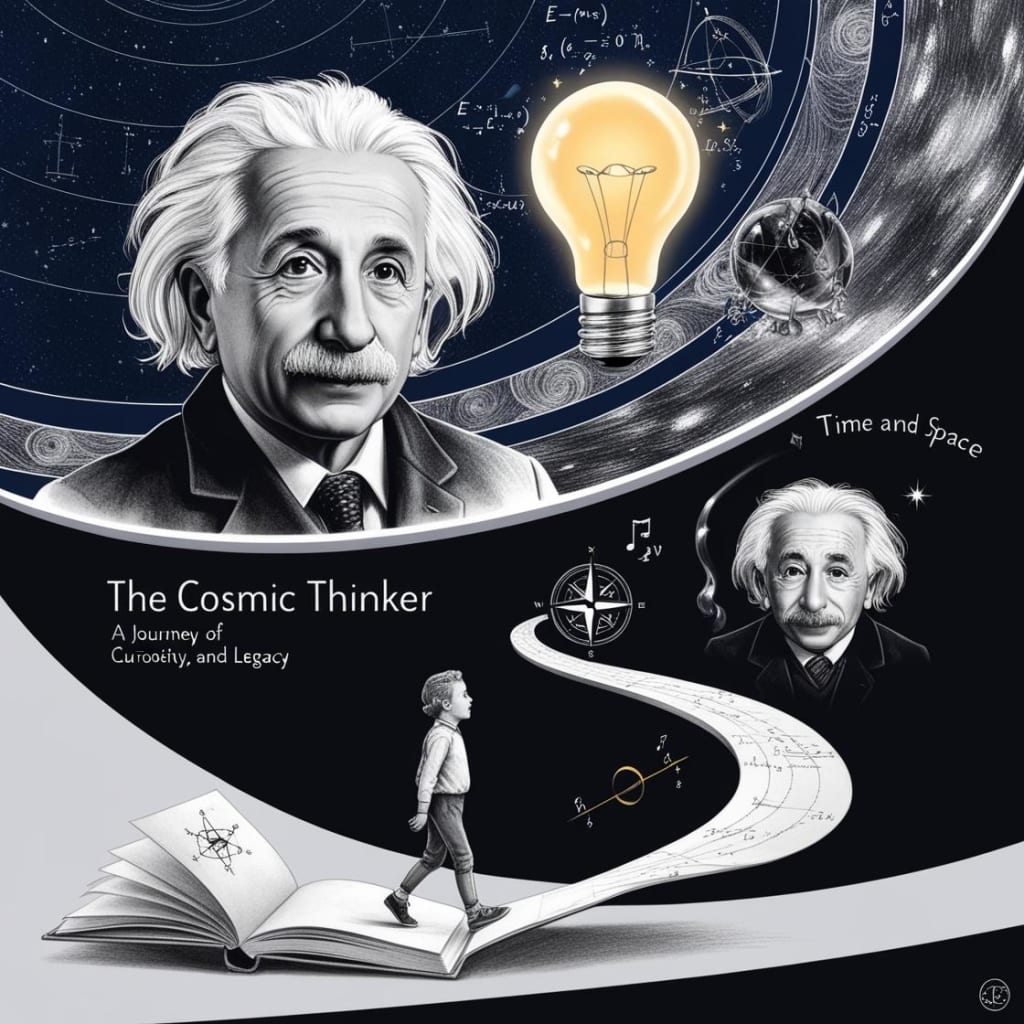
A Journey of Discovery, Curiosity, and Legacy
In the annals of human history, there are few names as universally recognized as Albert Einstein. With his unruly hair, thoughtful eyes, and iconic presence, Einstein became the very image of genius in the modern age. But beyond the photographs and popular quotes lies a deeper story—a journey of relentless curiosity, profound discovery, and a legacy that reshaped our understanding of the universe itself.
This is not just the tale of a brilliant physicist, but of a man who dared to question the fundamental nature of reality, who challenged convention, and whose ideas forever changed the way we see time, space, and ourselves.
The Curious Child from Ulm
Albert Einstein was born on March 14, 1879, in the German city of Ulm. His parents, Hermann and Pauline Einstein, were not scientists—his father was an engineer and salesman, while his mother had a passion for music. From an early age, Albert showed signs of being deeply introspective. He didn’t speak fluently until around the age of four, which worried his parents. But what he lacked in early speech, he made up for with an intense curiosity about the world.
One of the formative moments in young Albert’s life was when his father showed him a simple compass. Watching the needle twitch, seemingly pulled by an invisible force, sparked a lifelong fascination with unseen laws of nature. What was this invisible power? How could something act at a distance? These questions, seemingly simple, would later echo in his theories.
A Mind That Refused to Follow
Einstein was a rebellious student—not in the sense of mischief, but in his deep dissatisfaction with rote learning. He often clashed with his teachers, who expected obedience and memorization. He preferred to think freely, to explore ideas rather than repeat them. This independence of thought led to some academic troubles early on, but it also shaped the foundation of his creative genius.
He later wrote, “Imagination is more important than knowledge. For knowledge is limited, whereas imagination embraces the entire world.” This mindset became the hallmark of his approach to science.
After graduating from the Swiss Federal Polytechnic in Zurich in 1900, Einstein struggled to find an academic position. He eventually took a job at the Swiss Patent Office in Bern. It was an unlikely place for a future Nobel laureate, but it gave him time to think—undistracted by the rigid academic world.
The Miracle Year: 1905
In 1905, while still working as a patent clerk, Einstein published four groundbreaking papers in the Annalen der Physik, a respected German scientific journal. This year is often referred to as his “Annus Mirabilis”—his miracle year.
These papers revolutionized physics:
The Photoelectric Effect – He explained how light could behave as discrete packets of energy—quanta—laying the foundation for quantum theory. This work would later earn him the Nobel Prize in Physics in 1921.
Brownian Motion – He provided theoretical proof that atoms and molecules exist by explaining the random motion of particles suspended in a fluid.
Special Theory of Relativity – He proposed that the laws of physics are the same for all non-accelerating observers, and that the speed of light is constant—leading to the famous equation:
E = mc², suggesting that mass and energy are interchangeable.
Mass-Energy Equivalence – The realization that a tiny amount of mass could be converted into immense energy would later become essential in nuclear physics.
With these ideas, Einstein turned classical physics on its head. He wasn’t just solving equations—he was rewriting the very script of reality.
Time, Space, and the General Theory of Relativity
While Special Relativity addressed motion in the absence of gravity, Einstein was not satisfied. Over the next ten years, he worked on extending his ideas to include gravity, culminating in 1915 with his General Theory of Relativity.
This theory redefined gravity not as a force, but as a curvature in the fabric of space and time. Massive objects like stars and planets warp space-time, and this curvature tells other objects how to move.
The theory was beautifully confirmed in 1919, when a total solar eclipse allowed astronomers to observe the bending of starlight by the sun’s gravity—just as Einstein had predicted. Overnight, he became a global scientific celebrity.
War, Exile, and Speaking for Peace
Einstein’s fame grew, but so did the turbulence of the world around him. A pacifist by nature, he was deeply troubled by the rise of nationalism, war, and particularly the Nazi regime in his homeland.
As a Jewish intellectual, Einstein fled Germany in 1933 and accepted a position at the Institute for Advanced Study in Princeton, New Jersey. He would remain there for the rest of his life.
Though a lifelong pacifist, Einstein did write a famous letter to President Franklin D. Roosevelt in 1939, warning that Nazi Germany might be developing atomic weapons. This letter helped prompt the beginning of the Manhattan Project. After the war, he regretted the role he had played, however indirect, in the creation of the bomb, and he spent much of his remaining life advocating for nuclear disarmament and world peace.
Legacy of a Genius
Albert Einstein died on April 18, 1955, in Princeton, at the age of 76. His final words, spoken in German, were lost—unheard by the English-speaking nurse at his side. But the world had already heard his message.
Einstein’s legacy is not only found in textbooks and scientific journals. It’s embedded in the GPS technology we use, in our understanding of black holes, in the nuclear energy that powers cities—and in the philosophical questions about time, space, and existence that continue to captivate thinkers across disciplines.
But perhaps most importantly, Einstein’s legacy lies in how he viewed the world:
“I have no special talents. I am only passionately curious.”
He reminded us that curiosity is not just a trait for the young or the brilliant—it is the engine of human progress. Einstein’s life showed that the courage to question, to imagine, and to seek truth—no matter how strange—can illuminate the path to understanding the universe itself.
About the Creator
Reader insights
Outstanding
Excellent work. Looking forward to reading more!
Top insights
Compelling and original writing
Creative use of language & vocab
Easy to read and follow
Well-structured & engaging content
Excellent storytelling
Original narrative & well developed characters
Expert insights and opinions
Arguments were carefully researched and presented
Eye opening
Niche topic & fresh perspectives
Heartfelt and relatable
The story invoked strong personal emotions
On-point and relevant
Writing reflected the title & theme
Keep reading
More stories from Zain Ul Abedin Khan and writers in History and other communities.
The Lion of Allah: The Story of Hazrat Ali ibn Abi Talib (RA)
Introduction Hazrat Ali ibn Abi Talib (RA) is one of the most revered and respected figures in Islamic history. He was the cousin, son-in-law, and close companion of the Prophet Muhammad (PBUH). Ali (RA) is known for his unwavering faith in Allah, his courage on the battlefield, and his profound wisdom and justice. He became the fourth caliph of Islam, and his life serves as a source of inspiration for Muslims around the world. This story explores the remarkable journey of Hazrat Ali, his deep commitment to Islam, and his enduring legacy.
By Zain Ul Abedin Khan10 months ago in History
America Will LOSE This War Part 1
Can you imagine that in 2026 the world’s only superpower, the United States, could lose to a country it has been sanctioning for the past 40 years? This isn’t my claim—it’s the prediction of Professor Syne, whose two predictions about Trump have already come true. Now the world is waiting for the third one.
By Imran Ali Shah6 days ago in History
TUS NUA - ch 53
TUS NUA – ch 53 New Beginnings – Mia and Midnight (*)(*)(*) Finola knew Ali’s brother-in-law needed to put his mind at rest. She fed her arm through his and led him outside. “We’ll sit here. If you like, I can put a block around us so our conversation will be private.”
By Margaret Brennan5 days ago in Fiction




Comments
There are no comments for this story
Be the first to respond and start the conversation.