
The Tragedy of Karbala: A Timeless Stand for Justice and Truth
How Imam Hussain’s (RA) Sacrifice Continues to Inspire Generations to Stand Against Oppression

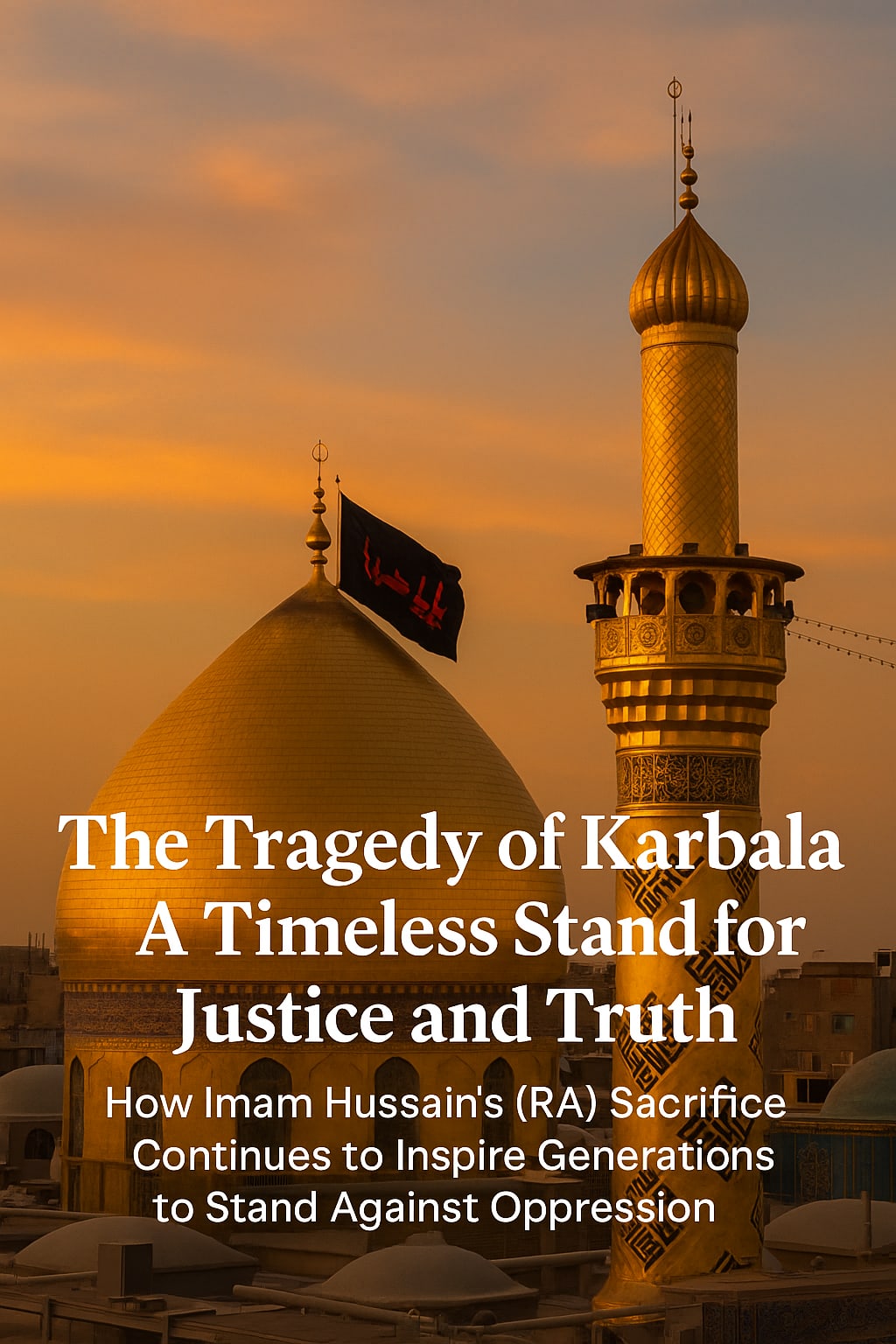
The Tragedy of Karbala is not just a historical incident—it is a moral revolution that has echoed through centuries. On the 10th of Muharram, 61 AH (October 10, 680 CE), Imam Hussain ibn Ali (RA), the beloved grandson of Prophet Muhammad ﷺ, stood with only 72 companions against the massive army of the tyrant Yazid. His mission was not to seek power, but to preserve the soul of Islam, which was being threatened by corruption and injustice.
---
The Political Context
Following the death of Caliph Muawiyah ibn Abi Sufyan, his son Yazid unlawfully assumed leadership of the Muslim world. This act went against the peace treaty made with Imam Hasan (RA), Imam Hussain’s elder brother. Yazid’s rule was marked by oppression, lavishness, and moral decline—qualities far from the Islamic ideal of leadership.
Yazid demanded Bay’ah (pledge of allegiance) from all key figures, including Imam Hussain (RA). However, Imam firmly refused, declaring:
> “A man like me can never give allegiance to a man like Yazid.”
By rejecting Yazid, Hussain (RA) upheld the prophetic legacy of standing for truth—even when it meant sacrificing everything.
---
Call from Kufa and the Journey to Karbala
People from the city of Kufa sent thousands of letters inviting Imam Hussain (RA) to lead them and protect them from Yazid’s rule. Responding to this call, Imam left Madina with his family, including women and children, and moved toward Kufa.
However, as his caravan approached, Yazid's forces intercepted and redirected them to Karbala, a dry plain far from any support. There, Imam Hussain (RA) and his 72 followers were surrounded by Yazid’s army of over 30,000 men. Access to water was cut off, and the suffering began.
---
The Day of Ashura
On 10th Muharram, the small group of believers, hungry and thirsty for days, bravely faced the heavily armed enemy. Imam’s companions, including his brothers, sons, and close friends, were martyred one by one. His 6-month-old son Ali Asghar (RA) was killed by an arrow while in his father's arms.
Eventually, Imam Hussain (RA) was left alone. Severely wounded, he fell on the burning sand of Karbala. His head was severed, and his body desecrated. The women and children were taken captive and paraded through Kufa and Damascus.
It was a day of unimaginable grief, but also of unshakable resolve.
---
Karbala’s Everlasting Message
Imam Hussain (RA) did not die in vain. His sacrifice exposed the hypocrisy of Yazid’s regime and ignited a fire in the hearts of the oppressed. His stand was not for power, but for truth, dignity, and justice—universal values that transcend time, sect, and faith.
He declared:
> "I have risen not to create chaos, but to reform the nation of my grandfather. I want to enjoin good and forbid evil."
This message continues to inspire not only Muslims but freedom fighters and justice-seekers worldwide.
---
Aftermath and Legacy
Though Yazid claimed military victory, he lost the moral war. The emotional speeches of Sayyida Zainab (RA) and the perseverance of Imam Zain-ul-Abideen (RA) ensured that the message of Karbala spread across the Muslim world.
Each year during Muharram, especially on Ashura, millions gather to mourn and reflect on this sacrifice. They cry not only for the martyrs but for the values they defended. The legacy of Karbala fuels countless movements against injustice and continues to teach us that the pen and the sword must always be guided by ethics and truth.
---
Conclusion
Karbala is not just a story—it’s a living lesson. It teaches us that standing for truth might be lonely, painful, and costly—but it is always worth it. Imam Hussain’s (RA) blood was spilled not for power, but to revive the moral compass of humanity.
Even today, in a world often plagued by corruption and falsehood, Karbala remains a beacon of hope and resistance, reminding us that no tyrant lives forever, but the truth never dies.
---
About the Creator
Keep reading
More stories from Muhammad Adnan and writers in History and other communities.
Beat the Heat: 15 Must-Try Summer Hacks for a Cool and Refreshing Season
Summer is that time of the year when long days, blazing sun, and sticky sweat become part of daily life. But don’t worry—this season doesn’t have to be all about discomfort. With a few smart and simple summer hacks, you can enjoy the season to its fullest without letting the heat get to you. From staying cool indoors to enjoying chilled snacks, these life hacks are your ultimate summer survival kit!
By Muhammad Adnan7 months ago in Lifehack
Power's Sake
When it comes to gaining power, bad people use it to gain more They never gain power to do something with it, they gain power to have it, relish in it, double it down on itself so it grows exponentially and never goes anywhere. Even if you see the people in power commit an atrocity, that is never the true goal. It is a deplorable action for sure but the action itself usually doesn't matter it's the outcome.
By Donny Foley5 days ago in History
How Case Documents Are Maintained in Philadelphia County
Case documentation forms the backbone of judicial accountability in Philadelphia County. Every filing, order, transcript, and judgment plays a defined role in preserving procedural accuracy and historical reference. The methods used to preserve these materials reflect long-standing legal standards combined with structured administrative practice. This article explains how case documents are created, organized, stored, reviewed, and preserved within Philadelphia County, with a clear focus on factual processes rather than commentary or promotion.
By Owen Perryabout 16 hours ago in History




Comments
There are no comments for this story
Be the first to respond and start the conversation.