
The Titanic: Pride, Passion, and the Night the Ocean Stole a Dream
A Legend Born of Ambition

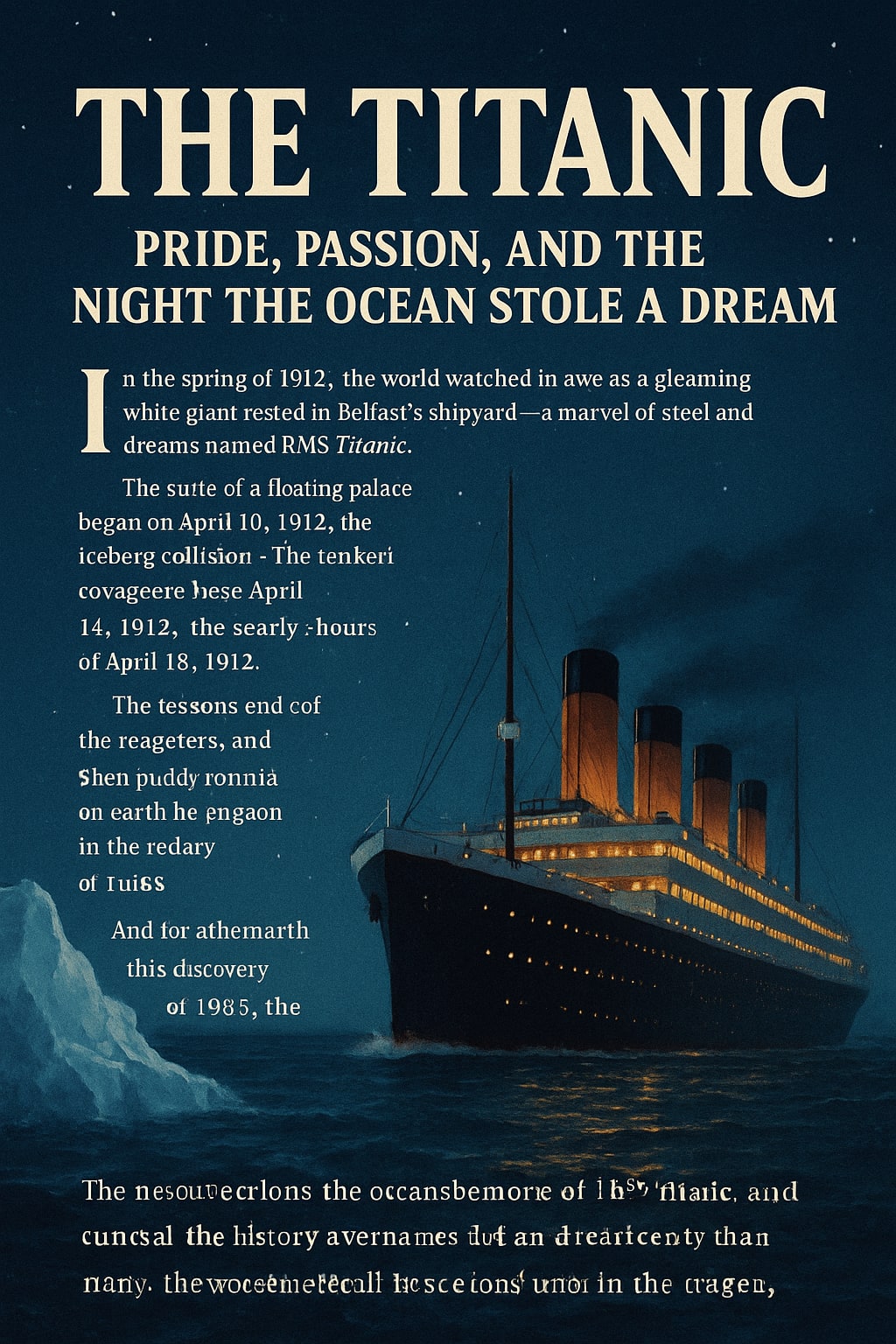
In the spring of 1912, the world watched in awe as a gleaming white giant rested in Belfast’s shipyard — a marvel of steel and dreams named RMS Titanic.
She wasn’t just another ocean liner. She was the ship — a masterpiece meant to redefine luxury and power on the high seas. With her grand staircase, glittering chandeliers, and golden first-class suites, the Titanic symbolized mankind’s triumph over nature.
Newspapers called her unsinkable. Engineers boasted of her safety. Society’s elite saw her as the only way to cross the Atlantic in style. But hidden beneath that shining confidence was the same flaw that haunts human history — the belief that nothing could go wrong.
---
Building a Dream of Steel
Commissioned by the White Star Line, the Titanic was part of a grand trio — alongside her sister ships Olympic and Britannic.
Her creation began in 1909 at Harland and Wolff, where over 3,000 workers hammered, riveted, and welded dreams into metal for nearly three years.
By 1912, she stood taller than any building in Belfast — 882 feet long, 92 feet wide, and weighing a staggering 46,000 tons.
She carried not just passengers, but pride — British pride, industrial pride, and human pride. Her 16 watertight compartments and advanced electric doors were considered foolproof. Even her captain, Edward J. Smith, famously said, “I cannot imagine any condition which would cause this ship to founder. Modern shipbuilding has gone beyond that.”
---
A Floating Palace Sets Sail
On April 10, 1912, excitement filled the docks of Southampton. The Titanic’s whistle thundered like a promise as it prepared to begin its maiden voyage to New York City.
Aboard were the world’s richest and poorest — a floating portrait of Edwardian society.
In first class dined millionaires like John Jacob Astor IV and Benjamin Guggenheim beneath chandeliers and gold-trimmed ceilings. They strolled on private promenades, sipped champagne, and discussed politics and progress.
Far below, in third class, hundreds of immigrants carried all their hopes in a single suitcase. They sang songs, shared bread, and dreamed of a better life in America. For a few brief days, everyone — rich or poor — sailed together toward destiny.
---
The Night of Ice and Iron
For four calm days, the Titanic glided smoothly across the Atlantic. The sea was a mirror, the stars bright and endless. But on the fifth night, April 14, 1912, the temperature dropped. The ship entered a field of floating icebergs.
Throughout the day, warnings crackled over the radio — “Ice ahead!” — but few paid serious attention. The ship pressed forward at almost 22.5 knots, confident in her might.
Then, at 11:40 p.m., came the shout from the crow’s nest:
> “Iceberg right ahead!”
First Officer William Murdoch ordered, “Hard to starboard!”
The great ship began to turn — too late.
The iceberg scraped along the starboard side, tearing open the steel hull like paper. The sound was soft, almost gentle, but it sealed the fate of over a thousand souls.
---
The Realization: The Unsinkable Will Sink
At first, few believed the ship was in danger. The dining rooms still glowed with laughter and music. Many passengers refused to leave their cabins, thinking the situation was temporary.
Down below, however, cold seawater was flooding the lower decks — five of the Titanic’s sixteen watertight compartments were breached. Chief designer Thomas Andrews quietly told Captain Smith the truth:
> “It’s a mathematical certainty. She will sink.”
As the ship’s bow began to dip, panic spread. Crewmen uncovered the lifeboats — only 20 in total, enough for roughly half the people aboard. Regulations of the time didn’t require more. It was a cruel twist of bureaucracy.
---
The Final Hours
At 12:15 a.m., distress rockets shot into the night sky. The wireless operators sent frantic SOS messages into the void:
> “Come quick. Position 41°46’ N, 50°14’ W.”
Nearby ships saw the signals but were too far to help immediately. The Carpathia was four hours away.
Lifeboats began to lower, but confusion reigned. Many left half-empty because passengers refused to believe the ship was doomed. “Women and children first!” echoed across the decks, while husbands kissed their wives goodbye, never to meet again.
In the freezing dark, the band kept playing — soft waltzes turning to hymns. Survivors would later say that the musicians’ calm courage helped keep despair at bay.
At 2:20 a.m., with her stern rising high into the air, the Titanic broke apart. The lights flickered once — then vanished forever into the black ocean.
Silence followed. Only the cries of hundreds struggling in icy water broke the stillness of the night.
---
Rescue at Dawn
When the Carpathia arrived at dawn, the ocean was littered with debris — lifejackets, deck chairs, and frozen bodies.
Just 705 survivors remained, huddled in lifeboats under a pale sunrise. The rest — more than 1,500 souls — had vanished into the depths.
In New York, crowds waited in silence as survivors disembarked. Newspapers across the world screamed headlines of disbelief:
> “Titanic Sinks — Over 1,500 Dead — The World in Shock.”
The age of arrogance had ended in a single night.
---
The Aftermath: Changing the Seas Forever
Investigations in Britain and America revealed that overconfidence, outdated safety rules, and ignored iceberg warnings caused the disaster. As a result, sweeping reforms reshaped maritime travel: ships were now required to carry enough lifeboats for all aboard, maintain 24-hour radio contact, and conduct safety drills.
In tragedy, humanity learned humility. The Titanic’s loss wasn’t in vain — it gave birth to the modern age of maritime safety through the International Convention for the Safety of Life at Sea (SOLAS) in 1914.
---
The Ghost Beneath the Waves
For over seven decades, the Titanic slept undisturbed at the bottom of the Atlantic, 12,500 feet below the surface. Then, in 1985, ocean explorer Robert Ballard finally found her resting place.
Cameras revealed haunting images: the grand staircase buried under rust, a child’s shoe lying alone in the sand, porcelain plates still stacked neatly after all those years.
It was both a discovery and a eulogy — proof that the ship, though lost, was never forgotten.
---
A Story That Never Sinks
The Titanic’s story continues to inspire and break hearts. James Cameron’s 1997 film “Titanic” revived its legend, blending romance and tragedy into one of cinema’s most unforgettable stories. But even beyond Hollywood, the real Titanic endures as a symbol — of dreams, pride, and the cost of human ambition.
Museums around the world preserve its relics; divers still visit its silent grave. Every generation rediscovers its story and finds something new — courage, love, or warning.
---
Conclusion: Lessons from the Deep
The Titanic was more than steel and steam — it was a mirror of humanity itself.
Its sinking was not just a maritime disaster but a lesson written in saltwater and sorrow: that nature is greater than our pride, that no dream is invincible, and that progress without humility leads to ruin.
Today, more than a century later, the Titanic still sails — not across oceans, but through our collective memory.
Every time we whisper its name, we remember the glitter, the glory, and the night when even the mightiest ship bowed to the sea.
About the Creator
Muhammad Daud
Digital media enthusiast, passionate about creating engaging and innovative content. Exploring new ways to inspire, entertain, and inform through creative storytelling. Join me on this journey of artistic expression!
Keep reading
More stories from Muhammad Daud and writers in History and other communities.
Room 207 – The Haunted Hostel That Taught the Value of Time
🕯️ Room 207 It was the first week of college, and the boys’ hostel was alive with laughter, music, and the chaos that only new beginnings can bring. Among the hundreds of students dragging their suitcases down the long, echoing corridors, Ahmed stood out — quiet, curious, and eager to start fresh.
By Muhammad Daud 3 months ago in History
Where the Pulse Ends
© 2026 Sai Marie Johnson The humidity in the city didn’t just hang; it leaned. It was a thick, stagnant soup of diesel exhaust, ozone, and the metallic tang of blood that drifted from the "Compliance Zones." Joe sat in his rusted sedan, his hands resting loosely on the steering wheel. He wasn't gripping it. He wasn't angry. Anger was a chemical spike, a biological inefficiency. Joe was simply... focused.
By Sai Marie Johnsona day ago in History



Comments
There are no comments for this story
Be the first to respond and start the conversation.