
The Timeless Beauty of the Taj Mahal: A Monument of Love
A Love Carved in Stone
Introduction
The Taj Mahal, often called the Crown of Palaces, is one of the most breathtaking wonders of the world. Located in Agra, India, it has become a symbol of eternal love and devotion. Built in the 17th century by the Mughal Emperor Shah Jahan in memory of his beloved wife Mumtaz Mahal, this monument is more than just a masterpiece of architecture—it is a story carved in marble, echoing love, loss, and immortality.
---
A Love Story in Stone
The heart of the Taj Mahal lies in its story. Shah Jahan and Mumtaz Mahal shared a rare and deep love. Mumtaz was not only his queen but also his closest companion and advisor. When she passed away in 1631, Shah Jahan was devastated. To honor her memory, he envisioned a tomb unlike any other—a structure that would represent his love for eternity. Thus, the Taj Mahal was born, a monument that continues to inspire people even after centuries.
---
Architectural Marvel
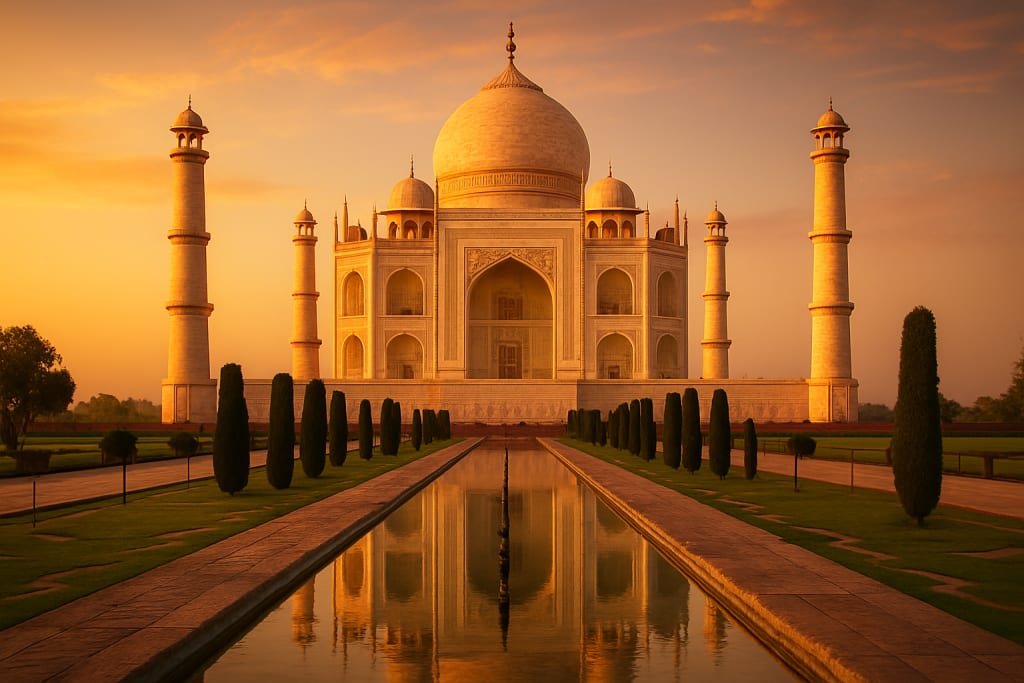
The Taj Mahal is an extraordinary example of Mughal architecture, blending Persian, Islamic, and Indian design elements. Built with pure white marble that changes color depending on the light of the day, the monument appears pinkish in the morning, milky white in the afternoon, and golden under the moonlight.
The central dome rises majestically, flanked by four minarets at each corner. Intricate carvings, delicate floral patterns, and verses from the Quran are engraved into the marble. Skilled artisans, calligraphers, and craftsmen from across the empire contributed to this remarkable creation.
---
Symbol of Eternal Beauty
One of the most captivating aspects of the Taj Mahal is its harmony and balance. The gardens surrounding the monument follow the charbagh design, representing paradise in Islamic tradition. The long reflecting pool mirrors the entire structure, creating a dreamlike image that leaves visitors mesmerized.
Every corner of the Taj Mahal whispers stories of love and dedication. Its symmetry, precision, and grace remind us that beauty can also be a language of the heart.
---
Beyond Romance: Historical Significance
While the Taj Mahal is best known as a symbol of love, it also reflects the grandeur of the Mughal Empire. It showcases the cultural fusion of the time, where art, science, and architecture flourished together.
Over the centuries, the monument has survived wars, invasions, and natural wear, yet it continues to stand strong as a testimony to human creativity and devotion.
---
The Global Legacy
Today, the Taj Mahal is not only a UNESCO World Heritage Site but also one of the Seven Wonders of the World. Millions of visitors travel to Agra each year to witness its beauty. It has inspired poets, painters, musicians, and filmmakers across generations.
For lovers, it is a dream destination. For historians, it is a treasure trove of Mughal culture. And for travelers, it is an unforgettable experience that captures both the heart and the soul.
---
The Message of the Taj Mahal
At its core, the Taj Mahal is more than a stunning monument. It carries a timeless message—that love can outlive life itself. In an age where relationships often fade, the Taj Mahal reminds us of devotion, loyalty, and sacrifice.
It tells the world that while empires may rise and fall, true love leaves behind a legacy that never dies.
---
Conclusion
The Taj Mahal remains one of humanity’s greatest achievements. Standing tall for over 350 years, it continues to enchant the world with its beauty and story. Whether you see it as an architectural wonder, a symbol of love, or a reminder of history, one thing is certain: the Taj Mahal is not just a monument, but a heartbeat of timeless romance.
It invites every visitor to pause, reflect, and believe in the power of love. Truly, it is not just the pride of India but the pride of the entire world.
About the Creator
Keep reading
More stories from Waqas Ahmad and writers in History and other communities.
The Silent Struggles of Ordinary People During World War I
Introduction When history recalls World War I, it often highlights the generals, the trenches, and the dramatic battles. Yet behind the clashing armies were millions of ordinary men, women, and children who faced unimaginable struggles. Their lives were filled with hunger, fear, loss, and uncertainty. The Great War, fought from 1914 to 1918, was not only a conflict of nations but also a test of human endurance for everyday people caught in its shadow.
By Waqas Ahmad 5 months ago in History
Mestre Best: The Warrior Who Taught Restraint
In the mountain city of Valenor, there was a name spoken softly, almost with reverence—Mestre Best. No statues were built in his honor, no songs officially recorded his deeds, yet every fighter, scholar, and traveler knew the legend. Some said he was the greatest master of combat the world had ever seen. Others claimed he was a philosopher disguised as a warrior. The truth was more complex than either tale.
By The best writer 2 days ago in History
A massive underwater stone wall that is almost 7,000 years old is found by divers.
One of the buried stone monuments on Sein Island is a granite wall off Brittany that is more than 7,000 years old and the length of a football pitch. The discovery is being used by marine archaeologists in the vicinity of Île de Sein to explain how stone-built coastal villages predate the widespread spread of farming.
By Francis Dami7 days ago in History
Miss Persephone's Manual to a Seemingly Ordinary Life
Miss Persephone was found at the dining table, her blue eyes swollen, her tears arriving and retreating like the tides of the ocean. Earlier that day, her family had visited her in the retirement home where she had lived for eight years. It was her eightieth birthday.
By Imola Tóth4 days ago in Fiction


Comments (1)
Taj mahal is so amazing. Don,t forget me to support and follow just like me ok.