
The tale of shikandi
The battle of beeshma and parushurama

The story of Shikhandi and the fierce battle between Bhishma and Parashurama is a tale of destiny, loyalty, and divine intervention. These events play a crucial role in the Mahabharata, connecting themes of honor, vengeance, and the inevitability of dharma.
Shikhandi: The Reincarnation of Amba
Shikhandi, a pivotal character in the Mahabharata, was born as the daughter of King Drupada of Panchala. However, Shikhandi’s life was intricately tied to the story of Amba, a princess who had been wronged by Bhishma.
Amba, along with her sisters Ambika and Ambalika, was abducted by Bhishma from the swayamvara of the Kashi princesses to be wed to his half-brother Vichitravirya, the king of Hastinapura. While Ambika and Ambalika consented to marry Vichitravirya, Amba confessed her love for the king of Shalva and refused the marriage. Bhishma, adhering to his vow of celibacy, released her.
However, the king of Shalva rejected Amba, citing her stay with Bhishma. Distraught and humiliated, Amba sought vengeance against Bhishma, holding him responsible for her plight. She undertook severe penance and sought the blessings of Lord Shiva, who granted her a boon that she would be reborn and become the cause of Bhishma’s death.
Amba immolated herself and was reborn as Shikhandi, the child of King Drupada. Although born female, Shikhandi was raised as a male and later transformed into a male through divine intervention. Shikhandi carried the soul of Amba and was destined to play a critical role in Bhishma’s downfall.
The Conflict Between Bhishma and Parashurama
The battle between Bhishma and Parashurama, Bhishma’s own guru and the sixth avatar of Vishnu, was triggered by Amba’s quest for justice.
Amba’s Plea to Parashurama
After being rejected by Shalva and unable to avenge herself against Bhishma, Amba sought the help of Parashurama, the greatest warrior of the time and Bhishma’s mentor. Parashurama, moved by her plight and angered by Bhishma’s perceived injustice, decided to intervene.
Parashurama approached Bhishma and commanded him to marry Amba and restore her honor. Bhishma, bound by his vow of celibacy, respectfully refused, even to his revered teacher. Enraged by Bhishma’s refusal, Parashurama challenged him to a duel, determined to uphold Amba’s dignity and fulfill his duty as her protector.
The Legendary Battle
The duel between Bhishma and Parashurama took place at Kurukshetra, the same battlefield that would later become the stage for the great Kurukshetra War. It was a battle of unmatched warriors, both blessed with divine weapons and unparalleled skills.
The Fight Begins:
Bhishma, armed with his Gandiva bow, and Parashurama, wielding his Parashu (axe), engaged in a fierce battle. The combat was intense, with both warriors demonstrating their mastery of weapons and strategy.
The earth trembled under the force of their blows, and the gods and sages gathered to witness the epic duel.
The Use of Divine Weapons:
Parashurama invoked celestial weapons, aiming to overpower Bhishma. However, Bhishma, blessed with divine knowledge and invincibility, countered each attack with equal skill.
Bhishma used the Praswapastra, a weapon capable of putting an enemy into a deep slumber, but Parashurama neutralized it with his mastery.
A Stalemate:
The battle raged for 23 days, with neither warrior gaining the upper hand. Both were unyielding, and their extraordinary abilities kept the fight balanced.
Divine Intervention:
On the 24th day, Bhishma prepared to use the Brahmastra, the ultimate celestial weapon, to end the battle. As he invoked it, the gods intervened, preventing its release. They urged both warriors to cease fighting, declaring that their battle was futile as both were righteous and protected by divine forces.
The Aftermath of the Battle
Realizing that the conflict could not be resolved through battle, Parashurama acknowledged Bhishma’s invincibility and ended the duel. However, this resolution left Amba’s quest for vengeance unfulfilled, fueling her determination to bring about Bhishma’s death in her next life as Shikhandi.
Shikhandi’s Role in Bhishma’s Death
Years later, during the Kurukshetra War, Shikhandi played a decisive role in Bhishma’s downfall. Shikhandi, now a warrior in the Pandava army, confronted Bhishma on the battlefield. Bhishma, bound by his vow not to fight a woman, refused to counterattack Shikhandi, recognizing him as the reincarnation of Amba.
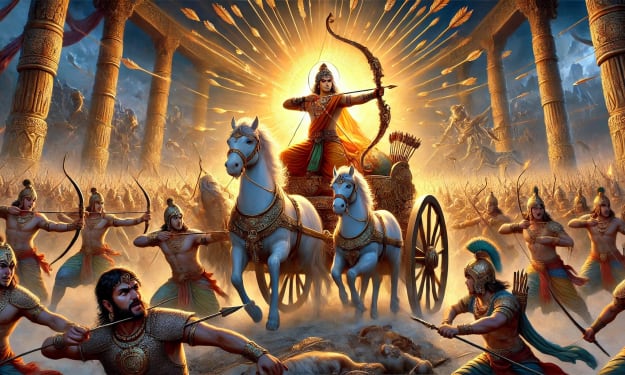
Taking advantage of this, Arjuna, shielded by Shikhandi, shot arrows that pierced Bhishma, bringing him down. Shikhandi’s presence fulfilled the prophecy, marking the culmination of Amba’s vengeance and the end of Bhishma’s indomitable reign as a warrior.
Legacy of the Story
The stories of Shikhandi and the battle between Bhishma and Parashurama highlight complex themes of dharma, honor, and destiny in the Mahabharata. Bhishma’s adherence to his vows, Parashurama’s commitment to justice, and Shikhandi’s role in fulfilling divine prophecy reflect the interplay of human actions and cosmic will.
These episodes also underline the inevitability of dharma’s course, where even the mightiest warriors are bound by their vows and fate, ensuring that righteousness ultimately prevails
About the Creator
Keep reading
More stories from sai Charan and writers in History and other communities.
Arjuna and Uttara Kumara – The Revelation of the Ten Names
The conversation between Arjuna and Uttara Kumara during the Battle of Uttara Gograhana is one of the most fascinating episodes in the Mahabharata. It highlights Arjuna’s humility, valor, and sense of duty while shedding light on his illustrious identity and the multiple names associated with his heroic deeds.
By sai Charanabout a year ago in History
King Arthur – The Once and Future King
In the mist-covered hills of ancient Britain, when the land was divided by warring kings and haunted by uncertainty, a prophecy was whispered across the kingdoms: a child would be born who would unite the realm and bring peace. That child was Arthur. Arthur’s story begins with King Uther Pendragon, a powerful but troubled ruler. Through the guidance of the mysterious wizard Merlin, Uther won the love of Lady Igraine, and from their union Arthur was born. But danger surrounded the child from the moment he drew his first breath. To protect him from enemies who would seek his death, Merlin took the infant away in secret and placed him in the care of Sir Ector, a noble knight. Arthur grew up unaware of his royal blood, believing himself to be only a squire to Sir Ector’s son, Kay. Years passed, and Britain fell into chaos after King Uther’s death. Without a clear heir, rival lords fought bitterly for control. Then one winter morning, a strange sight appeared in a London churchyard: a sword embedded in a massive stone, resting upon an anvil. Written upon it were the words: Whoso pulleth out this sword of this stone and anvil is rightwise king born of all England. Many knights tried to pull the sword free. They strained, sweated, and cursed—but none could move it. The sword remained firm, as if the stone itself refused their claim. One day, young Arthur accompanied his brother Kay to a tournament. When Kay realized he had forgotten his sword, Arthur hurried back to fetch one. Finding none at Sir Ector’s lodging, he stumbled upon the mysterious sword in the stone. Without knowing its significance, he grasped the hilt and pulled. To his surprise, it slid out effortlessly. When the truth was revealed, the great lords demanded he repeat the act. Again and again, Arthur drew the sword while others failed. At last, they bowed to him. A boy who had believed himself ordinary was crowned king. Arthur’s early reign was not easy. Many kings refused to accept him. Battles raged across the countryside, and Arthur proved himself not only worthy but courageous. With the guidance of Merlin and the loyalty of brave knights, he slowly united the fractured land. Among his greatest achievements was the creation of the Round Table at Camelot. Unlike ordinary tables, where the head seat showed rank and power, the Round Table symbolized equality. Knights sat side by side, bound by a code of honor, courage, and justice. They pledged to protect the weak, speak truth, and uphold righteousness. The knights of the Round Table became legendary. Sir Lancelot, the bravest of them all; Sir Gawain, noble and steadfast; Sir Percival, pure of heart; and many others whose names would echo through centuries. Together they undertook quests that tested their strength and virtue. One of the most sacred quests was the search for the Holy Grail—the cup said to have been used at the Last Supper and believed to hold divine power. Only the purest knight could find it. Many tried; few succeeded. The quest revealed both the greatness and the flaws of Arthur’s fellowship. Arthur himself was not without human weakness. Though he was a noble king, his life was shadowed by tragedy. He married Queen Guinevere, whose beauty and grace were admired throughout the kingdom. Yet her heart grew close to Sir Lancelot. Their forbidden love would one day shatter Camelot’s unity. Meanwhile, in the shadows, Arthur’s half-sister Morgan le Fay plotted against him. Skilled in magic and consumed by jealousy, she sought to undermine his reign. Through cunning and dark enchantments, she worked to weaken him whenever she could. As years passed, Camelot shone as a beacon of hope. Under Arthur’s rule, justice flourished. The poor were protected, and law replaced chaos. Songs were sung of golden halls, brave knights, and a king who believed that might should serve right. But no kingdom, however glorious, is free from fate. The betrayal of Lancelot and Guinevere tore the Round Table apart. When their secret was revealed, Arthur was forced to confront his closest friend. Torn between his duty as king and his love for his knight, Arthur chose justice. Lancelot fled, and civil war erupted among the knights. Brotherhood turned into bitterness. Amid this turmoil, Mordred rose. In some tales, Mordred was Arthur’s illegitimate son, born of deception and hidden from him. In others, he was merely a traitorous nephew. But in every version, he became the instrument of Arthur’s downfall. While Arthur fought abroad, Mordred seized the throne and attempted to claim Guinevere as his queen. Arthur returned to Britain, heart heavy but determined to reclaim his kingdom. The final battle took place at Camlann, beneath a sky darkened by storm clouds. The clash was fierce and devastating. Knights who had once feasted together now fought to the death. One by one, they fell until only Arthur and Mordred remained. In a final, desperate charge, Arthur struck Mordred with his spear. But even as Mordred fell, he dealt Arthur a mortal wound. Bleeding and weakened, Arthur knew his time was ending. He asked his loyal knight, Sir Bedivere, to return his sword—Excalibur—to the Lady of the Lake. Reluctantly, Bedivere cast the sword into the water. From the lake, a mysterious hand rose, caught the blade, and drew it beneath the surface. Soon after, a barge appeared upon the water, carrying mystical queens dressed in black. They bore Arthur away to the Isle of Avalon, where he would be healed—or so the legends say. Though Arthur was gone, the hope he represented endured. The people believed he was not truly dead, but sleeping, waiting for the moment Britain would need him again. Thus he became known as the “Once and Future King.” King Arthur’s story is not merely one of swords and battles. It is a tale of ideals—of striving for justice in a flawed world, of unity among differences, and of the fragile nature of greatness. Camelot stands in memory as a symbol of what humanity can achieve when guided by honor and courage. Even today, centuries later, the legend lives on. In books, songs, and whispered stories, Arthur rides again across the green hills of imagination. His sword gleams in the light of hope, and the Round Table remains a symbol of equality and fellowship. For legends never truly die. They wait—like a king in Avalon—until the world remembers them once more.
By The best writer 2 days ago in History
The adventures of odysseus
Nausicaä answered him kindly. She told him where he was and that the people of the country were kind to luckless wanderers. The King, her father, would receive him with all courteous hospitality. She summoned the frightened maids and bade them give the stranger the oil so that he could cleanse himself and find for him a mantle and a tunic. They waited while he bathed and dressed, then all set forth for the city. Before they reached Nausicaä’s home, however, that discreet maiden directed Odysseus to fall back and let her and the girls go on alone. “People’s tongues are so ill-natured,” she said. “If they saw a handsome man like you with me, they would be hinting at all sorts of things. And you can easily find my father’s house, it is so much the most splendid. Enter boldly and go straight to my mother, who will be spinning at the hearth. What my mother says my father will do.”
By Bahila Ataklti3 days ago in History



Comments
There are no comments for this story
Be the first to respond and start the conversation.