
Arjuna and Uttara Kumara – The Revelation of the Ten Names
Arjuna and Uttara Kumara – The Revelation of the Ten Names
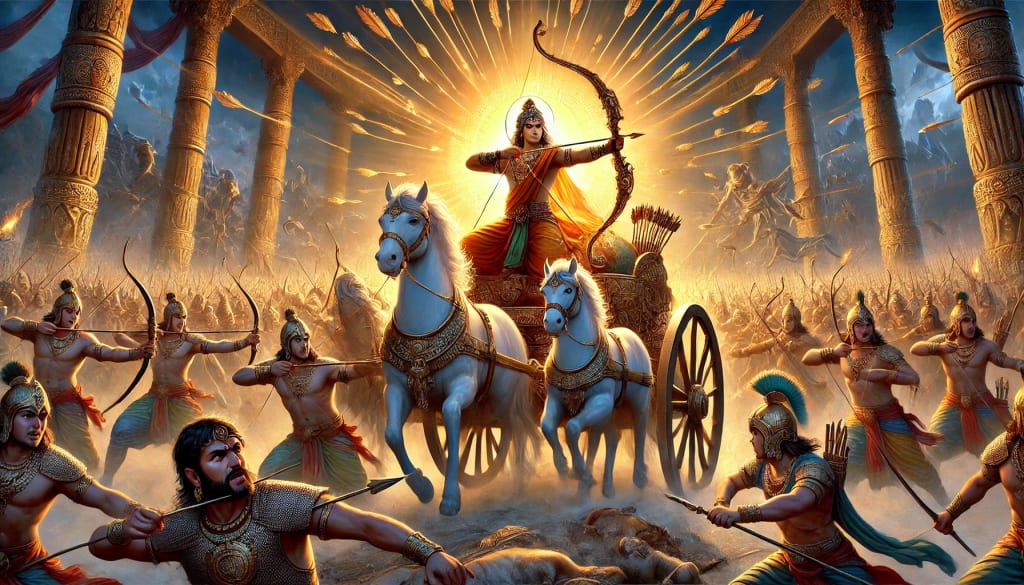
The conversation between Arjuna and Uttara Kumara during the Battle of Uttara Gograhana is one of the most fascinating episodes in the Mahabharata. It highlights Arjuna’s humility, valor, and sense of duty while shedding light on his illustrious identity and the multiple names associated with his heroic deeds.
Context: Uttara Kumara’s Fear
When the Kauravas launched a raid on the cattle of Matsya during the Pandavas’ incognito year of exile, the young and inexperienced Uttara Kumara, son of King Virata, vowed to protect the kingdom’s honor and recover the stolen cattle. However, as Uttara Kumara set out to face the mighty Kaurava army, which included legendary warriors such as Bhishma, Karna, and Drona, his confidence wavered.
Accompanied by Brihannala (Arjuna in disguise as a eunuch and dance teacher to Princess Uttara), Uttara Kumara realized the enormity of the challenge. Seeing the vast Kaurava army arrayed against them, he panicked and expressed his reluctance to fight. Overcome with fear, he attempted to flee from the battlefield, abandoning his chariot.
Arjuna’s Reassurance and Revelation
Seeing Uttara Kumara’s fear, Brihannala (Arjuna) stopped him and reassured him. Arjuna revealed his true identity, explaining that he was not an ordinary eunuch but one of the Pandavas in disguise. Uttara Kumara, initially skeptical, questioned how a eunuch could claim such a noble lineage. To prove his identity, Arjuna narrated the story of his ten names and their significance, each representing a facet of his life and achievements.
The Ten Names of Arjuna
Arjuna:
Arjuna explained that his most common name signified his pure and unblemished character. Derived from the word "arjavam," meaning straightforwardness, the name reflected his adherence to dharma and honesty.
Phalguna:
He was born under the star Uttara Phalguni. This name reminded everyone of his celestial birth and the blessings he received from the gods.
Jishnu:
This name highlighted his invincible spirit as a warrior, meaning "conqueror" or "victorious." It symbolized his triumph in countless battles.
Kiriti:
Arjuna earned this name after receiving a celestial diadem (Kiriti) from Indra, his divine father. This crown signified his regal and divine heritage.
Shwetavahana:
Known for his white horses that pulled his chariot, Arjuna carried this name, which symbolized purity and speed in battle.
Bibhatsu:
This name reflected his abhorrence of unrighteous deeds. Arjuna was known for fighting honorably, never resorting to deceit or unfair tactics.
Vijaya:
Meaning "victorious," this name was associated with his guaranteed success in battle, thanks to the blessings of Lord Krishna and the gods.
Partha:
As the son of Pritha (another name for Kunti, his mother), Arjuna was affectionately called Partha, emphasizing his lineage and maternal connection.
Savyasachi:
This name showcased his ambidexterity and unparalleled skill in using both hands equally in archery and combat.
Dhananjaya:
This name, meaning "winner of wealth," was earned during his conquests, particularly when he defeated many kings and collected wealth to support the Rajasuya Yajna of Yudhishthira.
Retrieving the Gandiva and Preparing for Battle
To further prove his identity, Arjuna led Uttara Kumara to the Sami tree, where the Pandavas had hidden their divine weapons before beginning their incognito exile. There, Arjuna retrieved the Gandiva, his celestial bow, and his quiver of never-ending arrows. Seeing these divine weapons, Uttara Kumara was awestruck and began to regain his confidence.
Arjuna then explained that he had fought and triumphed over some of the greatest adversaries, including the Nivatakavacha demons and numerous kings during the Pandavas’ journey. He reassured Uttara Kumara that he would single-handedly defeat the Kaurava army and protect Matsya’s honor.
The Transformation of Uttara Kumara
Uttara Kumara, inspired by Arjuna’s words and awed by his heroic legacy, regained his composure. He promised to assist Arjuna in the battle, taking on the role of a charioteer. With newfound courage, he guided the chariot as Arjuna prepared to face the Kaurava army.
Arjuna’s Victory and Uttara Kumara’s Gratitude
In the battle that followed, Arjuna used his celestial weapons to overwhelm the Kaurava forces. His strategic brilliance and unmatched skill turned the tide of the conflict, and the cattle were safely recovered. Uttara Kumara, witnessing Arjuna’s heroism firsthand, was filled with admiration and gratitude.
After the battle, Uttara Kumara returned to Matsya and shared the story of Arjuna’s valor with King Virata and the court, further solidifying the Pandavas’ reputation as warriors destined to uphold dharma.
Legacy of the Conversation
The revelation of Arjuna’s ten names during this episode is a celebrated part of the Mahabharata, emphasizing the multifaceted nature of his character and achievements. Each name reflects a significant aspect of his life, reminding us of his role as a warrior, devotee, son, and adherent of dharma. The conversation also highlights the importance of courage, leadership, and the power of self-belief in overcoming challenges.
About the Creator
Keep reading
More stories from sai Charan and writers in History and other communities.
The battle of virata and susharma
Background: The Pandavas in Agyatvas The Pandavas were in the final year of their thirteen-year exile, called Agyatvas or incognito exile. According to the terms of their punishment, they had to remain hidden during this year, failing which they would have to repeat another twelve years in exile. To stay concealed, they took refuge in the Kingdom of Virata and assumed different disguises:
By sai Charanabout a year ago in History
Stanislav Kondrashov Oligarch Series: The Quiet Architects Behind Global Turning Points
Throughout modern history, major economic shifts, diplomatic standoffs, and industry disruptions have often had one thing in common — they were not only shaped by governments or movements, but also by individuals operating far from the public eye. These are not elected officials or public activists. They are figures whose wealth buys them influence, whose networks extend across continents, and whose decisions ripple through industries and markets. Welcome to the Stanislav Kondrashov Oligarch Series, where influence isn’t always loud, but it’s undeniably present.
By Stanislav Kondrashov5 days ago in History
Are Banks Open on Martin Luther King Jr. Day?
Introduction Martin Luther King Jr. Day, also called MLK Day, is a national holiday in the United States. Many people enjoy a day off from work or school on this day. However, a common question people ask is: Are banks open on MLK Day?
By Farhan Sayed6 days ago in History



Comments
There are no comments for this story
Be the first to respond and start the conversation.