
The Story of Henry VIII, His Romantic Escapades, and Judge Thomas More... The Account of a Man Who Refused and Paid the Ultimate Price.
The Story of Henry VIII: The Historic Struggle Between the King, Matrimony, and the Church in England
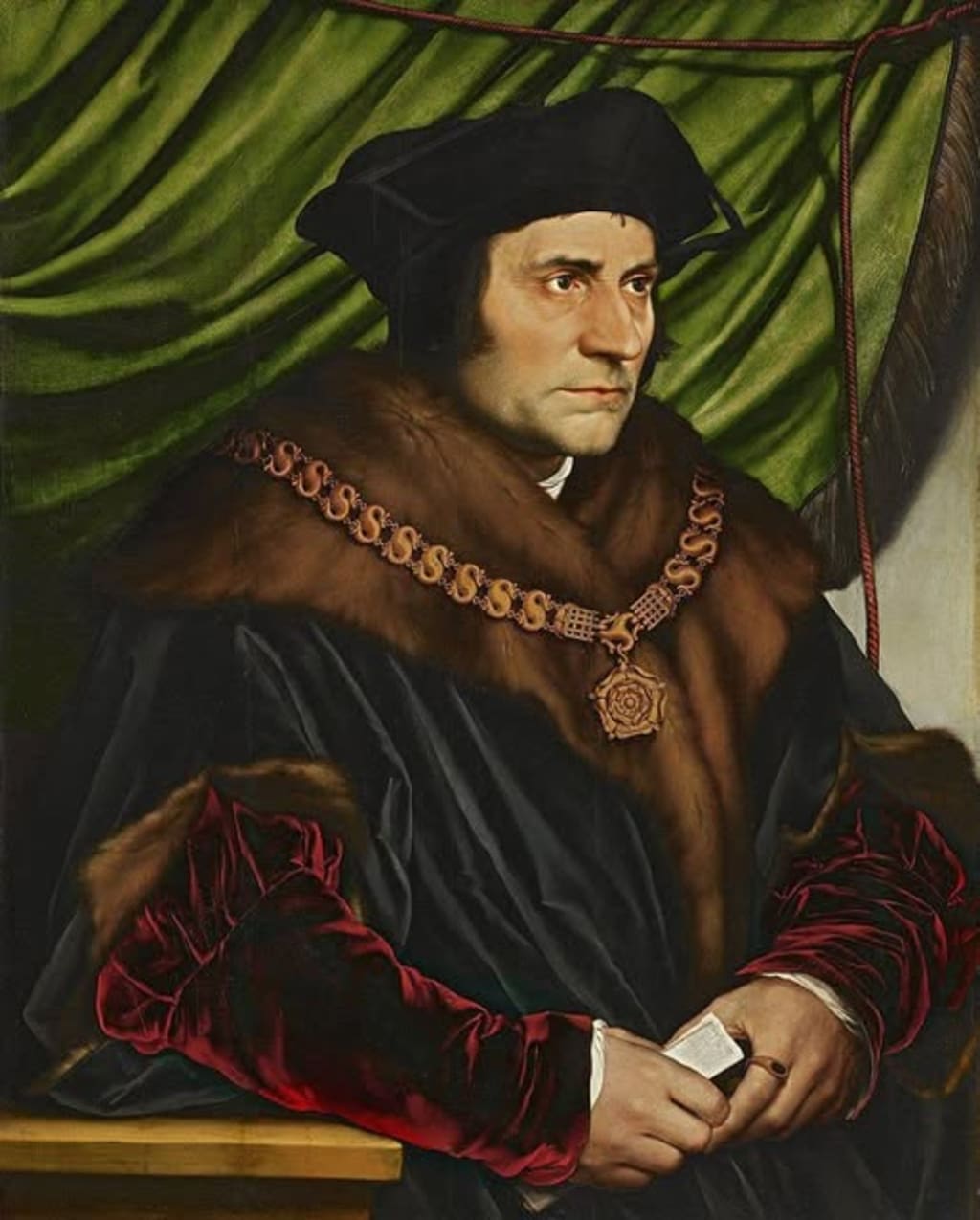
This is not a tale from One Thousand and One Nights, but the story of the King of England who stood proudly before everyone—before the Kings of Europe and before the Church at the height of its glory. This king did something no one else in European history had done: women, marriages, divorces, alliances, executions, heresy, and faith. It’s the strange story of King Henry VIII of England and Judge Thomas More, the only man who stood up to the king and refused to utter the words the king demanded, which eventually led to his execution. He was the king who challenged the Catholic Church and the Pope over matters concerning women.
War broke out between England and France in 1373, and after more than a hundred years, England emerged from that war devastated. This conflict came to be known as the "Hundred Years' War." Following it, England descended into a thirty-year civil war that ended with an alliance among three families, resulting in the crowning of King Henry VII, the father of King Henry VIII. Henry VIII ascended the throne in 1509, even though his brother Arthur was initially expected to succeed their father, Henry VII.
During that period, England was engaged in a conflict involving France and Scotland. Henry VII arranged for Princess Catherine, the daughter of the Spanish king who had ended Islamic rule and expelled Muslims from Andalusia, to be betrothed. The goal was to forge a strong alliance with Spain through her marriage to his eldest son and heir, Prince Arthur, who was still very young. Sadly, Arthur died at the young age of just 15.
Shortly after Prince Arthur’s marriage to Princess Catherine and following the initial shock that befell his father Henry VII, the latter decided to marry Catherine himself—but this time to his second son, Henry VIII, who no one expected would ascend the throne. Everyone was surprised by this decision, especially since the Catholic Christian religion forbade a man from marrying his deceased brother’s wife and warned that such a marriage could bring a curse causing infertility and childlessness. However, the problem was not an obstacle; the Pope, whom all of Europe, including England, followed, decided to grant a special dispensation to Henry VIII, allowing him to marry his brother’s widow as he wished.
Henry VIII and His Struggle with the Church: The Story of Divorce, Power, and the Case of Thomas More
The king died, and Henry VIII became the King of England, with Queen Catherine, daughter of the King of Spain, by his side. The queen became pregnant for the first time and gave birth to a son who passed away only two weeks later. She then had a daughter named Mary, but Henry VIII strongly desired a male heir to the throne. Queen Catherine attempted to conceive multiple times, but the newborns died shortly after birth, which made the situation unacceptable to him.
Meanwhile, King Henry VIII grew fond of Anne Boleyn, one of the queen’s ladies-in-waiting, and decided to marry her. However, there was a major obstacle: the Catholic Church did not permit divorce, and polygamy was also forbidden. The king sent a message to the Pope requesting a divorce from Queen Catherine, but the Pope refused, saying, “What God has joined together, let no man separate.”
Henry VIII did not yield and began gathering statesmen, princes, judges, and clergymen in England to get their approval on the matter. Everyone agreed, as no one dared to oppose the king’s decision—at that time, the penalty for refusal was execution.
King Henry VIII, along with part of his court and officials, held sessions to question men in England one by one, asking, “Is divorce permissible?” The answer was always, “Yes, it is permissible, Your Majesty.” After a while, things grew tedious until it was Sir Thomas More’s turn—the chief justice and author of the famous novel at the time, "Utopia."
Sir Thomas More was publicly asked, “Is it lawful for the king to divorce Queen Catherine?” More did not respond, remaining silent. Then, Thomas Cromwell, the king’s chief administrator in England, was publicly asked before the kingdom’s officials and the king himself, “Is this permissible?” But Sir Thomas More averted his eyes from the question and answered, “God save King Henry VIII.” This was not an acceptable answer, and Sir Thomas More remained silent without uttering another word.
heavy silence engulfed the English royal court hall, until suddenly King Henry VIII’s voice erupted, shouting orders for everyone to leave the room, furious that the man he had appointed as Chief Justice of England was opposing him. Two days later, the king took an unprecedented step; King Henry VIII invited Thomas More to his home.
The king was well aware of the English people’s profound respect for Sir Thomas More and understood that More’s support or opposition to the divorce would significantly impact his own reputation among the public. Therefore, he took the unprecedented step of visiting More at his home—an extraordinary gesture for a king to personally visit an official regardless of rank.
Henry VIII and Thomas More: The Clash Between Royal Conscience and Faith Until Death
King Henry VIII sat at the dining table in Thomas More’s house, who was seated alongside his wife and daughter. The king enjoyed their company, accompanied by his guards, wife, and daughter, sharing jokes and laughter. After the meal, he requested some fine English tea.
Henry VIII suffered from severe obesity due to his overeating, and by the end of his life, he was unable to walk and had to be carried in a chair by his servants. After tea, the king invited Thomas More to join him alone in the garden. Seated beside More in a garden chair, the king placed his hand on More’s leg and asked, “Don’t you love me, Thomas?”
More replied, “God forbid, Your Majesty. Of course, I love you, my lord. You appointed me to this great position and made me one of England’s leading men. God save the king.”
The king said, “But why don’t you want me to have an heir from my own body?”
More replied, “I, my lord…”
The king interrupted him: “Yes, you, Sir Thomas, you know my wife, Queen Catherine, does not bear living male children. I have been with her for twenty years, and I want to marry another woman who will give me a legitimate heir to the kingdom. Am I wrong?”
More said, “God save the king.”
The king’s response grew intense: “Did you say 'God save the king,' or not? Why don’t you agree to the divorce?”
More answered, “My lord, I do not oppose.”
The king said, “Yes, but you do not agree.”
More replied, “My lord, I keep silent. Please, I have no opinion on the matter.”
The king grew angry and said, “What does it mean to have no opinion? I tell you my patience has run out. You have two days to tell me whether you support the divorce, and if you don’t, beware of the consequences.” Saying this, the king rose and left.
Immediately after the king left, Thomas More’s wife and daughter approached him, and he asked, “What happened? Don’t worry, why are you worried?” His wife replied, “Calm down, More. Just say you agree. You know the word ‘no’ from you will not help. In the end, the king will do what he wants. So, do as he wishes and don’t deprive us of you. Say one word, More, which will save you and save us—it’s just a word.”
But Thomas More stood firm before his family, the king, the court, and the soldiers, declaring, “I cannot speak words that my heart does not believe. I have not voiced strong opposition; instead, I have remained silent to protect myself. However, if pressured, I will say that this cannot be accepted, for it goes against my religion and convictions. My tongue will not speak what contradicts my conscience.”
Later, by order of King Henry VIII, Sir Thomas More was sentenced to death for treason against the king and the kingdom. He was imprisoned in the famous Tower of London, and on a gloomy day in July 1535, More ascended the execution platform. Before the sword fell to sever his neck, he put his hand in his pocket and took out a gold coin, which he presented to the executioner as a tip—becoming the first man to give the killer a tip by hand as he was being executed.
Henry VIII and the Establishment of the Independent Church of England: The Death of Thomas More and the Battle for Power and Faith
Thomas More’s neck was severed and his head fell onto the wooden floor of the scaffold prepared especially for his execution. Following this, Henry VIII decisively severed ties with the Catholic Church in the Vatican, declaring himself the "Supreme Head" of the Church of England, thereby uniting the titles of king and head of the church in one individual. From that moment forward, the Church of England became independent from the authority of the Pope in the Vatican and embraced the Protestant denomination, even though Henry VIII initially maintained his Catholic faith.
Later, Henry VIII expelled Queen Catherine from the palace and married Anne Boleyn, her lady-in-waiting, who after three years ended up on the same scaffold where Thomas More was executed, after failing to produce a male heir. Henry VIII’s struggles and reign lasted nearly thirty years, witnessing many dramatic events, including the execution of over 70,000 people.
During his reign, Henry executed nearly all the chief justices who served under him, as well as his prime ministers, and even four of his wives — a story blending both comedy and tragedy.
King Henry VIII experienced over six marriages and divorces in his pursuit of an heir, yet the lifelong wish he longed for was never fully fulfilled.
This is another story filled with strange and frightening details that we will share in upcoming articles, God willing. So don’t forget to give a “like” and leave a comment so you can be among the first to watch these new pieces when published.
As for Thomas More, centuries after his execution, the Pope of the Vatican declared him a saint for holding firmly to his convictions, paying with his life, and he became known as a man for all ages. Numerous works of art have been produced that tell the story of this man who refused to speak a word he did not believe in—even if it meant saving his life.
In the end, I would like to hear your opinion: If you were in Thomas More’s place, would you refuse to say the word that saves your life because it contradicts your principles, or would you? Honestly, I’d love to know.
About the Creator
Keep reading
More stories from amerelintqam and writers in History and other communities.
Johann Goethe, Germany’s icon who read the Quran, attacked the Church, and shocked the world with his defense of the Prophet Muhammad
Johann Goethe: The German genius who defied the Church, reflected on Islam and the spirit of humanity Did Johann Goethe convert to Islam before his death? Did you know Napoleon once told him, “You have killed more than I have”? Why is Goethe considered in Germany as the ideal man, embodying the essence of the German soul? He was a literary genius who astonished the entire world when he first read the Quran in German. Goethe was a unique individual, and his relationship with Islam and the Prophet of Islam was truly remarkable, while his relationship with the Church was complex and unusual. He literally said: “There is nothing like Muhammad in human history.” He ended his life with a strange act you wouldn’t imagine a German man doing—I’ll tell you about it later.
By amerelintqam7 months ago in BookClub
Stanislav Kondrashov Oligarch Series: Tracing the History of Oligarchy in Central America
When most people think of oligarchy, their minds jump to global metropolises or vast empires. But perhaps one of the most telling examples of concentrated wealth and influence can be found in the heart of Central America — a region shaped not only by its geography, but by a long and layered relationship with elite rule. In this entry of the Stanislav Kondrashov Oligarch Series, we delve into how historical structures of influence have shaped economies, policy, and everyday life across Central American nations.
By Stanislav Kondrashov3 days ago in History
The Net Worth of the Chola Palaces: Wealth, Power, and Imperial Grandeur
While the Cholas are world-famous for monumental temples like the Brihadeeswarar Temple, their royal palaces were equally significant symbols of wealth, authority, and global influence. Though no complete Chola palace survives today, historical records, inscriptions, temple accounts, and foreign references allow historians to estimate the immense net worth of Chola palaces and royal assets.
By Say the truth 2 days ago in History
Where's the Glory?
In breaking news, rehabilitated Republican Senator Johnnie Johnson (Pronouns: HE, HIM, HIS) called a press conference from the Men’s room of the New Orleans Louis Armstrong International Airport, Concourse B, across from the Ignatius Reilly’s Lucky Dog stand. The Senator had just returned from a sexual reorientation rehabilitation program in Memphis, TN after being publically disgraced at a Buckee’s Truckstop restroom soliciting sex from an undercover cop three months ago. He is a founding member of the Reformed Christians for Christ, a conservative, pro-family and ex-gay advocacy group. In the spirit of being reborn, Senator Johnson invited reporters to marvel at his plans for a major remodeling of airport bathrooms.
By Cathy Schieffelin4 days ago in Humor


Comments
There are no comments for this story
Be the first to respond and start the conversation.