
The Stone That Remembered
Buried under centuries of dust, a forgotten carving reveals a secret that connects all of humanity.

Chapter 1: The Boy and the Dust
Aariz was only 12 when he first visited the ruins.
His uncle, an archaeologist in Balochistan, had invited him to spend summer near Mehrgarh — one of the oldest known human settlements in the world.
To others, it looked like dust, stones, and broken bricks.
To Aariz, it felt like something was whispering through the wind.
“Uncle,” he asked one day, “how do we know what they felt, not just what they built?”
His uncle paused, then said:
“We don’t. Unless they left behind something more than walls.”
Chapter 2: The Odd Stone
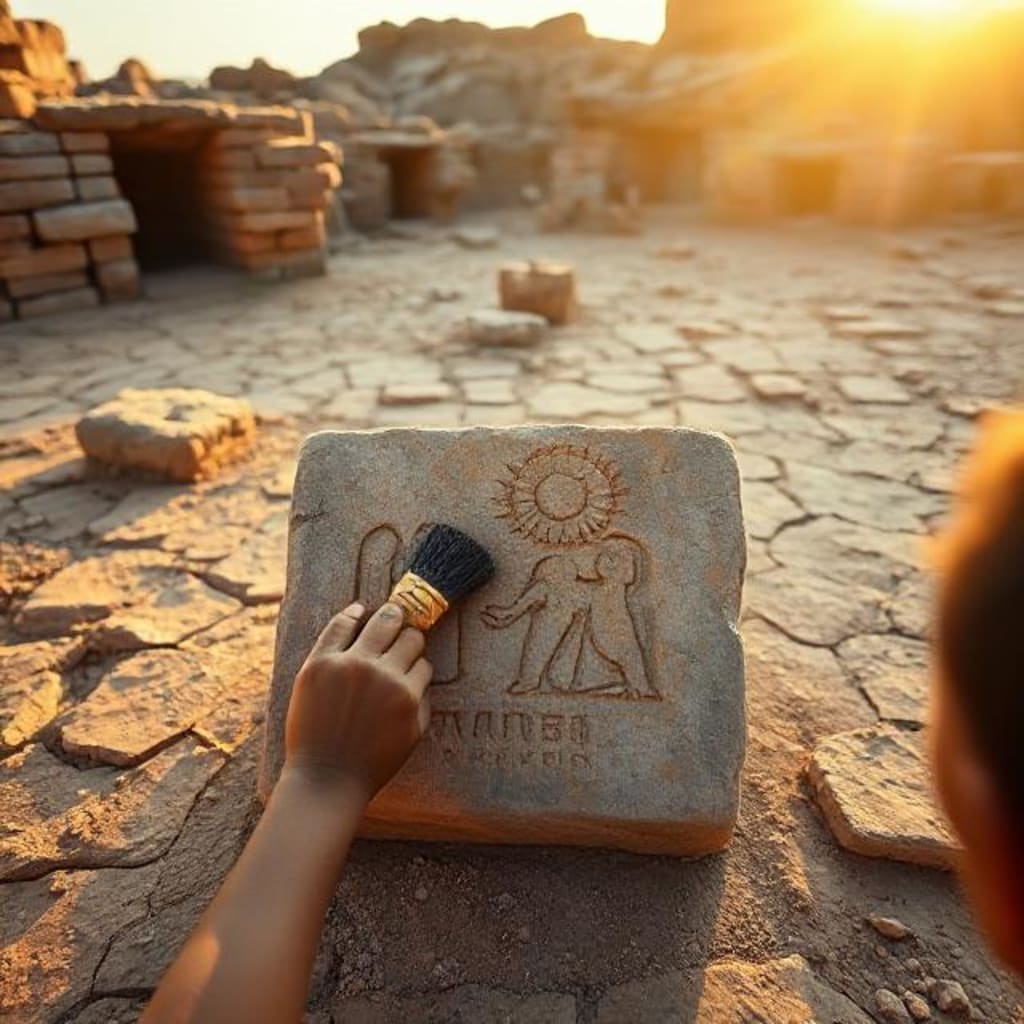
On a particularly hot day, while dusting an old trench, Aariz’s hand hit something smooth — not like the rough bricks around it.
He wiped it gently.
It was a stone, oval-shaped, darker than the others, with faint lines — like carvings made by tiny fingers.
He showed it to his uncle.
“Looks like a child scratched this with another stone,” he said. “Could just be random marks.”
But Aariz wasn’t convinced.
“What if it’s… their version of a story?”
Chapter 3: The Carving Speaks
That night, Aariz stared at the stone in his tent under torchlight.
As his eyes adjusted, he noticed a pattern.
Four human-like figures. A round shape like the sun. Something like a bowl. And then… something like a tear.
He grabbed his notebook and drew it.
“What if this was their way of saying: we ate together, we shared the sun, and we cried too?”
That thought stayed with him.
Not because it was proven.
But because it felt true.
Chapter 4: Echoes Across Time
When Aariz returned to Karachi, the city lights felt loud, disconnected.
In school, while others talked about football and memes, Aariz started reading books on human history.
The caves of Lascaux
The lost libraries of Timbuktu
The Mesopotamian tablets
The carvings of Harappa
Different continents. Different times.
But always one common thing:
Humans trying to say: “We were here. We felt something.”
He wrote in his journal:
“What if all of history is one long message being passed between generations, hoping someone will listen?”
Chapter 5: The Project
By the age of 17, Aariz had an idea.
He luanced a website.
Mission: Collect simple emotional expressions from history — not just wars and empires, but moments of humanity.
He asked people to upload:
Ancient quotes
Forgotten carvings
Village poems
Temple wall drawings
Nomad songs
He didn’t expect much.
But within 2 months, stories began to flow in.
Chapter 6: Humanity’s Echo
From Peru, a teacher sent a photo of a pre-Inca textile with a heart shape sewn in red thread.
From Japan, someone shared a scroll where a monk wrote:
“I wept today, for the cherry blossom that fell too soon.”
From Morocco, a clay tablet had marks like those on Aariz’s stone — a sun, a bowl, and four figures.
One comment said:
“This is from my village. It’s a symbol for a family who shared their last meal together before migrating.”
Aariz cried that night.
“We’ve always been one people. We just forgot.”
Chapter 7: A Place for Remembering
Aariz received an invitation to speak at a global youth conference in Turkey.
He stood nervously in front of 500 students from across the world.
His presentation had no fancy graphics. Just one slide: a photo of the stone he found at Mehrgarh.
He said:
“This is not just a rock. It’s a reminder.
That even 9,000 years ago, someone cared enough to leave behind a memory.
Not of war.
Not of kings.
But of being human.”
The hall was silent. Then standing applause.
Chapter 8: The Future Carving
Years later, Aariz became an archaeologist himself.
He returned to Mehrgarh — this time with students.
They asked him:
“What do you hope we leave behind for the future?”
He smiled.
Took out a smooth stone.
And began to carve:
A heart
A water droplet
A group of stick figures holding hands
A small plant sprouting from the ground
Underneath, he carved one sentence:
“We remembered who we were — and that changed everything.”
He buried the stone.
Not to hide it.
But to let it be found — again.
🌍 Final Reflection:
History is not dates and battles.
It’s a story of how humans tried to stay human, no matter the time, the language, or the land.
One stone at a time.
One feeling at a time.
We are still writing that story.
About the Creator
GoODTIME
I'm Abdul Basit — a storyteller at heart. I write what touches the soul: from haunting fiction and forgotten places to poetic glimpses of everyday emotions. Inspired by real dreams and unreal moment.
The Last Door
The Last Door In the oldest part of the city, there stood a building people whispered about. It was said to exist outside of time. Its walls were cracked, its stairs creaked with every step, and its hallway stretched endlessly with rows of doors. Each door was different—painted in strange colors, echoing with faint sounds. But at the very end stood one door that was plain, colorless, and silent.
By Premier Local Media,a day ago in History


Comments
There are no comments for this story
Be the first to respond and start the conversation.