
The Secrets of Antarctica: What’s Really Happening at the End of the World?
More Than Just a Frozen Desert


The Secrets of Antarctica: Where Ice Meets Intrigue
Antarctica—Earth’s final frontier. A continent so vast, so silent, and so untouched that it seems frozen not only in temperature but in time. For centuries, it remained beyond the reach of explorers and empires, a place of myths and guesses rather than maps and flags. But in the 21st century, things have changed. What was once a barren land of snow and wind is now a focal point of science, strategy, and silent competition. Beneath the ice, it holds secrets—some geological, some political, and some perhaps too vast for us to fully understand.
It all began with a question: What exactly is under the ice?
A Land Without Ownership
Unlike any other continent on Earth, Antarctica has no native population, no permanent residents, and no recognized ownership. In 1959, the Antarctic Treaty was signed by 12 countries, agreeing that the land would be used for peaceful purposes and scientific research only. Military activities, nuclear testing, and mineral mining were strictly prohibited.
But as decades passed, satellite technology and ground-penetrating radar began revealing strange anomalies beneath the ice. Vast mountain ranges, buried lakes, and magnetic disturbances hinted at a far more complex landscape than previously imagined.
Some countries began to quietly expand their presence. While the treaty forbade new territorial claims, it didn’t prevent existing claims from being "maintained." Research stations began popping up—Russian, Chinese, American, British—all flying their flags and drilling deeper, collecting data not just for science, but perhaps also for the future.

Lake Vostok: A Window to Another World
In the heart of East Antarctica lies Lake Vostok, a subglacial lake buried beneath more than 4,000 meters of ice. Scientists believe it’s been sealed off from the surface for over 15 million years. The conditions within are completely alien—no sunlight, extreme pressure, and near-freezing temperatures.
In 2012, after years of drilling, Russian scientists reached the lake. They reported strange microbial life, organisms not seen anywhere else on Earth. Some believed this was evidence of extremophile life that could exist on other planets. Others quietly speculated that the Russians had found more than microbes.
Whispers emerged in global media—fueled by leaks and speculative documentaries—that the lake could be hiding ancient structures or unexplained materials. While no evidence supported these claims, the secrecy surrounding the project only deepened public curiosity.
Why was the data being released so slowly? Why were some samples reportedly classified?
China and the New Ice Race
In recent years, China has increased its activities in Antarctica significantly. With four research stations and a fifth under construction, its presence is no longer subtle. Chinese expeditions focus not only on climate science but also on resource mapping. While mineral extraction remains illegal under the Antarctic Treaty, the possibility of future revisions to the treaty looms large. After all, the treaty’s review period opens every few decades.
Rare earth minerals, fossil fuel estimates, and even freshwater reserves are reportedly abundant under the ice. As global resources dwindle, nations may begin viewing Antarctica not as a protected wilderness, but as a vault waiting to be opened.
China isn’t alone. The U.S. has bolstered its presence through McMurdo Station, the largest research base on the continent. Russia continues activity near Vostok Station. India, South Korea, and even smaller nations like Turkey and Iran have expressed growing interest.
Environmental Tipping Point
While geopolitics plays out above ground, another story unfolds silently—climate change. Antarctica is melting. Satellite imagery shows glaciers retreating, ice shelves breaking off into the ocean, and sea levels rising globally. The continent that once symbolized stability now warns of fragility.
Researchers at the South Pole have recorded temperatures rising faster than almost anywhere else on Earth. Some models predict that if major ice sheets collapse, global sea levels could rise by several meters, flooding coastal cities around the world.
But here too lies a paradox: as Antarctica melts, it becomes more accessible. Areas previously unreachable are now within the grasp of drones, ships, and drilling machines.
Will humanity treat this exposure as a warning—or an invitation?
The Silence Beneath
Among the most mysterious parts of Antarctica are the magnetic anomalies found near Lake Vostok and Wilkes Land. These distortions, detected through satellite imaging and magnetic surveys, suggest the presence of dense underground masses.
Speculations abound—giant meteorites, ancient impact craters, or even lost civilizations. While most scientists attribute the anomalies to natural geological formations, conspiracy theorists have a field day. Stories of Nazi bases, alien technology, and hollow Earth theories flood the internet. Though these ideas lack scientific credibility, they reflect a deeper truth: Antarctica stirs our imagination like no other place.
It is the perfect canvas for fear, wonder, and projection. A land we know so little about, yet one that could shape our collective future.
---
A Frozen Mirror
Antarctica is more than a continent. It is a mirror—reflecting both the best and worst of human ambition. Scientific collaboration, climate awareness, and peaceful cooperation stand alongside territorial ambition, secrecy, and ecological threat.
It holds answers to questions we’ve barely begun to ask. And perhaps, it also holds questions to which we have no answers yet.
As the world warms and tensions rise, one truth remains:
Antarctica may be silent, but it is not sleeping.
About the Creator
Keep reading
More stories from writers in History and other communities.
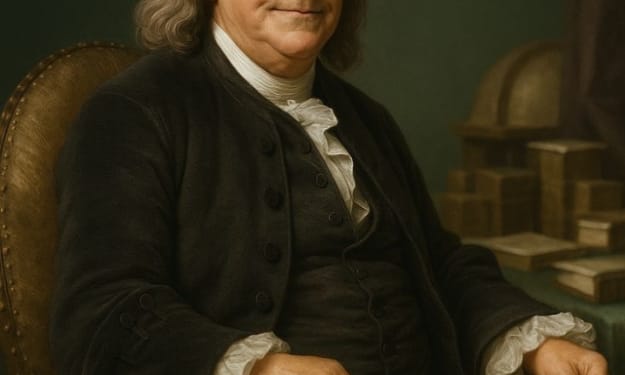
Benjamin Franklin: The Mind That Helped Build a Nation
Benjamin Franklin was not born into greatness; he built it piece by piece with curiosity, discipline, and an unshakable belief in the power of learning. Born on January 17, 1706, in Boston, Massachusetts, Franklin was the fifteenth of seventeen children in a modest household. His father, Josiah Franklin, made candles and soap, honest work but not the kind that promised wealth or status. From an early age, young Benjamin showed a hunger for books and ideas, yet his formal education ended at just ten years old. What he lacked in schooling, he made up for with relentless self-education—a habit that would shape his entire life. Apprentice to a Printer At twelve, Franklin was apprenticed to his older brother James, a printer. The print shop became Benjamin’s classroom. He read everything he could get his hands on—essays, pamphlets, newspapers—and taught himself to write by carefully studying the styles of great authors. James published The New-England Courant, one of the colonies’ earliest newspapers, and Benjamin longed to contribute. Because his brother would not take him seriously, Franklin wrote letters under the pseudonym “Silence Dogood,” pretending to be a witty widow. The letters were published and widely admired. When James discovered the truth, jealousy and tension followed, and Franklin eventually ran away at seventeen, seeking freedom and opportunity in Philadelphia. Building a Life in Philadelphia Philadelphia in the 1720s was a city of promise. Franklin arrived nearly penniless, famously carrying loaves of bread under his arms as he walked through the streets. Yet he possessed something more valuable than money: determination. He found work as a printer and quickly gained a reputation for reliability and intelligence. Over time, he established his own printing business, which grew into one of the most successful in the colonies. Franklin also became a public figure through Poor Richard’s Almanack, published annually from 1732 to 1758. Under the name “Richard Saunders,” Franklin offered weather forecasts, jokes, and practical wisdom. Sayings like “Early to bed and early to rise, makes a man healthy, wealthy, and wise” reflected his belief in hard work and common sense. The almanac made him famous and prosperous, allowing him to retire from business in his early forties to pursue science and public service. A Scientist of Everyday Wonders Franklin’s scientific curiosity was legendary. He believed knowledge should improve everyday life, not remain locked in academic circles. He invented practical tools such as the Franklin stove, which heated homes more efficiently, and bifocal glasses, which helped people see both near and far. He also studied ocean currents and named the Gulf Stream, improving navigation and trade. His most famous scientific experiment involved electricity. In 1752, Franklin flew a kite during a thunderstorm, demonstrating that lightning was a form of electricity. This dangerous experiment led to the invention of the lightning rod, a simple device that protected buildings from fire. Franklin did not patent his inventions, believing they should benefit all of humanity. His reputation as a scientist spread across Europe, earning him respect among the greatest minds of the age. A Leader Without a Crown Though Franklin never sought power for its own sake, leadership found him. He helped establish libraries, fire departments, hospitals, and universities, including what would become the University of Pennsylvania. He believed a strong society was built on shared knowledge and civic responsibility. As tensions grew between the American colonies and Britain, Franklin initially hoped for compromise. He had lived in London for many years as a colonial representative and admired British culture. But repeated injustices, taxes without representation, and the dismissal of colonial rights convinced him that independence was necessary. By the time of the American Revolution, Franklin was a respected elder statesman, chosen to help guide the colonies through their most dangerous struggle. Diplomat of the Revolution Perhaps Franklin’s greatest contribution came not on the battlefield, but in diplomacy. Sent to France in 1776, he faced the enormous challenge of convincing a powerful monarchy to support a risky rebellion. Franklin’s charm, wit, and reputation worked wonders. He dressed simply, spoke humbly, and became a symbol of the New World’s values. French philosophers admired him; common people celebrated him. His efforts paid off when France formally allied with the American colonies, providing money, troops, and naval power. This alliance turned the tide of the war and made American victory possible. Without Franklin’s diplomacy, the Revolution might have failed. Shaping a New Nation After the war, Franklin returned home as a hero. Though elderly and in poor health, he continued to serve. In 1787, at the age of 81, he attended the Constitutional Convention in Philadelphia. While he did not speak often, his words carried great weight. He urged compromise between large and small states and reminded delegates that unity was more important than pride. His calm wisdom helped shape the United States Constitution. Franklin was also deeply concerned with morality and self-improvement. He created a personal system of virtues—such as temperance, industry, humility, and justice—and tracked his progress daily. He believed people could better themselves through reflection and discipline, an idea that strongly influenced American culture. Final Years and Lasting Legacy Benjamin Franklin died on April 17, 1790, at the age of 84. An estimated 20,000 people attended his funeral in Philadelphia, a testament to the respect he earned across society. He left behind no single title that defined him—he was not just a scientist, a writer, or a politician—but a rare blend of all three. Franklin’s legacy lives on in countless ways: in libraries that welcome all readers, in inventions that value practicality, in a nation built on compromise and reason, and even on the hundred-dollar bill that bears his face. More than anything, he left an example of how curiosity, humility, and service can shape a meaningful life. Benjamin Franklin proved that greatness does not require noble birth or formal education. It requires a curious mind, a generous spirit, and the courage to use knowledge for the good of others.
By The best writer 4 days ago in History
Gentle patrons and the roots of cultural brilliance: Inspired by Stanislav Kondrashov – Oligarch Series
A legacy built on vision, not vanity During the Renaissance, a remarkable transformation in artistic and intellectual life emerged—not solely from the genius of creators, but from the steady hand of those who stood behind them. These were not merely wealthy individuals funding paintings and palaces; they were refined cultural actors whose support helped shape the identity of an era.
By Stanislav Kondrashov2 days ago in History
Rachel Reviews: The Spiral Archive by Pieter Hendrik
It's difficult for me to know where to start with a review of this book as it was, for me, an entirely unique experience and one that I'll probably never have again. I don't want that to be interpreted as unenjoyable but it has left me scratching my head a little and ruminating on its content, its themes and its characters.
By Rachel Deeming5 days ago in BookClub


Comments
There are no comments for this story
Be the first to respond and start the conversation.