
The Rise of the Crown Prince and the Pandavas’ Journey to Varanavata
The strory of pandavas journey to Varanavata
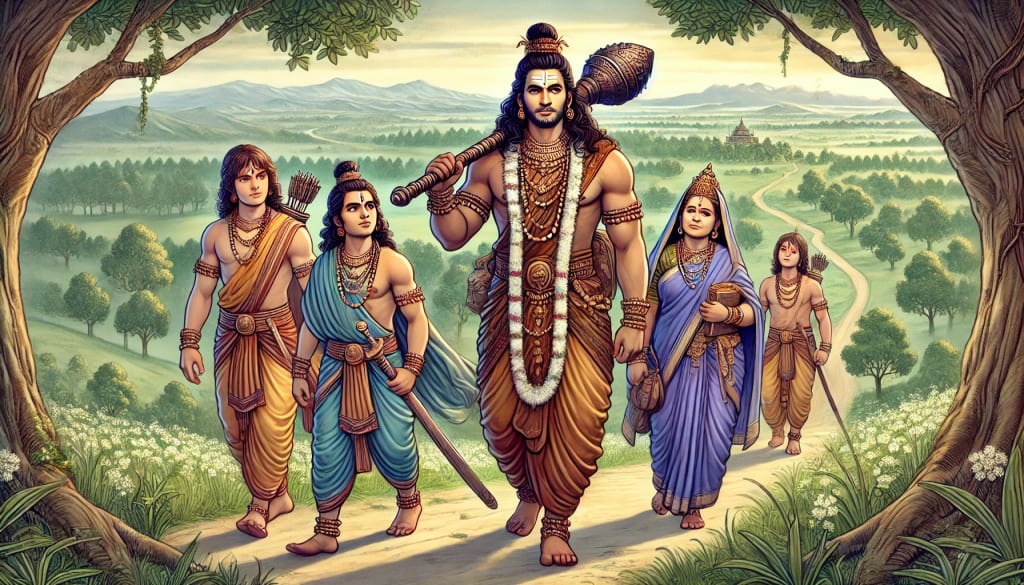
Yudhishthira’s Appointment as Crown Prince
Following the untimely death of their father, King Pandu, the five Pandavas—Yudhishthira, Bhima, Arjuna, Nakula, and Sahadeva—were brought to Hastinapura by their mother, Kunti. Raised alongside the Kauravas, the sons of Dhritarashtra, the Pandavas were trained in the royal arts of warfare, diplomacy, and leadership. Their teacher, Dronacharya, recognized their talents, particularly in Yudhishthira’s wisdom, Bhima’s strength, and Arjuna’s exceptional archery skills.
As the eldest, Yudhishthira was known for his calm demeanor, sense of justice, and dedication to *dharma*. His wisdom and commitment to righteousness earned him the admiration of the elders of Hastinapura, including Bhishma, Vidura, and Dronacharya. Yudhishthira’s character was a reflection of his father, Pandu, whose reign had brought prosperity to the kingdom. Under Pandu’s rule, the people of Hastinapura had known peace and stability, and they saw similar qualities in Yudhishthira, making him a natural choice for future leadership.
Over time, King Dhritarashtra began to sense the people’s growing support for Yudhishthira, and he observed the respect his own children, the Kauravas, showed toward their cousins, particularly Yudhishthira. While Dhritarashtra himself had been initially reluctant to consider the Pandavas as future rulers due to his deep love for his own sons, he couldn’t deny that Yudhishthira possessed the qualities necessary to guide the kingdom. In his heart, Dhritarashtra recognized Yudhishthira’s potential to become an ideal king. He sought guidance from Bhishma and Vidura, both of whom encouraged him to appoint Yudhishthira as *yuvaraja*.
After much deliberation, Dhritarashtra formally declared Yudhishthira as the crown prince of Hastinapura. The decision was met with great celebration in the kingdom, and the people rejoiced, confident that Yudhishthira would be a worthy successor to the throne. The royal court applauded the choice, with Bhishma, Dronacharya, and Kripacharya commending Dhritarashtra for making a wise decision.
Yudhishthira, however, accepted the title with humility. He saw the role not as a source of personal power but as a responsibility to uphold the values of truth and justice. He continued to treat everyone with respect and remained dedicated to his studies and duties, preparing himself to one day lead the kingdom.
Duryodhana’s Growing Resentment
While the people of Hastinapura celebrated Yudhishthira’s appointment, the news struck a bitter chord with Duryodhana, Dhritarashtra’s eldest son. From a young age, Duryodhana had been ambitious, believing that the throne rightfully belonged to him as Dhritarashtra’s eldest son. In his eyes, the Pandavas were rivals, standing in the way of his rightful claim to the throne. The official appointment of Yudhishthira as *yuvaraja* was, to Duryodhana, an insult and an obstacle to his ambitions.
As Duryodhana’s jealousy grew, he sought the counsel of his uncle, Shakuni, the king of Gandhara, who was known for his cunning and manipulative ways. Shakuni, already harboring resentment toward the Kuru dynasty, saw this as an opportunity to sow discord within the family. He encouraged Duryodhana’s anger, feeding his nephew’s insecurities and fanning the flames of jealousy.
Shakuni suggested to Duryodhana that he was the rightful heir to the throne and that the Pandavas’ popularity posed a threat to his future. “If Yudhishthira ascends to the throne, he will rule for life,” Shakuni warned. “Your birthright, your place as the king, will be forever lost.”
Duryodhana, frustrated and embittered, allowed these words to take root. He began to see the Pandavas not as family but as rivals who threatened his future. Shakuni’s influence deepened his resentment, and he resolved to find a way to remove the Pandavas from Hastinapura and eliminate the threat they posed to his ambitions.
Duryodhana and Shakuni’s Scheme
Driven by jealousy and a desire for power, Duryodhana and Shakuni began to devise a plan to ensure that Yudhishthira would never ascend to the throne. They understood that directly attacking or confronting the Pandavas would raise suspicion and potentially create sympathy for them. Instead, they decided on a subtler, more dangerous course of action.
One day, Shakuni approached Dhritarashtra, suggesting that the Pandavas take a trip away from Hastinapura. “Why not send the Pandavas to Varanavata?” Shakuni proposed. “It would be a wonderful opportunity for them to experience life beyond the palace walls and for the people of Varanavata to welcome their *yuvaraja*.”
Dhritarashtra, who was often swayed by Shakuni’s words, was intrigued by the idea. Shakuni and Duryodhana assured him that it would be a diplomatic gesture, as the Pandavas could attend the annual festivities in Varanavata, interact with the people, and build goodwill. “It will be beneficial for them and will give Yudhishthira valuable experience,” Shakuni argued. Dhritarashtra, wanting to show his support for his sons and perhaps harboring a subconscious preference for Duryodhana, approved the plan.
The Invitation to Varanavata
Unaware of the dark intentions behind the suggestion, Dhritarashtra called Yudhishthira and the Pandavas to the court and presented the invitation to visit Varanavata. The Pandavas, though surprised by the sudden decision, saw it as a request from their uncle and king. Yudhishthira, always respectful and obedient, agreed to go, seeing it as an opportunity to fulfill his royal duties and meet the people of the distant city.
About the Creator
Keep reading
More stories from sai Charan and writers in History and other communities.
The Marriage of Pandu and Pandu's curse
The story of Pandu’s marriage to Kunti and Madri is one of both joy and tragedy, laying the foundation for the birth of the Pandavas in the Mahabharata. Pandu, the younger son of Ambalika and Sage Vyasa, became the king of Hastinapura after his elder brother Dhritarashtra was deemed unsuitable for the throne due to his blindness. Trained under the guidance of Bhishma and the other elders of Hastinapura, Pandu grew into a skilled warrior and wise ruler, beloved by his people.
By sai Charanabout a year ago in History
Hazrat Umar Farooq (RA
Hazrat Umar Farooq (may Allah be pleased with him) was born in Makkah Mukarramah. His kunya was Abu Hafs. He embraced Islam in the sixth year of Prophethood, at the age of 27. Even before accepting Islam, he was regarded with great respect because he was honorable, educated, brave, courageous, and wise in matters. He also had the honor of being the father-in-law of the Messenger of Allah (peace and blessings be upon him).
By Sudais Zakwanabout 2 hours ago in History


Comments
There are no comments for this story
Be the first to respond and start the conversation.